Best net for landing a big muskie from a kayak
There's nothing quite like the thrill of hooking into a truly massive muskie, especially when you're out on the water in your kayak. But that heart-pounding excitement can quickly turn into frustration, or even a precarious situation, when you realize your standard bass net just isn't going to cut it for a toothy leviathan. This guide will walk you through everything you need to know to choose and use the best net for safely landing those big West Virginia muskies from your kayak, ensuring a successful catch and release.
The Unique Challenge of Landing Muskie from a Kayak
Landing any large fish from a kayak presents its own set of unique challenges, but a muskie takes those challenges to a whole new level. These aren't your average panfish; they're apex predators known for their incredible power, sharp teeth, and notoriously violent head shakes. When you're in a small, relatively unstable craft like a kayak, managing a thrashing muskie at boatside can become a truly chaotic experience if you're not properly equipped.
Why Standard Nets Fall Short
Many anglers, especially those new to muskie fishing or kayak angling, might try to make do with a conventional bass or walleye net. The problem is, these nets are simply not designed for the sheer size and ferocity of a muskie. A typical bass net often has a hoop that's too small, leading to a situation where you can only get half the fish in, or worse, the fish thrashes itself free. The mesh on these nets is usually too shallow, allowing a powerful muskie to easily jump or twist out. Even if you manage to get it in, the conventional nylon mesh can cause serious damage to the fish's protective slime coat and fins, which is a big no-no for catch-and-release, especially for a species like muskie that we want to protect for future generations. Plus, those hooks can get seriously tangled in the smaller mesh, turning a quick release into a prolonged, stressful ordeal for both you and the fish.
Kayak Stability and Angler Safety
When you're perched in a kayak, even a stable fishing kayak, your center of gravity is higher, and your ability to shift weight or quickly react is limited compared to being in a larger boat. A big muskie, sometimes reaching lengths of 40, 50, or even 60 inches, can easily pull your kayak around, potentially leading to an unexpected dip in the cold waters of the New River or Stonewall Jackson Lake. Their powerful tails can slosh a lot of water into your boat, and those razor-sharp gill plates and teeth are a real hazard. The last thing you want is a muskie flailing in your lap. A specialized net helps you control the fish quickly, keeping it in the water and away from your body, which is paramount for both your safety and the muskie's well-being. This is why having the right gear, like a reliable net, is just as important as knowing Kayak Fishing Techniques for West Virginia Rivers.
Essential Features of a Kayak Muskie Net
Choosing the right net for landing big muskie from a kayak isn't just about grabbing the biggest net you can find. It's about a combination of specific features that address the unique challenges of the fish, the confined space of a kayak, and the importance of responsible catch and release. Think of it as an extension of your Best Kayaks for West Virginia Fishing setup – it needs to be integrated and effective.
Generous Hoop Size and Depth
This is non-negotiable. For muskie, you need a net with a significantly larger hoop than what you’d use for bass or even large walleye. We're talking about hoops that are often 30-40 inches wide, if not more, to comfortably engulf a long, girthy muskie. The depth of the net is equally critical. A deep net bag allows the entire fish to be submerged, preventing it from flopping out and providing a calming, secure environment for the fish while you unhook it. A shallow net is just an invitation for the muskie to escape or injure itself.
Long, Extendable Handle
When you're sitting in a kayak, your reach is limited. A big muskie might be boatside, but still a little too far to comfortably net with a short-handled net. A net with a handle that extends, ideally to 4-6 feet, gives you the crucial extra reach you need to effectively scoop a fish without leaning precariously or having to get into an awkward, unstable position. Many muskie nets feature telescoping handles that lock securely, allowing for compact storage in the kayak while offering instant length when the moment of truth arrives. The ability to extend the handle quickly with one hand is a huge advantage when you're juggling a rod and a fighting fish.
Rubberized, Knotless Mesh
This feature is paramount for both the fish's health and your sanity. Traditional knotted nylon mesh can strip the protective slime coat from a muskie, making them more susceptible to disease. The knots can also cause damage to fins and eyes. A rubberized, knotless mesh is much gentler on the fish. Furthermore, muskie lures, with their multiple large treble hooks, have a nasty habit of becoming irrevocably tangled in knotted nylon mesh. Trying to untangle a giant treble hook from a net, all while a muskie is thrashing, is a recipe for disaster. Rubberized mesh drastically reduces snagging, making unhooking a much quicker and safer process. Brands like Frabill often offer excellent rubberized options in their muskie net lines, and you can find a wide selection at Bass Pro Shops or even through online retailers like Amazon.
Buoyancy and Durability
While not strictly "essential" in the same way as hoop size or mesh type, a buoyant net can be a real lifesaver if you accidentally drop it in the water, especially in a river with current like the Little Kanawha River. Many muskie nets are designed with buoyant features in their handles or frames. Beyond buoyancy, the overall construction needs to be incredibly robust. Muskie are powerful fish, and a flimsy net can bend, break, or simply fail when you need it most. Look for a strong aluminum or composite frame that can withstand the stress of a large, struggling fish.
Here's a quick comparison of what to look for:
| Feature | Importance for Kayak Muskie Net | Why it Matters |
|---|---|---|
| Hoop Size (Large) | Critical | Comfortably engulfs large fish, reduces escape risk, minimizes thrashing. |
| Handle Length (Extendable) | Very High | Provides essential reach from kayak, enhances control, improves stability. |
| Mesh Type (Rubberized, Knotless) | Critical | Protects fish's slime coat, prevents fin damage, reduces hook snags. |
| Net Depth (Deep Bag) | High | Prevents escape, allows fish to rest calmly in water during unhooking. |
| Buoyancy | High | Prevents loss if dropped overboard, especially in moving water. |
| Durability (Strong Frame) | Very High | Withstands immense stress from powerful fish, ensures long-term reliability. |
| One-Handed Operation | High | Crucial for safely managing rod, fish, and net simultaneously from kayak. |
Techniques for Safe and Effective Muskie Netting from a Kayak
Landing a muskie from a kayak is as much about technique as it is about having the right gear. Once you've got your Best Landing Net for Muskie, practicing these methods will make you more confident and effective on the water. Remember, the goal is always a quick, safe landing and a healthy release for these magnificent fish.
Pre-Fight Preparation and Positioning
Before you even hook a muskie, prepare your kayak and your mind. Ensure your net is easily accessible and untangled. Many kayak anglers rig their net to be deployed quickly, perhaps secured alongside their kayak with a bungee or leash, ready to grab. When you hook into a muskie, especially a big one that could represent a true Muskie Growth Rate to Trophy Size, try to maneuver your kayak into a stable position. If there's current, try to work the fish to a calmer eddy or slack water if possible. Keep your kayak broadside to the fish if it helps with balance, but be ready to pivot. Have any tools you might need – long-nosed pliers, hook cutters, or a measuring board – also readily accessible. You'll want to avoid fumbling around once the fish is in the net.
The Art of the Single-Handed Scoop
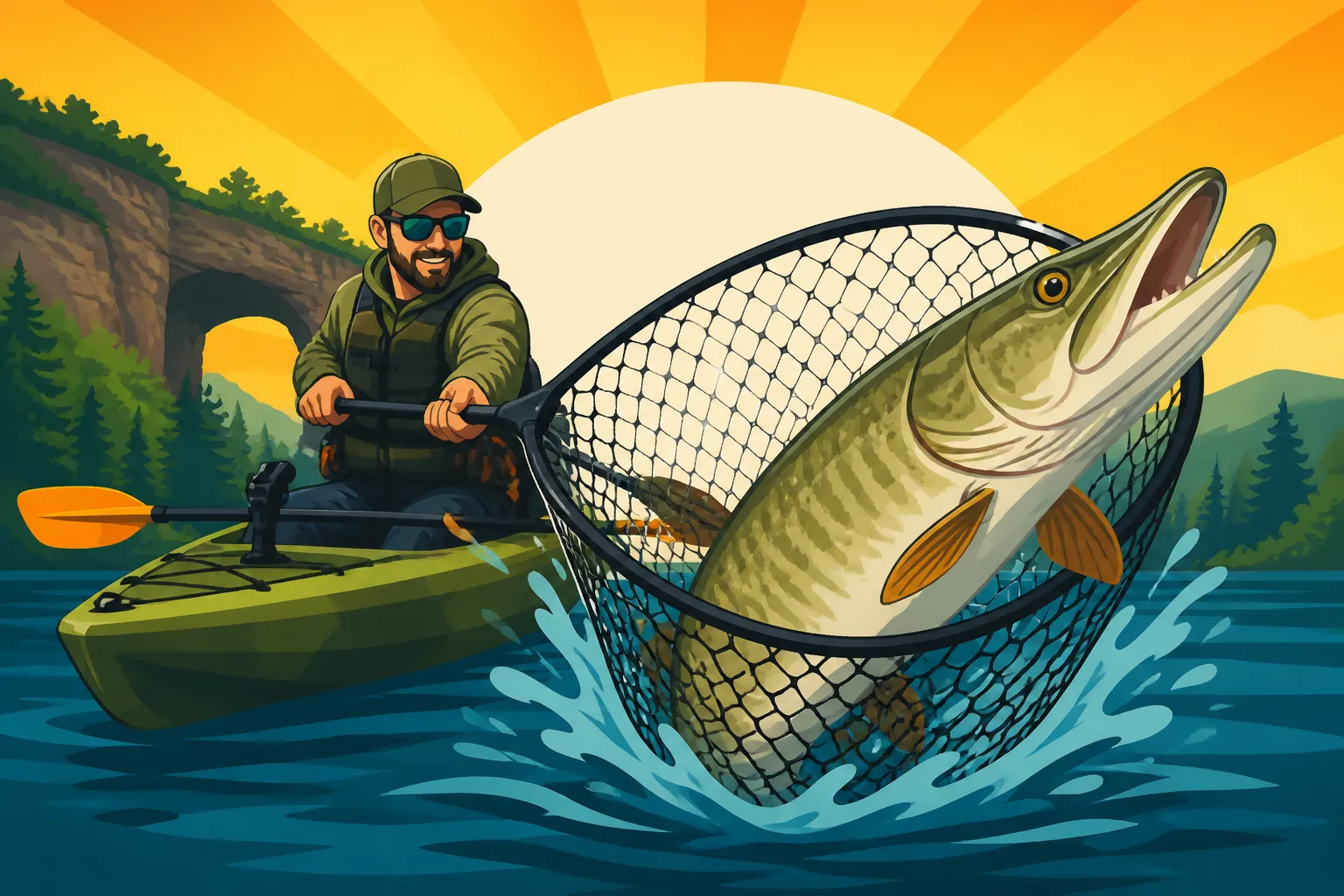
This is where the practice comes in. With one hand, you’ll be managing your rod, keeping the fish tired but still under control. With the other, you’ll be deploying and operating your net. This is why a net with a quick-release handle or an easy extension mechanism is vital. As the muskie tires and you bring it boatside, aim to lead the fish headfirst into the net. Muskies are typically easier to net headfirst, as their natural forward motion helps guide them. Don't chase the fish with the net; instead, position the net in the water and lead the muskie over the hoop. Once its head and shoulders are over, swiftly scoop upwards to capture the entire fish. The deep net bag will help contain the fish and keep it submerged, which calms it down considerably. If you're using a figure-eight maneuver boatside, as described in How to figure eight a muskie boatside, have your net ready for the moment the fish commits.
Handling and Release Protocols
Once the muskie is in the net, keep it in the water alongside your kayak as much as possible. This minimizes stress and keeps its gills submerged. If you need to bring it aboard briefly for a quick photo or measurement, be extremely careful. Cradle the net (and the fish) with one hand, and use your other hand to reach for tools. Always handle muskie with extreme caution. Their teeth are formidable, and their thrashing can be dangerous. Use those long-nosed pliers to quickly and gently remove hooks. If a hook is deeply set, don't hesitate to cut the hook with heavy-duty cutters – it’s better than causing undue trauma to the fish. After unhooking, keep the fish in the net, submerged in the water, until it shows signs of recovery and can swim off strongly under its own power. Never drop a muskie back into the water from a height; gently ease the net to release it. Understanding Muskie Regulations in West Virginia Waters will reinforce the importance of these responsible handling practices.
Net Maintenance and Kayak Rigging for Muskie Anglers
Having the best net for landing muskie from a kayak is only part of the equation; knowing how to maintain it and effectively rig it on your kayak ensures it's always ready when that trophy fish strikes. Proper care extends the life of your valuable gear and keeps you prepared for those exciting encounters.
Post-Trip Cleaning and Storage
After every muskie fishing trip, especially if your net has been used, a thorough cleaning is in order. Rinse your net with fresh water to remove any slime, mud, weeds, or debris. If your net has a rubberized mesh, a gentle scrub with a soft brush can help remove stubborn grime. Pay attention to the handle extension mechanisms, ensuring they are free of sand or grit that could impede their smooth operation. Allow the net to air dry completely before storing it. Storing a wet net, especially if it’s folded or collapsed, can lead to mildew, odors, and premature degradation of the mesh. Once dry, store your net in a cool, dry place, ideally in a way that prevents the mesh from getting crimped or tangled. Many anglers choose to hang their nets in a garage or shed.
Securing Your Net on the Kayak
When you’re paddling or fishing, you don’t want your net to be a hindrance, yet it needs to be instantly available. Different kayaks and angling styles will dictate the best rigging method.
- Side Mount: Many anglers attach their net along the side of their kayak using bungee cords or specialized net holders. This keeps the net out of the way for paddling and casting but allows for a quick grab. Ensure the handle is extended to its operating length or can be extended easily with one hand.
- Behind the Seat: For some kayaks, especially sit-on-tops with ample stern storage, the net can be laid flat behind the seat or secured across the stern tankwell. Again, ensure it’s not buried under other gear and can be retrieved smoothly.
- Leash System: Always consider leashing your net to your kayak. A simple bungee leash can prevent your net from becoming a runaway if you accidentally drop it or if a particularly feisty muskie manages to pull it overboard. This is especially important when fishing Best Fishing Rivers in West Virginia with strong currents.
Practice deploying your net from your chosen rigged position until it feels like second nature. The moment you hook a muskie isn't the time to be figuring out your net deployment strategy.
Protecting Your Net and Investment
Your muskie net is an investment, often costing more than a standard fishing net. Consider a soft mesh cover or even a simple piece of old towel to protect the rubberized mesh when it's stored or transported. This prevents it from snagging on other gear, sharp edges in your vehicle, or getting damaged by UV exposure if stored outdoors. Regular inspection of your net for any signs of wear, especially tears in the mesh, cracks in the handle, or loose connections, will allow you to make repairs before they become critical failures. After all, a broken net is about as useful as no net at all when a giant muskie is on the line. Being prepared with the right net and a well-thought-out rigging strategy will significantly increase your success rate and enjoyment when targeting Muskie Fishing in West Virginia.
Disclaimer
This article is for general informational purposes only and does not constitute professional advice. Laws, prices and regulations vary by location and change over time. Consult a qualified professional for guidance on your specific situation.