Best Jon Boats for Shallow Rivers
Navigating the beautiful, winding rivers of West Virginia can be an angler's dream, but it often comes with a significant headache: shallow water. There’s nothing more frustrating than wanting to explore that perfect stretch of river, only to realize your boat draws too much water, or worse, you hear that gut-wrenching scrape of your propeller against a hidden rock. This guide is here to cut through that frustration, helping you understand why jon boats are often the ultimate solution for skinny waters and what to look for when choosing the best one to conquer West Virginia’s challenging river systems.
Understanding the Challenges of Shallow West Virginia Rivers
West Virginia's rivers are legendary for their fishing, from the smallmouth bass in the New River to the muskies in the Little Kanawha, and the trout in the Elk. But what makes them so special – their wild, untamed nature – also makes them incredibly challenging for boaters. These aren't your typical placid lakes; they're dynamic, constantly changing environments that demand a specific kind of vessel.
The Perils of Low Water Levels and Rocky Bottoms
Anyone who has spent time on West Virginia's rivers knows how quickly water levels can fluctuate. A river that looked perfectly navigable in spring can become a minefield of exposed rock gardens and gravel bars by late summer or during periods of drought. Rivers like the Greenbrier, parts of the New River, and even sections of the South Branch Potomac are notorious for their shallow stretches, especially during dry spells. You might be cruising along confidently one moment, and the next, you're high and dry, or worse, you've just damaged your prop or the bottom of your hull.
This isn't just about soft sand or mud; West Virginia's geology means you're often dealing with hard, unforgiving rock, slate ledges, and submerged timber. A run-in with these can do serious damage to a conventional V-hull boat that's not designed to take such punishment. The constant anxiety of "will I hit something?" takes away from the pure joy of being on the water and focusing on the fish. You need a boat that can either float over these obstacles with minimal fuss or take a bump without sending you to the repair shop.
Limited Access and Traditional Boat Limitations
One of the biggest frustrations for anglers in West Virginia is the limited access to prime fishing spots. Many of the most productive and least-pressured areas are found upstream, in smaller tributaries, or in sections of the main river that are simply too shallow for larger, heavier boats. Traditional V-hull bass boats or deep-V walleye boats, while excellent in open water or large reservoirs, are often rendered useless in these skinny river environments. They require significant water depth for launching and navigation, trapping anglers at crowded public ramps and away from the truly wild stretches.
The sheer weight and deep draft of these conventional boats also make them a nightmare to launch at primitive access points, which are common along many of West Virginia's smaller rivers and streams. Imagine trying to muscle a heavy fiberglass boat down a rocky bank or through a muddy rut just to get a chance at some untouched water. It’s an exercise in futility and often leads to disappointment. Many anglers end up missing out on incredible fishing opportunities simply because their boat isn't built for the terrain, which is where a specialized craft truly shines.
Why Jon Boats Are the Unsung Heroes of Shallow Water
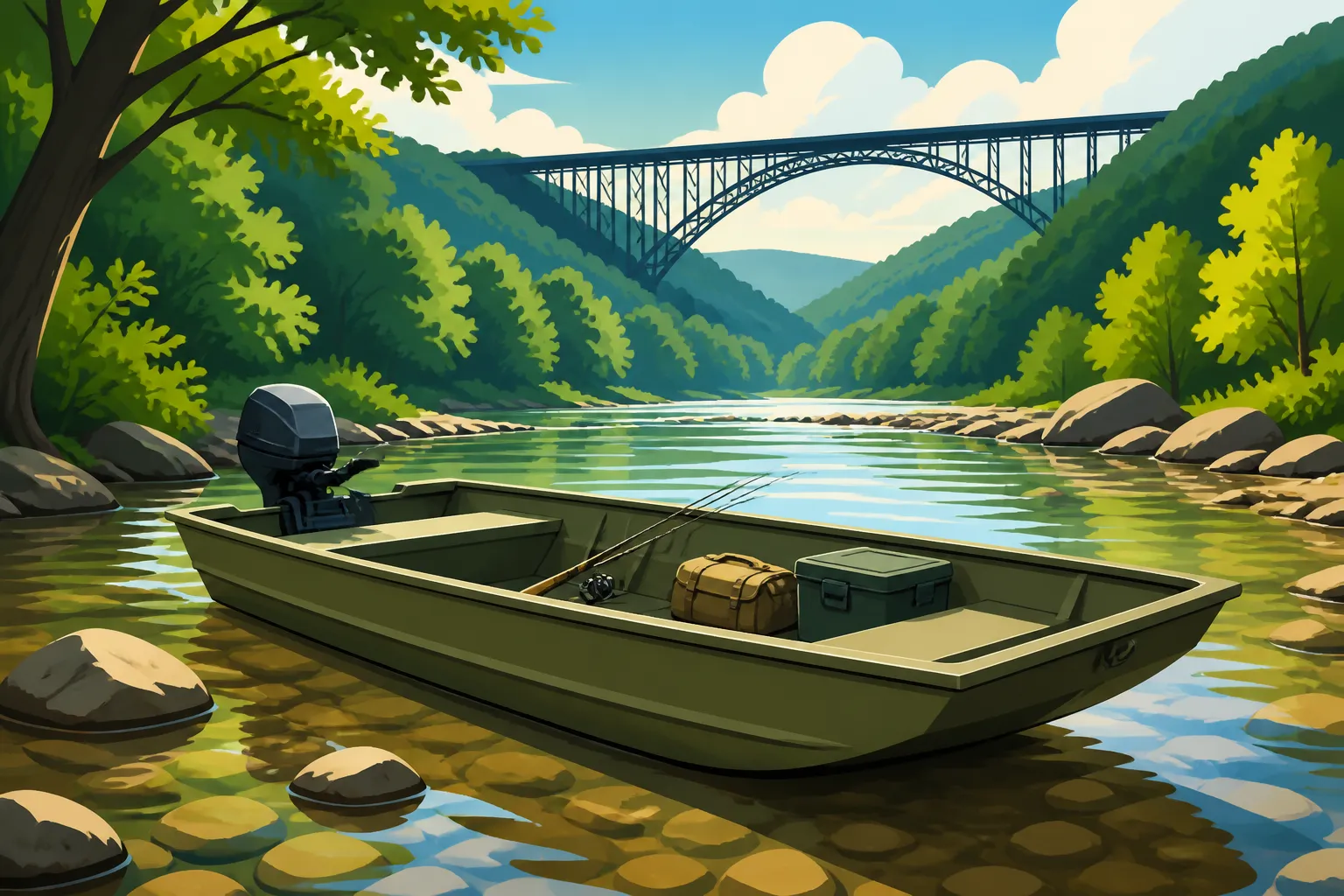
When it comes to tackling West Virginia's shallow rivers, the humble jon boat often emerges as the unlikely champion. These boats might not have the flashy graphics or plush seating of a high-end bass boat, but what they lack in frills, they more than make up for in rugged utility and shallow-water prowess. They are purpose-built for environments where other boats fear to tread, making them invaluable for river anglers.
The Flat-Bottom Advantage
The defining characteristic of a jon boat is its flat bottom. This design is not just a stylistic choice; it's a fundamental engineering principle that makes them incredibly effective in shallow water. Unlike V-hulls, which slice through the water and therefore require more depth, a jon boat's flat bottom allows it to literally "plane" on top of the water, spreading its weight over a larger surface area. This results in an incredibly shallow draft, often allowing them to skim over just a few inches of water without issue. Imagine floating over those gravel bars and submerged logs that would spell disaster for a deeper-keeled boat.
This flat-bottom design also contributes significantly to stability. When you're standing up to cast, fighting a fish, or moving around the boat, a jon boat provides a remarkably stable platform. This is a huge advantage in river fishing, where you might be casting into tight spots, maneuvering around obstacles, or simply enjoying a long day of standing and sight fishing. For anglers who value stability and minimal draft above all else, the flat-bottom jon boat is a clear winner, giving you access to spots on the Elk River or Cheat River that other boats can only dream of.
Durability and Simplicity for River Life
West Virginia rivers are tough on boats, and jon boats are built tough enough to handle them. Most jon boats are constructed from robust aluminum, a material known for its strength-to-weight ratio and resilience. This isn't thin, flimsy material; many quality river jon boats feature a thicker gauge aluminum, designed to withstand bumps, scrapes, and even direct hits from submerged rocks and stumps. While a fiberglass boat might crack or spiderweb from such impacts, an aluminum jon boat is more likely to dent, which is often easily repairable. This inherent durability means less worry about accidental damage and more confidence when exploring unfamiliar waters.
Beyond their tough exterior, jon boats are celebrated for their simplicity. They typically feature an open, no-frills interior layout, which is a huge advantage for river anglers. This uncluttered space makes them incredibly easy to clean – just hose them out after a muddy river trip. It also means more usable space for gear, tackle, and even multiple anglers. Their straightforward design also makes them highly customizable; you can add rod holders, trolling motor mounts, depth finders, and custom seating with relative ease. This simplicity translates to less maintenance and more time spent doing what you love: fishing those wild West Virginia waters, perhaps with gear picked up from Bass Pro Shops or even custom-fabricated by a local outfitter.
Key Features to Look for in a Shallow River Jon Boat
Not all jon boats are created equal, especially when you're looking to navigate the specific challenges of West Virginia's shallow and rocky rivers. To truly excel in these environments, you need to pay close attention to several key features that dictate a boat's performance, durability, and suitability for river fishing. Thinking about these details beforehand can save you a lot of headaches and potential repairs down the line.
Hull Design and Gauge Thickness
When you're constantly bumping over rocks and gravel, the integrity of your boat's hull is paramount. The first thing to consider is the overall hull design. While all jon boats are flat-bottomed, some might have a slightly modified V-bow (a "mod-V" or "sem-V") that helps cut through chop a bit better on larger bodies of water, but still transitions to a flat or nearly flat bottom. For truly shallow rivers like the New River's upper sections or the Greenbrier, a pure flat-bottom jon boat will offer the shallowest draft. The wider the bottom, the more stable the boat will be and the shallower it will draft, but it might also be slightly less maneuverable in tight currents.
Beyond the shape, the aluminum gauge thickness is absolutely critical. This is the measurement of the aluminum sheet used to construct the hull. You'll often see numbers like .080, .100, or .125. For the rough-and-tumble nature of West Virginia rivers, you want to lean towards the thicker side. A .100 or, even better, a .125 gauge hull offers significantly more resistance to dents and punctures from unexpected impacts. A thinner hull might save a few bucks upfront or be slightly lighter, but it can quickly become a liability, leading to costly repairs or even compromising safety. Another point of consideration is whether the hull is welded or riveted. Welded hulls are generally considered stronger and more watertight for rigorous river use, as they eliminate the potential for rivets to loosen or leak over time, though riveted boats can be lighter and still perfectly serviceable for many anglers.
Transom Height and Motor Considerations
The transom is the flat stern section of your boat where the outboard motor is mounted. Its height is crucial for proper motor selection and efficient shallow-water operation. Most jon boats will have either a 15-inch or a 20-inch transom, designed to perfectly match a short-shaft (15-inch) or long-shaft (20-inch) outboard motor, respectively. It’s absolutely vital to match these correctly. Putting a short-shaft motor on a 20-inch transom will mean your prop is too high in the water, cavitating constantly and struggling to push the boat. Conversely, a long-shaft motor on a 15-inch transom will have your prop digging too deep, increasing your draft and making it more prone to hitting bottom.
For the shallowest water conditions, many West Virginia river anglers opt for a jet drive outboard motor. A jet drive replaces the traditional propeller with an impeller that sucks in water and expels it out the back, creating thrust. This means there's no propeller extending below the bottom of the boat, allowing you to run in incredibly shallow water – often just a few inches deep. Brands like Mercury Marine and Yamaha offer reliable jet drive options. While jet drives are fantastic for extreme shallow water, they do have some trade-offs: they're typically less fuel-efficient than propeller motors, slower, and require more horsepower to achieve the same thrust. They also can be more prone to clogging from weeds or debris. For those who want a versatile option, some manufacturers like Tohatsu make small outboards that can easily switch between prop and jet lower units, offering the best of both worlds.
Interior Layout and Customization Potential
The open, often utilitarian interior of a jon boat is one of its biggest assets for river anglers. You'll typically find an open floor plan with various bench seats, though some models will have small casting decks built into the bow. An open floor plan offers maximum flexibility, allowing you to arrange your gear, coolers, and seating as needed for each trip. This is particularly useful for fishing different species or techniques that require different setups.
Look for models that have a solid, flat floor, possibly with a non-skid surface, for safe standing and casting. Some jon boats might offer built-in features like a livewell, rod storage, or a dedicated battery compartment in the bow for a trolling motor. While these add convenience, the beauty of a jon boat is how easily you can customize it yourself. You can add flush-mount rod holders, install a removable casting brace, or even build custom storage boxes. Many accessories, from sturdy boat seats to advanced fish finders, can be sourced from retailers like Bass Pro Shops or online through Amazon, allowing you to tailor your boat precisely to your fishing style. This allows you to create a functional, comfortable fishing machine that's perfectly suited for Best Kayak Fishing Spots in West Virginia or deeper sections of the Kanawha River.
Sizing Your Jon Boat for West Virginia Waters
Choosing the right size for your jon boat is a balancing act, influenced by the specific rivers you plan to fish, the number of anglers you typically bring along, and your own physical capabilities for launching and handling. A boat that's perfect for a solo mission on a small creek might feel cramped and unstable on a larger river, while an overly large boat might be impossible to launch at your favorite primitive spot.
Length and Width: Finding the Right Balance
Jon boats come in a wide range of lengths, typically from 10 feet up to 18 or even 20 feet. The length directly impacts carrying capacity, stability, and maneuverability.
-
Smaller Jon Boats (10-12 feet): These are fantastic for solo anglers or two very light anglers, especially on smaller, tighter streams with sharp bends and limited access. Think of exploring narrow sections of the Cranberry River or Cheat River. They are incredibly light, often capable of being car-topped or easily trailered by a small vehicle. Their small size means they turn on a dime and can navigate tight spots with ease. The downside is limited space for gear and less stability in strong currents or when encountering boat wakes on larger rivers.
-
Medium Jon Boats (14-16 feet): This is often the sweet spot for many West Virginia river anglers. A 14-foot or 16-foot jon boat offers a great balance of portability, stability, and fishing space. They can comfortably accommodate two anglers with gear, and sometimes even three if everyone travels light. Rivers like the Greenbrier, Elk, or the middle sections of the New River are perfectly suited for this size. They're still relatively easy to launch at most access points but provide enough room to move around, stand, and cast without feeling cramped.
-
Larger Jon Boats (18+ feet): If your primary target is larger rivers like the Ohio River tributaries, the mainstem Kanawha, or wider sections of the Potomac, and you often fish with two or more people, a larger jon boat makes sense. An 18-foot jon boat offers significantly more space, handles chop better, and can carry more weight and gear. However, they are much heavier, definitely requiring a trailer, and can be challenging to launch at primitive, unimproved access points. Their size also makes them less maneuverable in swift, tight currents.
The width, or "beam," of the boat is equally important. A wider boat will always be more stable, which is a huge advantage when standing to cast or when dealing with another angler moving around. It also generally offers more interior space. However, an excessively wide boat might struggle to fit through very narrow channels or be harder to row or maneuver in strong currents if you're not using a motor. For most river fishing in West Virginia, a beam between 48 and 60 inches provides a good balance.
Weight, Portability, and Launching Considerations
The overall weight of your jon boat setup—boat, motor, and gear—will dictate its portability and ease of launching. Many West Virginia river access points are far from ideal; you won't always find concrete ramps with ample parking. Often, you're dealing with gravel banks, muddy slopes, or even just a pull-off by the side of the road.
-
Lightweight Options: If you plan on frequently fishing smaller, more remote streams, or need to launch where there are no formal ramps, a lighter boat is key. A 10- or 12-foot jon boat with a small outboard or electric trolling motor might be light enough for two people to carry down a bank or even slide off the back of a pickup truck. This versatility opens up a huge number of less-fished spots.
-
Trailer Dependency: As you move into the 14-foot and larger range, a trailer becomes a necessity. Even if the boat itself isn't incredibly heavy, the combined weight with a motor, fuel, and gear makes manual launching impractical. Consider the type of trailer needed – a simple bunk trailer is usually sufficient, but ensure it's well-maintained and has good tires, especially if you're accessing rougher roads or launch areas. You'll also want to make sure your vehicle is capable of safely towing the combined weight. Knowing your boat's registration requirements, as outlined in West Virginia Boat Registration Requirements, is also a must.
Ultimately, the best size is the one that allows you to comfortably fish the waters you frequent most often, with the people you usually fish with, and can be easily launched and retrieved at your preferred access points. Don't buy a boat that's too big for your typical fishing grounds, or you'll quickly find yourself limited and frustrated.
Essential Gear and Rigging for Shallow River Jon Boats
Outfitting your jon boat for West Virginia's shallow rivers goes beyond just the boat and motor. The right combination of accessories and safety gear can significantly enhance your fishing experience, improve your chances of success, and, most importantly, keep you safe. From how you power your boat to how you keep your gear organized, every choice contributes to a more efficient and enjoyable day on the water.
Motors, Trolling Motors, and Anchoring Systems
The propulsion for your jon boat is critical. For navigating the currents of West Virginia's rivers, a reliable outboard motor is often indispensable. As mentioned earlier, a propeller motor with the correct shaft length (15-inch for a 15-inch transom) is standard, but for the shallowest runs, a jet drive outboard is truly transformative, allowing you to skim over mere inches of water. Make sure whatever motor you choose is adequately powered for your boat size and the currents you'll encounter – a 9.9 HP might be fine for a 12-foot boat, but an 18-foot model on a major river might need a 40 HP or even more.
In addition to your primary outboard, an electric trolling motor is a game-changer for precise boat control, especially when fishing for smallmouth bass on a river like the New River Smallmouth Bass Fishing. A bow-mounted trolling motor allows you to quietly hold position against the current, creep along a productive bank, or precisely maneuver into tight eddies. Brands like Minn Kota and MotorGuide offer robust options, often with GPS anchoring features that can hold your boat in place with incredible accuracy. You'll need a good deep-cycle battery (or two) to power it, so consider how you'll mount and charge these.
Finally, an effective anchoring system is non-negotiable for river fishing. The typical mushroom anchor used on lakes simply won't hold in strong currents or on rocky bottoms. You'll want a grappling anchor with flukes that can dig into rock or gravel, or even better, a spud pole system. A spud pole is a heavy-duty pole that you drive into the river bottom to hold your boat in place. This allows for quick, silent deployment and retrieval, perfect for working a specific run or hole. Also, make sure you have enough anchor rope (or chain and rope combo) – generally, 3-5 times the depth of the water you expect to anchor in, to provide a good holding angle.
Safety and Navigation Must-Haves
Safety should always be your top priority on the water. For West Virginia rivers, some safety items are not just good practice, but legal requirements. Always ensure you have enough U.S. Coast Guard-approved life jackets for everyone on board, and wear them! The currents on rivers can be deceptively strong, and conditions can change rapidly. Don't forget that Life Jacket Requirements for West Virginia Boaters specifically address age requirements for children.
Beyond life jackets, a basic safety kit should include:
- First-aid kit: For minor cuts, scrapes, or other injuries.
- Whistle or air horn: To signal other boaters or alert for help.
- Paddles or oars: Even with a motor, these are vital for propulsion if your motor fails or you run out of fuel.
- Fire extinguisher: For any motorized boat.
- Throw cushion or throw bag: A personal flotation device designed to be thrown to someone in the water.
For navigation, especially if you're exploring new stretches or fishing in challenging conditions, consider a basic fish finder/GPS combo unit. Brands like Humminbird and Lowrance offer affordable units that can show you depth, pinpoint submerged structure, and help you navigate back to your launch point or marked fishing spots. Even a waterproof map of the river and a compass can be invaluable. You can find a wide range of these devices, from basic models to advanced ones, on Amazon. This equipment can greatly assist in finding those hidden honey holes, perhaps even the Best Bank Fishing Spots at Summersville Lake or identifying prime structure on the New River.
Rod Holders, Storage, and Custom Comforts
One of the beauties of a jon boat's open layout is the potential for customization to make it truly yours. Maximizing space and keeping your gear organized is key to an enjoyable day.
- Rod Holders: You'll want sturdy rod holders to keep your rods secure while running, moving between spots, or even when you're just taking a break. Flush-mount holders can be installed into the gunwales, while clamp-on or track-mounted holders offer more flexibility for positioning. Ensure they can hold different types of rods, whether you're bringing a fly rod for Fly Fishing for Trout in West Virginia or a heavy setup for Muskie Fishing in West Virginia.
- Storage Solutions: With an open boat, dry bags are your best friend. Keep spare clothes, electronics, and valuables safe from spray and rain. Tackle boxes and bags should be compact and well-organized. You might even consider adding a custom storage box or two, perhaps built from marine-grade plywood, to create dedicated compartments for tackle, safety gear, or a cooler. A good Best Tackle Bag for Bank Fishing can easily transition to a jon boat, keeping everything within reach.
- Comfort Features: While jon boats are utilitarian, you can certainly add some creature comforts. Swivel boat seats mounted to the benches, or even custom pedestals, can make long days more comfortable. A Bimini top can provide much-needed shade on hot summer days. Portable coolers are essential for drinks, snacks, and keeping your catch fresh. Remember, a comfortable angler is a happy and more effective angler!
By carefully selecting and rigging your jon boat with these essential items, you'll be well-prepared to tackle the unique challenges and endless opportunities that West Virginia's shallow rivers have to offer.
Comparing Jon Boat Sizes for West Virginia Rivers
To help you visualize how different jon boat sizes align with various West Virginia river scenarios, here's a quick comparison. This table highlights typical characteristics and ideal uses for common jon boat lengths, helping you make an informed decision for your specific fishing needs.
| Feature / Scenario | Small Jon Boat (10-12 ft) | Medium Jon Boat (14-16 ft) | Large Jon Boat (16-18 ft) |
|---|---|---|---|
| Ideal for: | Small streams, tight bends, car-topping, solo trips, creeks like Mill Creek or Warm Springs Run | Medium rivers (Greenbrier, Elk, South Branch Potomac), small lakes, 1-2 anglers | Larger rivers (Kanawha, Ohio River backwaters, mainstem New River), open lakes, 2-3 anglers, Cheat Lake |
| Max Draft: | Very shallow (3-5 inches) | Shallow (5-8 inches) | Moderate shallow (8-10 inches) |
| Maneuverability: | Excellent | Good | Moderate |
| Portability: | High (often car-topped or easily carted) | Medium (trailer usually required, can be dragged at primitive spots) | Lower (trailer always required, difficult at primitive spots) |
| Typical Motor Size: | Electric, 2.5-9.9 HP outboard | 9.9-25 HP outboard (or small jet) | 25-40 HP outboard (or larger jet) |
| Pros: | Light, easy to launch, fits tight spaces, access remote areas | Versatile, stable, good balance of size/portability, ample room for two | More space, handles chop better, very stable fishing platform, higher weight capacity |
| Cons: | Limited space, less stable in chop, slower, can feel cramped with two | Can still be tight with 3 anglers, heavier to launch solo | Heavier, harder to launch in primitive spots, larger motor needed, less agile in tight streams |
This comparison should give you a clearer picture of what to expect from each size class. Remember, there's no single "best" boat; there's only the best boat for your specific needs and the unique character of the West Virginia waters you love to fish.
Disclaimer
This article is for general informational purposes only and does not constitute professional advice. Laws, prices and regulations vary by location and change over time. Consult a qualified professional for guidance on your specific situation.