Best Anchor System for River Fishing
Fishing in West Virginia's rivers can be an incredibly rewarding experience, offering some of the most stunning scenery and feisty fish in the country. However, anyone who has spent a day on the New, the Gauley, or even smaller tributaries knows the sheer frustration of trying to hold your position against a swift current. You cast, you drift, you try to anchor, and then suddenly you're dragging, your boat is swinging wildly, or worse, your anchor is hopelessly snagged, leaving you feeling more like a river guide than an angler. This guide is all about cutting through that frustration by helping you understand and choose the best anchor system for tackling West Virginia's diverse and often challenging river environments, ensuring you can stay put and focus on catching fish.
Navigating West Virginia's Dynamic River Currents
West Virginia's rivers are truly special, but their very nature—the geology, the gradient, and the ever-changing flow—presents unique challenges for anglers trying to stay put. Unlike a calm lake, a river is a constantly moving system, and ignoring its dynamics will quickly lead to a frustrating day on the water. Understanding these forces is the first step in choosing an anchor system that actually works for you.
The Unpredictable Nature of River Flow
One moment you might be in a relatively slack pool, and the next, you've drifted into a roaring chute. West Virginia rivers are characterized by these dramatic shifts in current speed and direction. You have the main current, which can be surprisingly powerful, especially after a good rain or during seasonal high water. Then there are eddies, which are those swirling pockets of water that often flow upstream or sideways, creating complex currents that can spin your boat around if you're not careful. Beneath the surface, there can be undertows that pull an anchor line in unexpected directions.
Furthermore, the depth of the water significantly impacts current. Shallower riffles can have incredibly fast, turbulent flows, while deep pools might seem calm on the surface but still have a strong, steady pull underneath. Trying to use a lightweight lake anchor in these conditions is like trying to hold a runaway horse with a piece of twine; it's simply not going to work. Your anchor system needs to be able to bite into the bottom and withstand these varying forces without dragging or causing your boat to dangerously swing into obstacles. Understanding these flow dynamics is crucial for both safety and effective fishing. You don't want to find yourself in a tight spot only to realize your anchor can't hold.
Understanding River Bottoms and Their Gripping Power
The bottom of a river is rarely uniform, and what lies beneath your boat dictates how well an anchor can hold. In West Virginia, you'll encounter a wide array of bottom types, each presenting its own anchoring puzzle. You might find areas of solid rock, which offer fantastic grip for the right anchor, but can also lead to irreversible snags. Then there are stretches of coarse gravel, where a well-designed anchor can dig in beautifully. Moving into slower, deeper sections, you might encounter sand, mud, or even thick clay, which require a different approach entirely.
Submerged timber, fallen trees, and large boulders are also common, particularly in the wilder sections of our rivers. These features, while often prime fish habitat, are absolute anchor magnets. A traditional fluke anchor, designed for sandy lake bottoms, would likely just slide over rocks or bury itself irretrievably in mud in a river. Conversely, a grapple anchor that works wonders on a rocky ledge might get completely gummed up in a silty bottom. The effectiveness of your anchor isn't just about its weight; it's about its ability to penetrate and hold firm in the specific substrate you're trying to stop on. Best Anchor for fishing moving river current dives into some of these specifics for different bottom types.
The Peril of Snags and Obstructions
Every river angler has a story about a lost anchor. It's almost a rite of passage. West Virginia's rivers, with their rugged terrain, strong currents, and natural debris, are notorious for gobbling up anchors. Submerged trees, known as "strainers," are particularly dangerous, as the current can pin your boat against them if you're not careful. Large rocks and underwater ledges can create perfect pockets for anchor flukes or tines to wedge into, making retrieval impossible without significant effort, or even requiring cutting the line.
Beyond natural obstructions, you might also contend with old fishing line, discarded tires, or even remnants of old bridge structures. These hidden hazards don't just lead to a lost anchor; they can create dangerous situations where your boat is suddenly tethered in a strong current, or you're forced to make a quick decision to cut your line to avoid capsizing. A truly effective river anchor system not only needs to hold well but also needs a strategy for dealing with these inevitable snags, whether through breakaway components or specialized retrieval methods. This concern is often at the forefront of a West Virginia angler's mind when anchoring in unfamiliar waters.
Popular Anchor Types for West Virginia River Anglers
Given the diverse and often challenging conditions of West Virginia's rivers, a single "best" anchor type doesn't really exist. Instead, successful river anglers often carry a selection or choose a system optimized for their specific craft and the prevalent bottom conditions they expect to encounter. Let's look at the workhorses of river anchoring.
River Anchors: The Flat-Sided Workhorses
When most folks think of an anchor for a boat, they often picture a traditional fluke anchor. However, for river fishing, a different breed of anchor often shines: the flat-sided or pyramid-style "river anchor." These anchors are typically designed with a broad, flat base or a pyramid shape, often with a slight concavity, and are significantly heavier than their lake counterparts for their size. Their primary advantage lies in their ability to dig into softer bottoms like sand, mud, or fine gravel, relying on their weight and surface area to create significant drag and resistance.
Unlike a fluke anchor that needs to "set" by digging its blades into the bottom, a river anchor holds by literally sinking and resisting the current's pull. This makes them less prone to skipping across the bottom in a strong current once they've settled. They are particularly effective in the deeper, slower pools of rivers like the Greenbrier or the Kanawha where the bottom is often silty or sandy. While they excel in these conditions, they can struggle to get a solid purchase on very rocky bottoms, often just sliding or tumbling until they find a pocket. Many anglers will purchase these from reputable outdoor retailers like Bass Pro Shops, which offers a range of weights and designs specifically for river use.
Grapple Anchors: Grabbing onto the Rocky Bottom
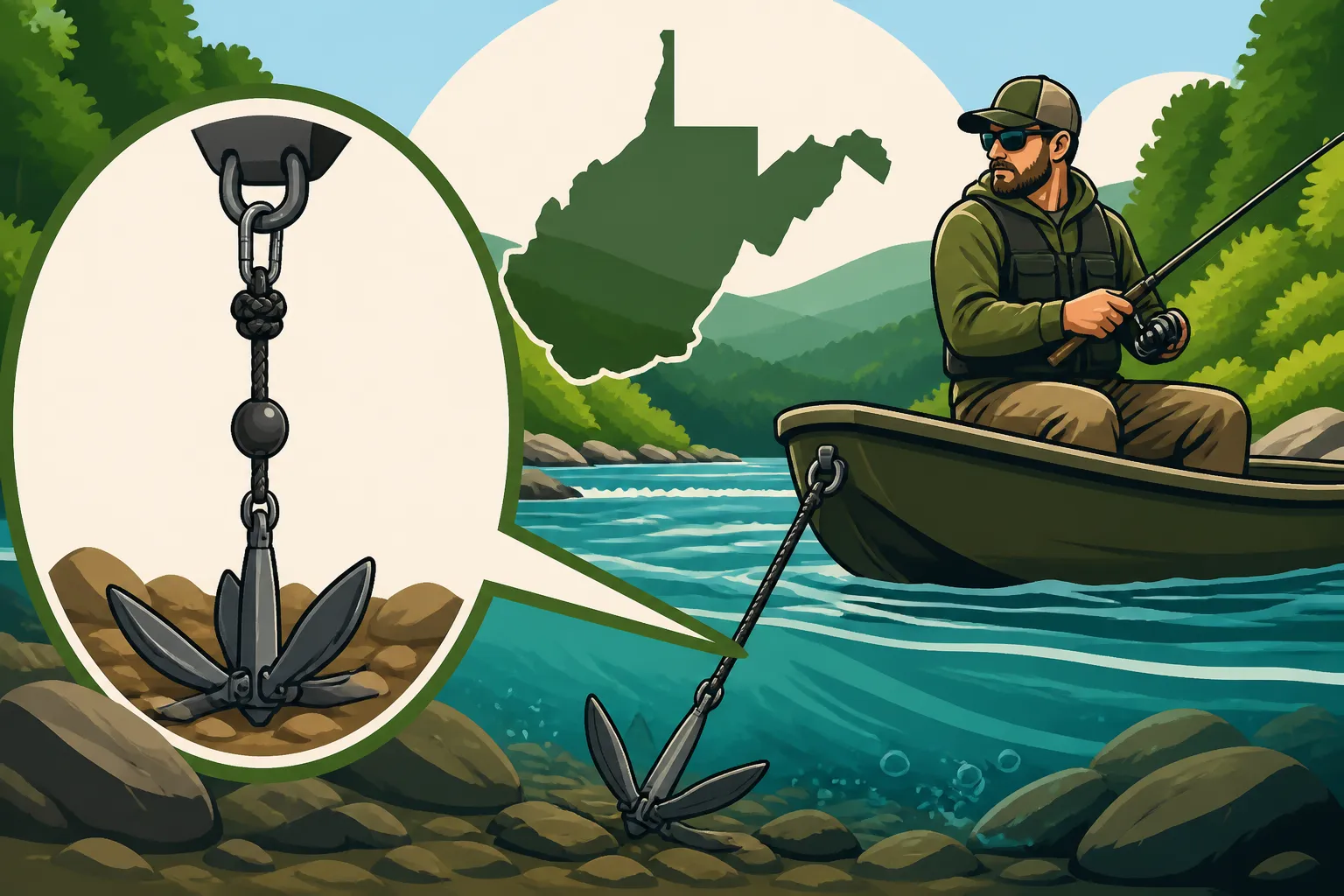
If your fishing frequently takes you to rivers with predominantly rocky bottoms, such as the New River Gorge with its abundance of boulders and ledges, a grapple anchor is your best friend. These anchors are characterized by multiple "tines" or prongs, typically four, that are designed to hook onto rocks, roots, or other underwater structures. Many grapple anchors are also foldable, making them incredibly compact for storage, which is a huge bonus for smaller boats like kayaks or canoes.
The magic of a grapple anchor is its ability to find purchase where other anchors would simply slide. It's not about burying itself; it's about snagging. This strength, however, is also its biggest weakness. Because they are designed to snag, they are incredibly prone to getting permanently stuck. Anglers who rely on grapple anchors often employ various "breakaway" or retrieval systems to prevent permanent loss, which we'll discuss later. Despite the risk of snagging, for navigating challenging rocky riverbeds, a well-deployed grapple anchor can provide a rock-solid hold that no other anchor type can match. For anyone exploring the fantastic smallmouth bass fishing on the New, having a good grapple anchor is almost essential.
Drift Socks and Drag Chains: For Controlled Drifting
Sometimes, the goal isn't to stop completely, but to slow down and control your drift. This is where drift socks, also known as drift anchors, and drag chains become indispensable tools. A drift sock is essentially a large, cone-shaped parachute made of durable fabric that deploys in the water, creating significant drag against the current. It's not designed to stop your boat entirely, but to slow its forward momentum, allowing you to thoroughly fish a stretch of river or maintain a specific speed that matches your lure presentation.
Drag chains are simply heavy chains, often repurposed from industrial uses, that are deployed off the bow or stern. They drag along the bottom, providing resistance and slowing the boat, much like a drift sock, but with the added benefit of potentially snagging slightly on the bottom for a bit more friction. Both drift socks and drag chains are fantastic for precise river navigation, especially when targeting species that prefer specific current speeds, or when you want to make multiple passes over a productive run without constantly lifting and redeploying a traditional anchor. Many kayak anglers on rivers like the Greenbrier use a combination of a small grapple anchor for stopping and a drift sock for controlled movement, especially when Kayak Fishing Techniques for West Virginia Rivers.
| Anchor Type | Primary Bottom Type | Holding Power (River Current) | Snag Risk | Best Use Case |
|---|---|---|---|---|
| River Anchor | Sand, Mud, Fine Gravel | Good | Low | Deeper, slower pools; less rocky rivers |
| Grapple Anchor | Rocks, Rubble, Timber | Excellent | High | Rocky rivers with strong current; New River |
| Drift Sock | All (doesn't 'anchor') | Low (slows, controls) | Very Low | Controlled drifting, slowing down, multiple passes |
| Drag Chain | Sand, Gravel, Soft Mud | Moderate (slows, drags) | Moderate | Controlled drifting, extra drag in current |
Building a Robust River Anchor System
An anchor isn't just a piece of metal you throw overboard; it's one component of a larger system. For effective and safe river fishing, you need to think about the entire setup, from the rope that connects your anchor to your boat, to the mechanisms that allow for quick release and retrieval. Skimping on these components can turn a good anchor into a liability.
Anchor Ropes, Chains, and the Importance of Scope
The anchor rode—the rope, chain, or combination that connects your anchor to your boat—is just as crucial as the anchor itself. For river fishing, durability and strength are paramount. Nylon rope is a popular choice for its strength, stretch (which absorbs shock from waves and current), and abrasion resistance. Polypropylene rope floats, which can be useful in some situations but is generally less durable and can get tangled in propellers more easily. Many anglers find a good balance with a strong, sinking rope.
Crucially, an anchor system needs adequate "scope." Scope refers to the ratio of the length of anchor rode deployed to the vertical distance from your boat's bow to the river bottom. A common recommendation for calm waters is a 7:1 ratio, meaning 7 feet of rope for every 1 foot of depth. In a strong river current, you need even more. A longer scope allows the anchor to pull horizontally along the bottom, increasing its ability to dig in and hold. Without enough scope, the anchor will pull upwards, causing it to drag or even lift off the bottom. Additionally, a short length of galvanized chain (often 3-6 feet) between your anchor and rope is highly recommended. This chain provides weight near the anchor, helping it lie flat and dig in, and offers superior abrasion resistance against rocky bottoms compared to rope alone. You can find excellent quality marine-grade rope and chain at outdoor suppliers.
Quick-Release Systems and Cleats for Safety
In the dynamic environment of a river, being able to quickly release your anchor can be a matter of safety. Imagine being anchored, and suddenly a large log comes drifting downriver directly towards your bow. Or perhaps the current unexpectedly surges, putting dangerous strain on your boat. A quick-release system allows you to instantly detach your anchor line, letting you move out of harm's way. This can be as simple as a strong knife kept readily accessible, but more sophisticated systems involve specialized cleat designs or clips that can be unlatched in an instant.
Cleats are essential for securing your anchor line. There are various types, from standard horn cleats to cam cleats and jam cleats. For river fishing, ensure your cleats are robust, securely mounted, and positioned where they are easily accessible but won't interfere with fishing or movement. For smaller craft like kayaks, an anchor trolley system, which allows you to run your anchor line from bow to stern (or anywhere in between) via a pulley system, is invaluable. This lets you adjust your boat's orientation to the current and release the anchor from a seated position, greatly enhancing safety and control. You can find a wide range of cleats and quick-release accessories from online retailers like Amazon or specialized marine stores.
Retrieval Aids and Breakaway Rigs
Losing an anchor in a river is a common and frustrating occurrence. However, with the right retrieval aids and breakaway rigs, you can significantly reduce the chances of a permanent loss. For grapple anchors, a common method is a "breakaway" or "trip" rig. This involves attaching the anchor line not to the eye of the anchor, but to the bottom of the anchor, then running the line back up to the anchor eye with a weaker link, like a zip tie or a lighter gauge wire. If the anchor gets truly stuck, a strong pull on the line will break the weak link, allowing you to retrieve the anchor from the opposite end, ideally freeing it from the snag.
Another popular retrieval aid is an anchor ring or grapple puller. This device slips over your anchor line and, with the help of a float, can be used to pull your boat directly over a snagged anchor, often from a different angle, which can help dislodge it. For particularly tricky situations, some anglers even carry a long pole with a hook or a grapple at the end to try and reach a snagged anchor. The goal here is always to minimize the impact of snags, both on your wallet and your fishing time. Considering the amount of debris in some rivers, having these systems in place is a smart investment. Always remember that Life Jacket Requirements for West Virginia Boaters are critical, especially when dealing with anchor snags in current.
Tailoring Your Anchor System to Your Watercraft and Fishing Style
Just as you wouldn't use a muskie rod for trout fishing, you wouldn't use the same anchor system for every boat or every fishing scenario in West Virginia. The type of watercraft you operate and your preferred method of fishing will heavily influence the most effective and safest anchor setup.
Kayak and Canoe Anchoring Strategies
Kayaks and canoes are incredibly popular for navigating West Virginia's rivers, offering stealth and access to skinny waters that larger boats can't reach. However, their light weight and low freeboard make anchoring a unique challenge. A heavy, traditional anchor is often overkill and cumbersome to store. Instead, kayak anglers often opt for lightweight anchors, typically 1.5 to 5 pounds. Small grapple anchors are a favorite, as their folding design and ability to grab onto rocks are perfect for these agile craft. Many kayak anglers also use a specialized "river anchor" that is smaller and weighted specifically for kayaks, often shaped like a pyramid or a box.
The most crucial component for kayak and canoe anchoring is the anchor trolley system. This ingenious setup uses a line and pulleys to allow you to position your anchor point anywhere along the length of your boat. Want to fish facing upstream with the current hitting your bow? Move the anchor line to the bow. Need to fish a bank while positioned sideways? Move the anchor line to the stern. This flexibility allows for precise boat positioning, reduces swing, and significantly enhances safety, especially when you need to quickly release the anchor from a seated position. Many modern fishing kayaks are designed with easy anchor trolley installation in mind. You can find detailed guides on setting up these systems, and all the necessary parts, at specialty outdoor stores or online at retailers like Amazon. Best Kayaks for West Virginia Fishing offers more insight into choosing the right vessel.
Jon Boats and Small River Skiffs
Jon boats and small river skiffs are the workhorses for many West Virginia river anglers, offering stability, portability, and enough space for gear. For these boats, a more robust anchor system is typically required than for a kayak, but it still needs to be manageable for relatively shallow and sometimes rocky conditions. A combination of anchor types often works best. A dedicated river anchor (the flat-sided or box style) in the 10-20 pound range is excellent for holding in sand or gravel bottom pools. Complementing this, a grapple anchor (5-10 pounds) can be carried for those times you need to get a strong bite on a rocky ledge.
Deployment methods for jon boats can vary. Many prefer to deploy the anchor from the bow for maximum stability against the current. However, for some fishing techniques, like jigging or bait fishing, deploying from the stern can provide a more favorable presentation. Some anglers even use two anchors – one off the bow and one off the stern – to precisely position their boat and prevent any swing. Electric anchor winches are a luxury for some, offering effortless deployment and retrieval, but a strong cleat and a good arm will get the job done for most. Remember to check West Virginia Boat Registration Requirements for your specific boat size and engine.
Larger River Boats and Drift Boats
For larger motorized river boats, such as those used on the Ohio River or the lower stretches of the New River, and specialized drift boats, the anchoring needs scale up considerably. These vessels can weigh significantly more and often operate in faster, deeper water, demanding heavier and more sophisticated anchor systems. Large river anchors, often in the 20-40 pound range, are common, especially if fishing deep pools with soft bottoms. For drift boats, which are designed for precision floating and often use the anchor to slow down or pivot rather than stop completely, a sturdy drag anchor system is fundamental.
These larger boats typically feature robust anchor davits, anchor lockers, and often hydraulic or electric anchor winches for ease of use. Multiple anchors might be carried: a heavy river anchor for main channel stopping, and a smaller, lighter anchor for secondary positioning or in emergencies. Safety quick-release mechanisms are even more critical on larger, faster-moving boats, as the inertia and force of the current can be immense. Given the size and power of these vessels, ensuring your anchor system is appropriately matched to your boat's weight and the anticipated river conditions is not just about convenience, but about serious safety. For these boats, considering premium anchor brands and materials is a wise investment, as reliability is key.
Best Practices for Deploying, Using, and Maintaining Your River Anchor System
Having the right gear is only half the battle; knowing how to use it safely and effectively is paramount, especially on West Virginia's unpredictable rivers. A poorly deployed anchor can be useless at best, and dangerous at worst.
Proper Deployment and Retrieval Techniques
Deploying an anchor in a river is not simply tossing it overboard. When approaching your desired fishing spot, always approach upstream of where you want to stop. As you near the spot, kill your engine or stop paddling, allowing the boat to drift backwards slightly. Then, gently lower the anchor (don't throw it!) until it touches the bottom. Once it hits, pay out more line, allowing the current to carry the anchor downstream and letting it dig into the bottom. Continue paying out line until you have sufficient scope (remember that 7:1 ratio, or more for stronger currents), then cleat it off. The boat should settle into position, facing upstream. If you're using an anchor trolley on a kayak, move the anchor point to the bow for maximum stability.
Retrieval requires a similar level of care. Motor or paddle slowly upstream directly over your anchor, pulling the slack as you go. Once you are directly above the anchor, a strong, vertical pull should break it free. Never try to muscle a snagged anchor from a distance, as this puts undue strain on your boat and could pull it under. If it's truly stuck, use your breakaway system or retrieval ring. Remember, patience is key. Trying to rush anchor deployment or retrieval can lead to snags, tangles, or even an accidental dunking. Always consider Operating a Boat Near an Angler in West Virginia to ensure courtesy and safety around others.
Understanding Anchor Hold and Redropping
Once your anchor is deployed, it's crucial to understand if you have a good "hold." The signs of a good hold are that your boat stops drifting and maintains a relatively stable position, with only minor swing from side to side in the current. Your anchor line should feel taut but not vibrating wildly, and your boat should be oriented predictably to the current. If you feel your boat slowly but steadily slipping downstream, or if you're experiencing excessive swing, your anchor isn't holding.
In this scenario, don't just sit there hoping it gets better. You need to either pay out more scope, which often means drifting further downstream to give the anchor more line to dig in, or retrieve the anchor and re-deploy it in a slightly different spot. Sometimes, moving just a few feet can make all the difference if the bottom changes from soft mud to firm gravel. It might take a few tries to find the sweet spot, especially in unfamiliar waters. Listen to your boat, watch your position relative to the banks, and don't be afraid to adjust. It's far better to take a few extra minutes to set a good anchor than to spend your fishing time constantly drifting or fighting a bad hold.
Seasonal Maintenance and Pre-Trip Checks
Like all your fishing gear, your anchor system requires regular maintenance to ensure its longevity and reliability. After every trip, especially if you've been in muddy or silty water, rinse your anchor rope and chain thoroughly with fresh water to remove any grit, mud, or corrosive elements. Lay out your rope to dry completely before storing it to prevent mildew and rot, which can significantly weaken the fibers. Inspect your rope for fraying, cuts, or weak spots, especially near the anchor connection and where it runs over cleats. Replace any damaged rope immediately.
Check your anchor itself for any bent flukes, tines, or corrosion. If you have a folding grapple anchor, ensure the hinge mechanism moves freely and locks securely. Inspect all connection points, shackles, and quick-release mechanisms to ensure they are functioning properly and free of rust or wear. A pre-trip checklist should always include a quick visual inspection of your entire anchor system. Just like you'd check your Life Jacket Requirements for West Virginia Boaters before heading out, verifying your anchor system is in top condition will prevent failures on the water, ensuring your fishing trips remain safe and enjoyable. Taking a few minutes for maintenance can save you from a lost anchor or, more importantly, a dangerous situation in a swift river current.
Disclaimer
This article is for general informational purposes only and does not constitute professional advice. Laws, prices and regulations vary by location and change over time. Consult a qualified professional for guidance on your specific situation.