Best ned rig setup for finesse fishing
There are those days on the water in West Virginia when nothing seems to work. The bass have lockjaw, the sun is high, and the fish just aren't interested in your usual power fishing baits. It's incredibly frustrating to feel like you've tried everything, yet your livewell remains empty. This guide is dedicated to a technique that shines precisely when fishing gets tough: the Ned Rig. We're going to dive deep into setting up and fishing the Ned Rig, transforming those difficult days into productive, rewarding experiences, especially when West Virginia's smallmouth and largemouth bass are playing hard to get.
What is a Ned Rig and Why it Excels in West Virginia Waters
The Ned Rig, sometimes affectionately called the "Midwest Finesse" technique, isn't about flash or aggression. It's about subtlety, persistence, and mimicking nature's most vulnerable creatures. Born from the minds of anglers in the Midwest who needed a way to catch pressured bass, this simple setup has found a powerful home in the diverse and often challenging waters of West Virginia.
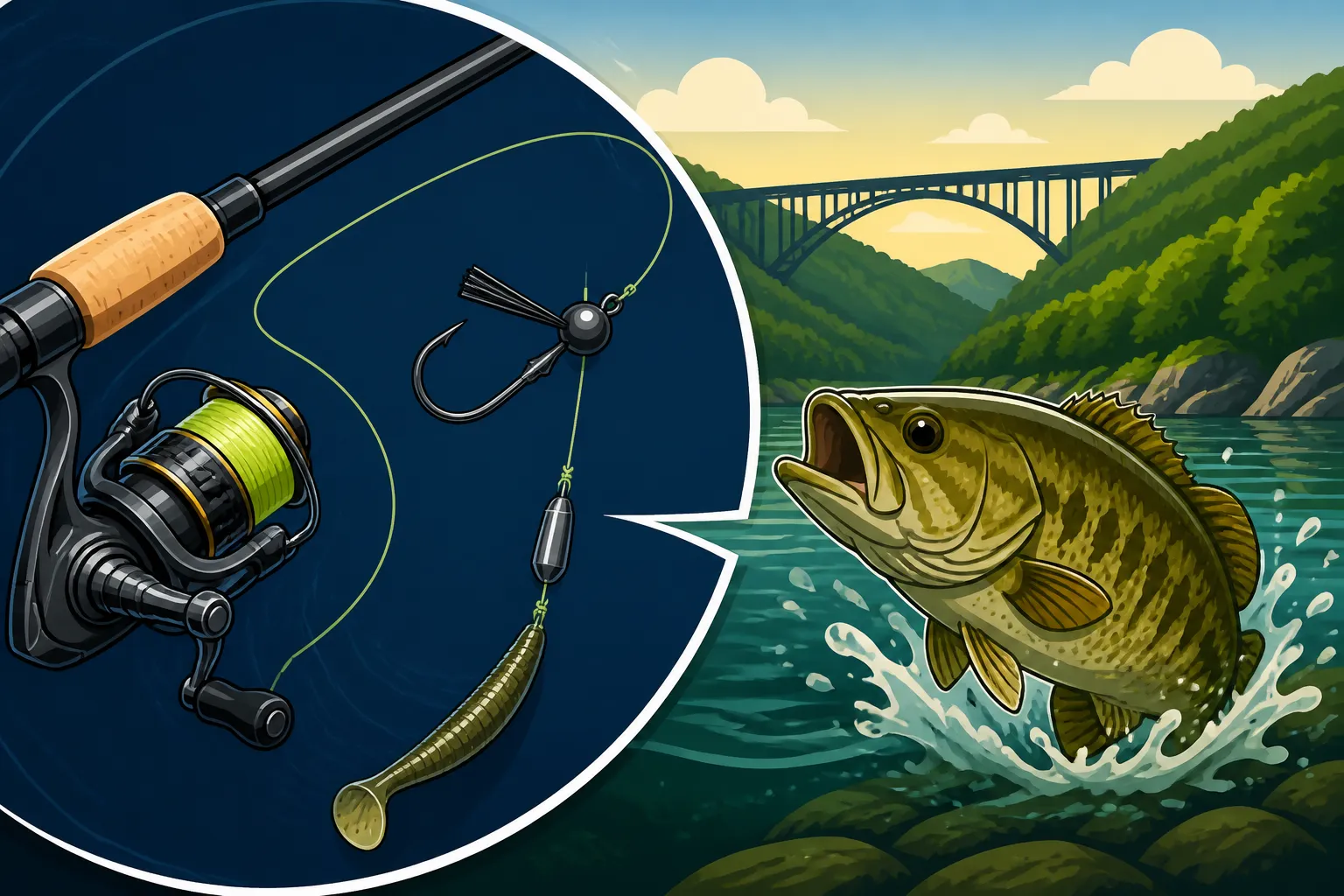
At its core, a Ned Rig consists of a small, mushroom-shaped jig head paired with an equally small, buoyant soft plastic bait, typically a short stickbait or worm. What makes it so effective, especially here in West Virginia, is how it behaves in the water. That buoyant plastic, combined with the flat head of the jig, allows the bait to stand straight up on the bottom, waving tantalizingly with the slightest current or rod twitch. It looks like a foraging baitfish, a small crawfish, or an injured minnow — basically, an easy meal that's too enticing for even the most finicky bass to ignore.
The Power of Subtlety on Pressured Fish
Think about our popular West Virginia lakes like Summersville Lake or Stonewall Jackson Lake, or even heavily fished sections of the New River. These waters see a lot of angler pressure, and fish here become wise to big, flashy presentations. That's where the Ned Rig steps in. Its diminutive size and natural action don't scream "predator!" but rather "easy snack!" This quiet approach can trigger strikes when bigger, noisier baits simply get ignored.
It's particularly effective when you're dealing with clear water conditions, which we often encounter in our mountain streams and reservoirs. In clear water, bass have a lot of time to inspect your lure, and anything that looks unnatural is often passed over. The Ned Rig's subtle profile and natural movement make it incredibly convincing, fooling even the wariest of bass. You'll find it can often unlock bites on days when a cold front has moved through, or when the water temperatures are fluctuating, making bass lethargic. Cold Front Fishing Tactics for West Virginia Bass often involves scaling down your presentation, and the Ned Rig is the king of that strategy.
Mimicking Natural Forage with Minimal Effort
The beauty of the Ned Rig lies in its ability to imitate a wide range of natural forage without complicated retrieves. Whether you're fishing a rocky point on the Ohio River, a current seam on the South Branch Potomac, or a weed line in a smaller pond, the Ned Rig's upright posture and subtle undulation can mimic whatever local delicacy the bass are feeding on. A small jig and soft plastic can look like a tiny crawfish scurrying along the bottom, a dying shad twitching erratically, or a small worm disturbed from its resting place. This versatility makes it an indispensable tool for any West Virginia angler's tackle box, allowing you to adapt to whatever the fish are keying in on, even if you're not entirely sure what that is. It really is one of the Best Tackle for West Virginia Smallmouth Bass.
Essential Components of a West Virginia Ned Rig Setup
Building the perfect Ned Rig setup isn't complicated, but choosing the right components makes a world of difference in your success. Each piece of the puzzle works together to maximize sensitivity, ensure proper bait presentation, and give you the best chance of landing those light-biting bass. This isn't a setup for heavy flipping or frogging; it's all about feeling the subtle "tick" of a bite and setting the hook gently.
The Right Rod and Reel: A Finesse Foundation
When it comes to Ned Rigging, a spinning setup is your best friend.
Rod Selection
You'll want a light to medium-light power spinning rod with a fast or extra-fast action. Why? The light power allows you to cast those super lightweight jigs and baits accurately, and it ensures the rod bends enough to give the bait its natural action without overpowering it. The fast or extra-fast action means the rod tip is very sensitive, allowing you to feel the faintest bites, yet it still has enough backbone in the mid-section to drive the hook home and fight a spirited West Virginia bass without fear of snapping your light line. A good length typically falls between 6'6" and 7'2". A shorter rod (6'6" to 6'9") is fantastic for pinpoint casts around cover, while a slightly longer rod (7'0" to 7'2") offers better casting distance and line control, especially useful when you're making longer casts from shore or covering open water. Finding a good quality, sensitive rod like this is key, and you can often find excellent options at a Bass Pro Shops, or by browsing online. For more dedicated options, check out Best Spinning Rods for Smallmouth Bass.
Reel Selection
Pair your finesse rod with a small, lightweight spinning reel in the 1000 to 2500 size range. The most important characteristics here are a smooth drag system and a lightweight feel that balances well with your rod. A smooth drag is absolutely critical when you're fighting larger fish on light line, preventing break-offs. You want a reel that feels comfortable in your hand for hours of casting and retrieving. Look for models from reputable brands that offer consistent performance.
Line Choices: The Connection to the Bite
Your fishing line is the crucial link between you and the fish, and for Ned Rigging, a specific combination works best.
Mainline: Braided Line
Start with a thin diameter braided line for your main line, typically 6 to 10 lb test. Braided line offers exceptional sensitivity, virtually no stretch, and incredible strength for its diameter. This means you'll feel every bump, scrape, and subtle bite. Its lack of stretch also helps with hook sets over longer distances. The only downside is its visibility, which is where your leader comes in.
Leader: Fluorocarbon
To combat the visibility of braided line and provide a bit of shock absorption, you'll attach a fluorocarbon leader. A 6 to 8 lb test fluorocarbon leader is ideal. Fluorocarbon is nearly invisible underwater, extremely abrasion-resistant (a must when fishing around rocks and timber in West Virginia rivers), and provides that small amount of stretch needed to prevent line snaps on a sharp hookset. Your leader length can vary, but anywhere from 3 to 10 feet is common. A good knot like an FG knot or an Albright knot is essential for connecting your braid to your fluorocarbon seamlessly. For a deeper dive into line choices, consider Best Fluorocarbon Line for Clear River Water.
Ned Rig Jig Heads: The Foundation
The jig head is what gives the Ned Rig its unique action.
Mushroom Shape is Key
Look for mushroom-shaped jig heads. The flat bottom of the mushroom head is what allows the soft plastic bait to stand upright on the bottom, mimicking a feeding or injured creature. Weights typically range from 1/16 oz to 1/8 oz for most West Virginia applications, though you might go as light as 1/20 oz in very still, shallow water or as heavy as 1/4 oz for deeper water or strong current. Experiment with weights to find what works best for the conditions you're fishing.
Hook Size and Type
Most Ned Rig jig heads come with a stout, light-wire hook designed to penetrate easily. A good quality, sharp hook is paramount. You might also find weedless versions with small wire guards, which are excellent for fishing around light cover like submerged grass or sparse wood, common in many of our impoundments.
Here's a quick comparison of common Ned Rig jig head weights:
| Jig Head Weight | Ideal Depth Range | Current Conditions | Bottom Composition | Best For |
|---|---|---|---|---|
| 1/20 oz | 0-5 feet | Still to Very Light | Soft bottom, Sand | Ultra-finesse, very shallow water, calm days |
| 1/16 oz | 2-10 feet | Light to Moderate | Sand, Gravel, Rocky | General purpose, subtle presentation |
| 1/10 oz | 5-15 feet | Moderate | Rocky, Gravel, Sparse Weeds | Versatile, good for light wind & current |
| 1/8 oz | 10-25 feet | Moderate to Strong | Rocky, Structure | Deeper water, stronger current, windy days |
| 1/4 oz | 20+ feet | Strong | Deep Ledges, Swift Rivers | Heavy current, very deep water |
Soft Plastic Baits: The Enticer
While there are many small soft plastics that can work, the original and still most popular choice is a stickbait made from ElaZtech material.
ElaZtech Advantage
Brands like Z-Man Fishing Products popularized ElaZtech, a super-stretchy, incredibly durable, and naturally buoyant plastic. The buoyancy is crucial because it helps the bait stand up off the bottom. The durability means one bait can last through dozens of fish, saving you money and time re-rigging. The classic is the Z-Man Finesse TRD, a 2.75-inch stickbait that's just irresistible.
Other Bait Options
Beyond the classic stickbait, small creature baits, finesse worms, or even tiny grub bodies can be effective on a Ned Rig. Experiment with colors that match local forage – natural greens, browns, and black/blue are always good starting points, but sometimes a brighter color like chartreuse can trigger a reaction bite. You can often find a wide variety of these specialized baits on Amazon or at local tackle shops across West Virginia.
Techniques and Tips for Fishing the Ned Rig in West Virginia
Now that your setup is dialed in, it's time to learn how to present this subtle offering to West Virginia's bass. The Ned Rig isn't a power-fishing bait; it demands a patient, delicate approach. Forget the hard rips and fast retrieves; finesse is the name of the game.
The Art of the Retrieve: Less is More
The most common mistake anglers make with a Ned Rig is working it too aggressively. The magic of this bait is its natural, upright posture on the bottom. Your goal is to impart just enough movement to make it look alive, without dragging it so fast that it falls over or skips along unnaturally.
Drag and Pause
The most fundamental retrieve is the drag and pause. Cast your Ned Rig out, let it sink to the bottom on a semi-slack line (watching for the line to jump or twitch as it falls, indicating a bite!), and then simply drag it a short distance with your rod tip, perhaps 6 inches to a foot. Then, pause. Let it sit there. This pause is often when bites occur as the bait stands up and quivers. Repeat this process, slowly covering water. Think of it like a crawfish scuttling and then freezing.
Short Hops
Another effective retrieve involves short hops. After your bait reaches the bottom, gently lift your rod tip just enough to make the jig head hop an inch or two off the bottom, then let it fall back down on a slack line. Again, pause. The key is to keep these hops minimal and controlled. This can be particularly effective when fish are slightly more active or when you're trying to clear a small piece of cover.
Dead Sticking
Sometimes, the most effective retrieve is to do almost nothing at all. Dead sticking involves casting the Ned Rig out and letting it sit on the bottom for an extended period, sometimes 10, 20, or even 30 seconds, occasionally giving it a tiny twitch. This technique is deadly in cold water, when fish are extremely lethargic, or in very clear water where bass have ample time to inspect the bait. It perfectly embodies the "easy meal" concept, requiring minimal energy expenditure from the fish. This is a crucial tactic for Best Techniques for Winter Catfish and sluggish bass.
Prime Target Areas in West Virginia
The versatility of the Ned Rig means it can be effective in a wide range of environments.
Rocky Banks and Points
Whether you're on the New River targeting smallmouth or a rocky point on Cheat Lake, these areas are prime Ned Rig territory. Bass often hold tight to rocky structure, waiting for ambush opportunities. Dragging a Ned Rig slowly over and through these rocks can trigger bites from fish that are otherwise unwilling to chase. Consider New River Smallmouth Bass Fishing where rocky ledges and current breaks are everywhere.
Current Seams
In our many rivers and streams, current seams – where fast water meets slower water – are always a hotspot. Bass use these areas to rest while still having access to food that drifts by. Cast your Ned Rig upstream of a seam and let it drift naturally into the slower water, controlling your line to keep it in the strike zone. This can be incredibly effective for smallmouth on the Elk River or the Greenbrier.
Drop-Offs and Ledges
In larger reservoirs, bass will often congregate along drop-offs, especially where a shallow flat quickly transitions to deeper water. Work your Ned Rig slowly down these ledges, paying close attention as it tumbles over the edge. These transitions are often feeding zones. This is also a good tactic to explore Stonewall Jackson Lake Fishing spots.
Sparse Weeds and Wood
While the Ned Rig isn't for punching through thick mats, it excels in areas with sparse submerged grass or scattered laydowns. The weedless jig head versions are perfect for this, allowing you to slowly crawl the bait through cover where bass might be hiding.
The Hook Set: A Gentle Sweep
Because the Ned Rig is so light and the bites are often subtle, a powerful, snapping hook set can often pull the bait right out of the fish's mouth or break your light line. Instead, when you feel that tell-tale "tick," or your line starts moving, simply lower your rod tip, reel down to take up any slack, and then perform a long, smooth sweep of your rod to the side or up. This gentle but firm pressure is usually all it takes to embed the small, sharp hook.
Troubleshooting Common Ned Rig Challenges
Even with the best intentions, every fishing technique comes with its own set of frustrations. The Ned Rig is no exception, but many of its common challenges have simple solutions that can keep you on the water and catching fish.
Dealing with Snags and Hang-Ups
Fishing bottom-bouncing baits like the Ned Rig inevitably means you'll encounter snags, especially in West Virginia's rocky rivers and timber-laden lakes. It's truly disheartening to lose a good jig head and bait to an underwater obstruction.
Choose the Right Jig Head
The primary way to combat snags is to use jig heads with weed guards. Many manufacturers offer Ned Rig specific jig heads with light wire guards that deflect off wood and rocks while still allowing for easy hook penetration when a fish bites. While not 100% snag-proof, they significantly reduce hang-ups. Another tip is to choose jig heads with an exposed hook that runs parallel to the bottom rather than directly out, as this slightly reduces the chance of snagging on vertical structures.
Adjust Your Retrieve
Often, snags happen when you drag the jig too quickly or too hard over obstacles. Slowing down your retrieve, using shorter hops, and really feeling the bottom will help. When you feel the jig bump into something, pause, shake your rod tip gently, or lift it slightly to clear the obstruction rather than pulling hard, which usually wedges it deeper. This approach applies to many types of fishing, especially when trying to How to Fish a Jerkbait for Early Spring Bass around structure.
Line Selection Matters
Using a strong braided main line with an appropriate fluorocarbon leader can actually help you free snags sometimes. The zero-stretch of braid allows you to feel the snag distinctly, and a sharp "pop" with the rod while maintaining tension can sometimes break the jig free.
Interpreting Subtle Bites
The Ned Rig is a finesse technique, and bites are often far from aggressive. You're rarely going to get your rod ripped out of your hand. This subtlety can lead to missed opportunities if you're not paying close attention.
Watch Your Line Like a Hawk
Many Ned Rig bites aren't felt, but seen. Keep a keen eye on your fishing line where it enters the water. Any twitch, jump, or subtle movement to the side, or even just the line suddenly going slack when it shouldn't, can indicate a bite. If you see anything out of the ordinary, set the hook with that gentle sweep we discussed.
Focus on Rod Tip Feel
Even with braided line, some bites will feel like nothing more than a faint "tick" or a spongy resistance on your rod tip. Hold your rod in a way that maximizes contact with the blank (e.g., forefinger on the rod blank above the reel). This tactile connection helps transmit even the weakest vibrations from the bait.
Adjust Your Weight
If you're having trouble feeling the bottom or detecting bites, consider going up one size in jig head weight, assuming current conditions allow. A slightly heavier jig will maintain better contact with the bottom and transmit vibrations more clearly.
Fishing in Windy Conditions
Wind is the bane of many finesse anglers. It creates a bow in your line, making it incredibly difficult to feel bites and control your bait.
Go Heavier
The simplest solution to wind is to increase your jig head weight. If you were using a 1/16 oz, try a 1/10 oz or even 1/8 oz. The extra weight will help your bait sink faster, maintain better bottom contact, and reduce the effect of the wind bowing your line.
Cast Downwind or Crosswind
Whenever possible, try to cast downwind or crosswind. This minimizes the amount of line exposed to the wind, reducing drag and increasing your sensitivity. If you must cast into the wind, make shorter, more precise casts.
Maintain a Tight Line
While you need to allow some slack for the bait to fall naturally, once it's on the bottom, try to keep as straight a line as possible without moving the bait too quickly. This helps you feel those light bites and maintain control. Sometimes, fishing the bank from a kayak in a crosswind can be difficult, even for Best Kayak for the New River.
Knowing When to Tie On Something Else
While the Ned Rig is fantastic, it's not always the best tool for every situation. Trying to force it in the wrong conditions can be just as frustrating as trying a power bait when finesse is needed.
Heavy Cover Situations
If you're fishing in really thick cover – dense submerged timber, heavy lily pad fields, or matted grass – the Ned Rig's light wire hook and small profile aren't designed for it. You'll get snagged constantly, and even if you hook a fish, it's tough to pull it out of heavy cover on light line. For these situations, opt for heavier gear like Texas-rigged worms, jigs, or frogging setups.
Aggressive Fish and Reaction Bites
On days when fish are actively chasing bait, busting on the surface, or hitting anything that moves, the Ned Rig might be too slow and subtle. In these scenarios, a faster, more aggressive presentation like a crankbait, spinnerbait, or topwater lure will often be more effective and cover water much more quickly. Best Crankbaits for West Virginia Smallmouth Bass are fantastic when the bite is on.
The Ned Rig is a finesse tool that shines when others fail. By understanding its strengths, knowing your gear, and refining your technique, you'll be well-equipped to tackle even the toughest fishing days across West Virginia.
Disclaimer
This article is for general informational purposes only and does not constitute professional advice. Laws, prices and regulations vary by location and change over time. Consult a qualified professional for guidance on your specific situation.