Best crankbait colors for muskie in stained water
There’s nothing quite as frustrating as heading out to your favorite West Virginia muskie water, pumped for a day of chasing the toothy critters, only to find the river or lake looking like a cup of muddy coffee. Stained water conditions can throw a serious wrench in your game plan, making you second-guess every lure choice. That's why understanding which crankbait colors truly shine when visibility is low is absolutely crucial, and this guide is here to unravel that mystery for you, helping you land more fish even when Mother Nature makes things murky.
Understanding Stained Water Conditions for Muskie
When we talk about "stained water" in West Virginia, it's not always a one-size-fits-all scenario. It can range from a light tint that slightly reduces visibility to thick, opaque murk that feels like trying to see through pea soup. These conditions profoundly affect how muskie perceive their environment and, by extension, your lures. If you've ever felt like your perfectly natural-looking bait is disappearing the second it hits the water, you're experiencing this challenge firsthand.
Knowing the specific type of stained water you're fishing in can give you a significant edge. West Virginia's diverse waterways, from the mountain rivers to larger reservoirs, can exhibit various forms of low visibility. For instance, after a heavy rain, rivers like the Kanawha or parts of the Cheat River might become heavily turbid with suspended sediment. Other times, especially in the fall, some waters develop a tannic, tea-stained hue from decaying leaves and organic matter, which, while dark, can still hold surprisingly good visibility at certain depths. Algae blooms in warmer lake coves during summer can also create a green or brownish stain that looks unappealing but is still fishable. Each of these conditions subtly alters how light penetrates the water and how colors appear to a muskie.
Different Types of Stained Water
The common perception is that "stained" simply means "dirty," but it's a bit more nuanced than that, especially when muskie fishing in our beautiful Mountain State. Recognizing the specific type of stain can really fine-tune your approach.
For example, many of our pristine mountain streams and even larger rivers can develop a distinct tea-colored stain. This is often due to tannins leaching from decaying leaves and organic matter, particularly in areas like parts of the Blackwater River or smaller tributaries. While it looks dark to our eyes, this tannic stain often allows a surprising amount of light penetration, and the water typically remains quite clear, just tinted. Fish in these waters are accustomed to it, and while they might not see vibrant colors from afar, silhouettes and subtle flashes can still be effective. It’s a different ballgame than true muddy water.
Then there's the classic "muddy" or "turbid" water, which we often see after heavy rainfall. Think of the lower sections of the New River after a significant storm, or many of our larger feeder creeks flowing into lakes like Summersville. Here, fine sediment particles are suspended throughout the water column, drastically reducing light penetration and overall visibility. In these conditions, fish rely much more on their lateral line system to detect vibrations rather than sight. The challenge isn't just that the water is dark; it's that it's optically dense, making even bright colors fade quickly. This is where high-contrast and very bright, unnatural colors often shine.
How Muskie Perceive Lures in Low Visibility
It's a common misconception that muskie are purely sight feeders, especially when the water clarity drops. While their vision is excellent in clear conditions, these apex predators have evolved incredible sensory systems to hunt in all sorts of environments, including stained water. Their lateral line system is a marvel, allowing them to detect subtle vibrations and pressure changes in the water. This means a crankbait's wobble and the sound of its rattles can be just as important, if not more so, than its color when visibility is compromised.
However, sight isn't completely out of the picture. Even in heavily stained water, a muskie can still see a lure, albeit at a much closer range. Think of it like looking through fog – you can still see objects, but their details are obscured, and you need to be much closer to identify them. In this scenario, what becomes paramount is the lure's silhouette, its contrast against the background light, and any luminescence or glow it might emit. A dark lure creates a strong, distinct profile against a brighter sky, while a bright, fluorescent lure might actually glow or "pop" when limited light penetrates the water. So, while vibration draws them in, color and contrast often seal the deal at the final attack.
Top Crankbait Colors for West Virginia's Stained Muskie Waters
When you're faced with stained water in places like the Little Kanawha River or specific sections of Tygart Lake, choosing the right crankbait color isn't about perfectly mimicking forage. Instead, it's often about contrast and visibility. You want a color that either stands out boldly or creates a distinct silhouette, making it easier for a muskie to zero in on.
Over the years, anglers have discovered a few consistent winners when the water clarity takes a dive. These aren't just random choices; they're colors that work because of how light interacts with stained water and how muskie eyes are designed to pick up on movement and contrast. It's a blend of science and countless hours spent on the water, figuring out what makes those elusive fish strike.
Chartreuse and Bright Yellows
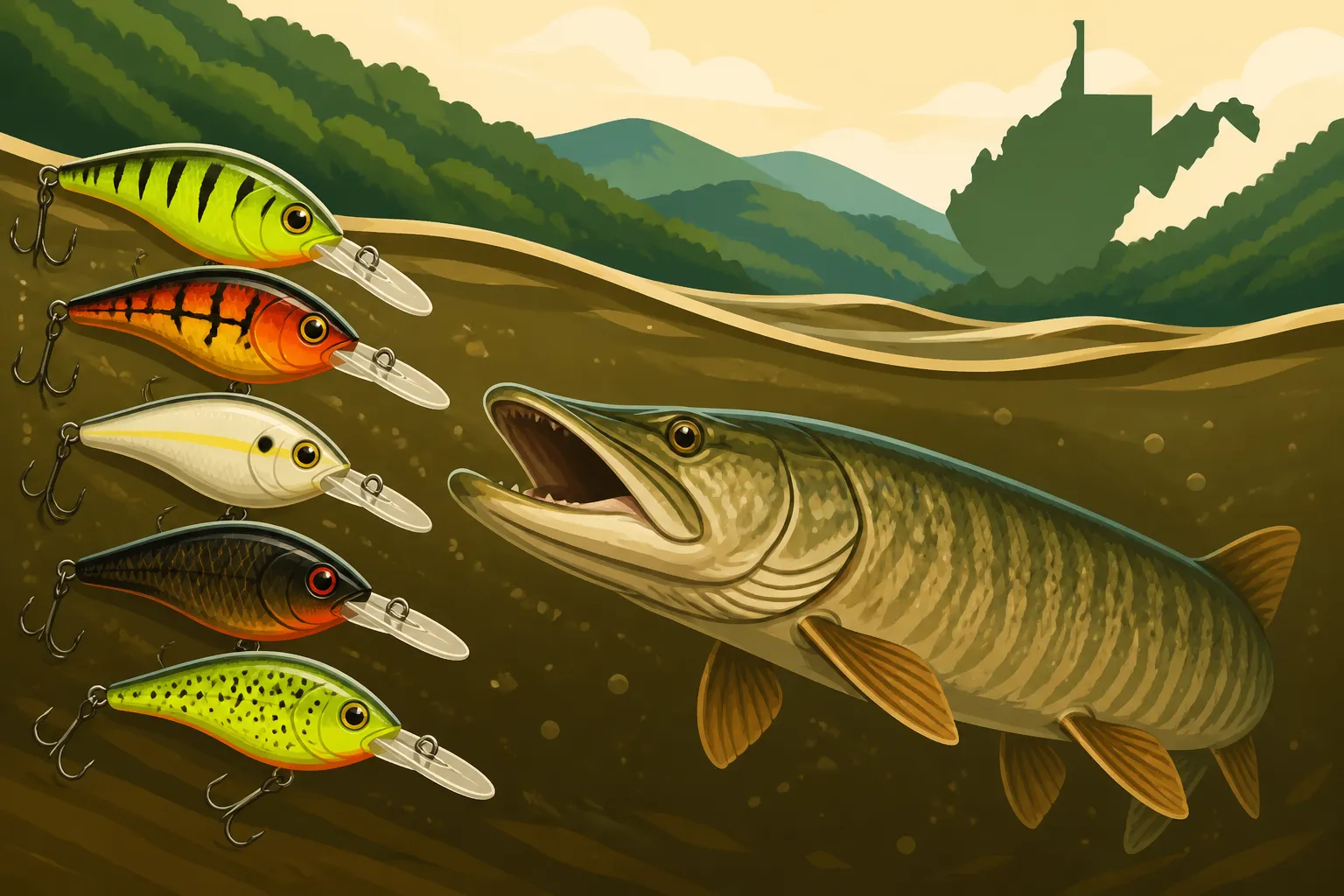
If there's one color family that consistently produces in stained water, it's the chartreuse and bright yellows. These colors have a remarkable ability to stand out, even when the water is murky. They reflect the ambient light, making them appear almost luminous, which can be irresistible to muskie struggling to locate prey. When you're fishing a heavily overcast day on a tannin-stained section of the Gauley River, for instance, a chartreuse crankbait can be the only thing that gives the muskie a clear target.
These vibrant hues are especially effective in very dark, turbid water where natural patterns simply disappear. Think of a scenario after a significant rain event, where the water is heavily laden with sediment. A bright chartreuse or yellow crankbait cuts through that murk like a beacon, providing a strong visual cue that triggers strikes. Many anglers swear by brighter patterns, like those from Musky Mania or Drifter Tackle, often found on Amazon – they tend to be reliable choices for these conditions. It's not about looking natural; it's about being seen, plain and simple.
Fluorescent Orange and Fire Tiger
Another powerhouse in the stained water arsenal is fluorescent orange, often coupled with black stripes in what's known as the "Fire Tiger" pattern. These colors offer incredible contrast and visibility. Orange, particularly fluorescent orange, carries well through murky water and creates a strong visual signature. The Fire Tiger pattern, with its mix of bright green, yellow, orange, and black stripes, creates a jarring, high-contrast display that can effectively attract a muskie's attention from a distance.
When the water is moderately stained, say, a brownish tint after a lighter rain or during periods of higher flow, these colors can be exceptionally potent. They don't just stand out; they also evoke an aggressive response, especially from fish that might be ambushing prey in lower visibility. Imagine working a Fire Tiger crankbait through a snag-filled cove in Bluestone Lake during moderate stain – the vibrant stripes and strong profile can trigger a reactionary strike from a muskie tucked tight to cover. These patterns often mimic certain distress colors or even the brighter hues of some local baitfish, making them a compelling option for aggressive muskie.
Black and Dark Silhouettes
This might seem counter-intuitive after all the talk about bright colors, but black and other very dark crankbaits are incredibly effective in stained water, especially on bright, sunny days. The magic lies in the silhouette they create. When viewed from below against a brighter sky, a dark lure creates a stark, unambiguous profile. It doesn't rely on reflecting light; instead, it absorbs it, creating a clear, bold shape that a muskie can easily detect.
Consider fishing a dark, coffee-colored section of the Greenbrier River on a cloudless afternoon. A jet-black crankbait, slowly retrieved, will appear as a distinct, moving shadow to a muskie looking up. This is a subtle yet powerful presentation. Often, muskie don't need to see intricate details; they just need to identify a moving object of potential prey. A strong, dark silhouette provides exactly that. This technique is also fantastic during low-light conditions, like dusk or dawn, or even Night Fishing for Muskie in West Virginia where ambient light is minimal. The key is to create the clearest possible outline for the muskie to track.
Perch and Shad Patterns with a Twist
While ultra-bright and dark colors are often the go-to in stained water, you don't have to abandon natural forage patterns entirely. Sometimes, it's about adapting them. Perch and shad patterns are staples in the muskie world because they accurately mimic common baitfish in many West Virginia waters. However, in stained conditions, a standard, muted perch pattern might get lost in the murk.
The "twist" comes in choosing perch or shad patterns that incorporate brighter, more fluorescent accents, or ones with very strong, dark outlines. For example, a perch pattern that has bright orange or chartreuse highlights, or a shad pattern with a prominent black back and reflective sides, can still offer that crucial contrast while maintaining a semblance of natural forage. Some crankbaits, especially those with iridescent or UV finishes, can also add a subtle flash even in low light, making a "natural" pattern stand out more effectively. It’s about giving the muskie something familiar, but making sure they can actually see it at the moment of truth.
Factors Beyond Color in Stained Water Muskie Fishing
While color plays a huge role in getting a muskie's attention in murky water, it’s only one piece of the puzzle. These fish are finely tuned predators, and in conditions where their primary sense of sight is hampered, their other senses become paramount. Focusing solely on color without considering other factors can lead to missed opportunities. Truly effective muskie anglers understand that the entire presentation – from the lure's action to its size and even the retrieve – must work in concert to elicit a strike. It’s about building a compelling argument for the muskie to bite, one that appeals to more than just their eyes.
Vibration and Sound
When muskie can't rely heavily on their eyesight in stained water, their lateral line system becomes their primary tool for hunting. This sensory organ allows them to detect vibrations and pressure changes in the water, essentially "feeling" prey moving nearby. This is why crankbaits with a strong, distinct wobble and internal rattles are absolute game-changers in murky conditions. The louder and more erratic the vibration, the better the chance a muskie has of locating your lure.
Many crankbaits are specifically designed with chambers that house small BBs or other metal objects, creating a rattling sound as the lure moves through the water. Couple this with a wide, aggressive wobble, and you have a lure that screams "I'm here!" through the murk. Consider fishing spots known for holding muskie, even in stained conditions, like certain bends in the Elk River or deeper channels of Stonewall Jackson Lake. A noisy, vibrating crankbait can draw fish out of cover or trigger a reaction strike from a fish that might otherwise ignore a subtle presentation. These lures help muskie pinpoint their target long before they can see it clearly, making that final visual confirmation much easier.
Size and Profile
In stained water, bigger often means better when it comes to lure size and profile. The logic is simple: a larger object is easier to detect visually, even when visibility is limited, and it also displaces more water, creating a stronger vibration for the muskie's lateral line to pick up. A massive crankbait with a significant profile, like a magnum sized diver, presents a more substantial target that simply won't get lost in the murk as easily as a smaller bait.
Muskie are opportunistic feeders, and they're not afraid to tackle a large meal. In low visibility, their prey might be harder to find, so when they do detect something sizable, they're often more willing to commit. Think about a muskie lurking in the current of the New River. If the water is off-color, a substantial lure creates a much clearer "blip" on their sensory radar. So, don't be shy about upsizing your crankbaits when the water is stained. It helps the fish to not only see it but to feel it from a greater distance, making your presentation more effective overall.
Retrieve Speed and Depth
Adjusting your retrieve speed and depth is another critical factor when fishing crankbaits for muskie in stained water. The general rule of thumb is to slow down. If a muskie's visibility is reduced, they need more time to locate, track, and ultimately commit to your lure. A lightning-fast retrieve might simply outpace their ability to react effectively in murky conditions. A slower, more deliberate retrieve allows the muskie more opportunities to pick up on the lure's vibration and get into a striking position.
Furthermore, fishing your crankbait closer to known muskie holding areas, such as submerged timber, rock piles, or current seams, becomes even more important. In stained water, muskie often hold tighter to cover, waiting to ambush unsuspecting prey. By presenting your lure slowly and precisely through these zones, you increase the chances of it passing directly in front of a hidden muskie, giving them the best possible opportunity to strike. This is often where anglers practicing Best Techniques for Fall Muskie Fishing find success, even as water clarity drops with autumn rains.
The Power of Flash and UV
While strictly not a "color" in the traditional sense, incorporating flash and UV elements into your crankbait selection can significantly enhance visibility in stained water. Many crankbaits come equipped with reflective components like holographic foils, glitter, or polished metal blades that, even with minimal light penetration, can catch and reflect what light is available. This sudden burst of reflected light can be a powerful attractant, mimicking the flash of a fleeing baitfish.
UV (ultraviolet) active lures are also gaining popularity. Unlike conventional colors that rely on visible light, UV-reactive pigments absorb ultraviolet light (which penetrates water better than visible light) and then re-emit it as visible light, making the lure "glow" more intensely than its surroundings. This subtle luminescence can make a huge difference in low-light, stained water conditions, essentially making the lure pop to a muskie's eye in ways traditional colors cannot. Many top muskie brands offer UV-enhanced options, especially for their perch or shad patterns, offering that extra edge when the water is less than clear.
Practical Tips for Choosing and Presenting Crankbaits
Navigating stained water for muskie isn't just about picking a color and casting. It's an art that combines observation, adaptation, and a willingness to experiment. The conditions in West Virginia's rivers and lakes can change rapidly, and what worked last week might not work today. This means staying flexible, reading the environment, and always being prepared to switch tactics. It's easy to get stuck in a rut with your favorite lure, but stained water demands a more dynamic approach.
Experimentation is Key
No matter how much advice you get, the absolute best way to figure out what works in a particular stained water scenario is to experiment. Muskie can be finicky, and what excites them one day might be ignored the next. Don't be afraid to cycle through different crankbait colors until you start getting some follows or strikes. Start with the high-contrast, confidence-boosting colors like chartreuse or Fire Tiger, and if those aren't producing, try switching to a dark silhouette. Even subtle changes in hue within the same color family can sometimes make a difference.
Keep a mental note, or even a literal log, of what colors worked in what specific stained conditions (e.g., "heavy rain mud," "tannic stain," "algae bloom"). This data will build your personal knowledge base for your local waters, like the Kanawha or the Tygart. Remember, every day on the water is a learning opportunity, and the muskie will tell you what they prefer if you pay attention to their responses, or lack thereof.
Reading the Water
Becoming a proficient muskie angler in stained water means learning to "read" the water. This isn't just about looking at the color; it's about assessing the level of stain and understanding its potential causes. Is it a light tint from runoff, or a dense, coffee-like mud? Is it consistent throughout the entire body of water, or are there clearer pockets you can target?
For example, if you're on a larger river system after a significant rain, you might find clearer water near feeder creeks that weren't as impacted, or where eddies allow sediment to settle. Conversely, a river like the New River Gorge Fishing Guide might have areas that stay clearer due to bedrock bottoms, even when other parts are murky. Adjust your color choices based on this assessment. Lighter stains might still allow for more nuanced, but still bright or high-contrast, patterns, while truly opaque conditions demand the most extreme visibility colors. This constant evaluation and adaptation are what separate consistent anglers from those who struggle when conditions aren't ideal.
Seasonal Adjustments
The time of year also plays a significant role in how muskie react to lures in stained water. Their metabolism, aggression levels, and preferred holding areas change with water temperature and forage availability, and this directly impacts how they'll respond to your crankbaits. For instance, in colder water conditions, such as early spring or late fall, muskie are often less active and their strikes can be more lethargic. In these scenarios, a slower presentation with a dark, high-contrast lure might be more effective, giving them ample time to react without expending too much energy.
Conversely, in warmer summer months, muskie are typically more active and aggressive. Even in stained water, they might be more willing to chase down a faster-moving, brighter lure. Consider the difference in muskie behavior during the peak of summer compared to the crisp days of November, which are prime for Best Techniques for Fall Muskie Fishing. The water temperature affects their vision, their lateral line sensitivity, and their overall hunting strategy. Keeping these seasonal shifts in mind will help you fine-tune your crankbait color and retrieve for maximum effectiveness, even when the water isn't perfectly clear. This knowledge is part of becoming a well-rounded angler for Muskie Fishing in West Virginia.
Here's a quick guide to help you choose:
| Water Clarity Level | Recommended Crankbait Colors | Why They Work | Key Considerations |
|---|---|---|---|
| Lightly Stained | Chartreuse, Fire Tiger, Perch (with bright accents), Orange | Good light penetration, colors pop without being overwhelming. | Muskie can still discern some detail; focus on high contrast. |
| Moderately Stained | Fluorescent Orange, Chartreuse, Fire Tiger, Dark Black | Excellent visibility, strong silhouette, triggers reactionary strikes. | Vibration becomes more important. Strong wobbles and rattles are key. |
| Heavily Stained/Muddy | Bright Chartreuse, Fluorescent Yellow, Solid Black, White | Maximum visibility/contrast, creates clear silhouette against brighter background. | Prioritize vibration, size, and a slow, deliberate retrieve. |
| Tannic/Tea-Stained | Dark Perch, Black, Orange, Chartreuse | Maintains natural feel (darker hues), but brighter colors provide contrast. | Water often clearer than it appears; focus on defined profiles. |
Remember, while these are excellent starting points, nothing beats personal experience on your specific body of water. Keep an eye on the water conditions, adjust your approach, and you'll be well on your way to catching more muskie in West Virginia's stained waters. And don't forget to check out articles like Best Lures for Muskie Fishing in West Virginia for more gear ideas. If you're wondering about the legal side, you can find details on Muskie Regulations in West Virginia Waters. For the right setup, consider guides on Best Line Weight for Muskie Fishing and Best Leader for Pike and Muskie Fishing.
Disclaimer
The information provided in this article is for general guidance and informational purposes only. Fishing regulations, conditions, and fish behavior can change. Always consult the latest West Virginia Division of Natural Resources (WVDNR) regulations before heading out. Fishing involves inherent risks; always prioritize safety on the water.