Best kayak cart for portaging around rapids
There's nothing quite like the thrill of chasing fish in West Virginia's wild and wonderful rivers, but anyone who's tried to access those prime, secluded spots knows the struggle of the portage. Dragging a fully loaded kayak across rocky riverbanks, muddy trails, or around formidable rapids is not only exhausting but can feel like you're wrestling an alligator, all while risking damage to your precious vessel. This guide is all about making those treks easier, faster, and much kinder to your back and your kayak, showing you how to pick the best kayak cart for portaging around rapids so you can spend less time struggling and more time fishing.
Why a Kayak Cart is Essential for West Virginia River Anglers
Let's be honest, those stunning, untouched fishing holes in West Virginia aren't always conveniently located next to a paved parking lot and a smooth boat ramp. Sometimes, the best spots are upstream of a tricky set of rapids, around a dam, or simply down a winding, unmaintained trail that demands a bit of effort. That's where a good kayak cart becomes less of a luxury and more of an absolute necessity for the serious angler.
The Reality of River Access in the Mountain State
Think about places like the New River Gorge, where world-class smallmouth bass fishing thrives, or some of the more remote sections of the Cheat or Gauley Rivers. Often, getting to these honey holes means traversing some seriously rugged terrain. You might have to navigate over exposed roots, sharp rocks, patches of mud, or steep inclines and declines just to get from your vehicle to the water, or to bypass an unrunnable section of whitewater. Trying to shoulder a 60-pound kayak, plus all your gear – rods, tackle box, cooler, safety equipment, and perhaps even a Best Landing Net for Muskie – is a recipe for exhaustion and frustration before you even cast a line.
Without a cart, you're either risking back injury, enlisting a friend to carry one end (which isn't always feasible), or worse, attempting to drag your kayak, scraping up the hull and compromising its longevity. This isn't just about convenience; it's about smart angling and preserving your equipment. Investing in a quality cart truly changes the game for accessing West Virginia's more challenging but rewarding fishing locations.
Protecting Your Investment (and Your Back!)
Your kayak is a significant investment, whether it's a sleek fishing machine designed for stability or a nimble river runner. Repeatedly dragging it across abrasive surfaces like gravel, asphalt, or sharp rocks will inevitably lead to scratches, gouges, and structural wear. These aren't just cosmetic issues; they can weaken the hull, potentially leading to leaks over time and reducing the lifespan of your boat. A kayak cart elevates your boat off the ground, shielding it from this kind of abuse.
Beyond protecting your kayak, consider your own body. Hauling heavy gear and a kayak over uneven ground puts immense strain on your back, shoulders, and knees. Many a great fishing day has been cut short by an angler pulling a muscle or simply being too worn out to enjoy the actual fishing. A good cart takes the brunt of that weight, allowing you to roll your kayak and gear with relative ease, conserving your energy for the fight with a trophy fish. It's about working smarter, not harder, especially when you're headed to fish spots like those detailed in the New River Gorge Fishing Guide where access can be rugged.
Maximizing Your Fishing Time
Let's face it: if getting to your chosen fishing spot is an epic struggle, you might find yourself choosing easier-to-access, but perhaps less productive, locations. The hassle of portaging can deter you from exploring new waters or revisiting those challenging spots that hold the biggest fish. With a reliable kayak cart, the "hassle factor" is drastically reduced. You can spend less time and energy on the arduous task of transportation and more time actually doing what you came for: fishing.
Imagine the freedom of confidently planning a trip to a remote section of river, knowing that getting there won't drain your energy reserves. This efficiency means you can arrive at the water feeling fresh, ready to rig up your Best Tackle for West Virginia Smallmouth Bass, and focus on the fishing instead of recovering from the hike. It opens up a whole new world of angling opportunities, letting you truly explore the "wild and wonderful" aspects of West Virginia's fishing landscape.
Key Features to Look for in a Kayak Cart for Rapids
When you're trying to portage around rapids or over rough West Virginia terrain, a generic cart just won't cut it. You need something robust, reliable, and purpose-built for the challenges you'll encounter. Here are the critical features to prioritize when choosing your kayak cart.
Wheel Type and Terrain Capability
This is, without a doubt, the most important consideration for a kayak cart destined for West Virginia's rivers. You won't always be on a smooth, paved path. Expect gravel, mud, roots, sharp rocks, and potentially slippery banks.
- Pneumatic (Air-Filled) Wheels: These are often the best all-around choice for varied terrain. They offer excellent shock absorption, which is crucial when rolling over uneven ground, helping to protect both your kayak and the cart itself. Larger diameter pneumatic wheels are especially good for navigating obstacles like roots and larger rocks. Just like your bike tires, they require occasional inflation and can get flats, but many heavy-duty models are quite robust. Look for durable, knobby treads if you expect a lot of mud or loose gravel. Many good options can be found on online retailers like Amazon, offering a wide range of sizes and tread patterns.
- Solid/Hard Rubber Wheels: These are puncture-proof and maintenance-free, which sounds appealing. However, they offer little to no shock absorption, making for a bumpy ride on rocky trails. They tend to perform best on smoother, harder surfaces like paved paths or packed gravel. For truly rough, rocky portages around rapids, they might struggle and transmit a lot of jarring force to your kayak.
- Balloon Wheels: While fantastic for soft sand (think beach launches), balloon wheels aren't typically ideal for the sharp rocks and roots you'll encounter around West Virginia's river rapids. They are designed to float over soft surfaces by distributing weight widely, but on hard, uneven ground, they can be cumbersome and less effective than sturdy pneumatic wheels.
For the unpredictable and often rugged conditions of West Virginia rivers, prioritizing large, heavy-duty pneumatic wheels with good tread is generally your best bet.
Frame Construction and Durability
The frame is the backbone of your kayak cart, and it needs to stand up to abuse. You're going to be putting stress on it, especially when navigating inclines, declines, and uneven surfaces with a heavy boat.
- Material: Most quality kayak carts are made from either marine-grade aluminum or stainless steel. Aluminum is lighter and highly corrosion-resistant, which is fantastic for constantly wet environments. Stainless steel is incredibly strong but heavier and can still rust if not properly maintained, especially in saltwater (though less of a concern for freshwater West Virginia). For ultimate durability with a good balance of weight, a high-quality anodized aluminum frame is often preferred.
- Weight Capacity: Always check the cart's maximum weight capacity and compare it to the weight of your fully loaded kayak. Remember, that's the kayak's weight plus all your gear, tackle, cooler, and anything else you're hauling. Overloading a cart is a sure way to bend or break the frame and can void warranties.
- Corrosion Resistance: Given that you'll be around water constantly, and sometimes even putting the cart in the water during launch or retrieval, ensuring excellent corrosion resistance is key. Look for stainless steel hardware, aluminum frames, and robust finishes.
When you're shopping at places like Bass Pro Shops, pay close attention to how sturdy the joints look and feel. A well-built frame will feature strong welds or thick-gauge tubing that won't flex under load.
Securing Your Kayak
Once your kayak is on the cart, it needs to stay there securely, especially when you're traversing uneven or sloped ground. The last thing you want is your kayak tumbling off mid-portage.
- Cradles/Pads: Look for wide, padded cradles or bunks that distribute the kayak's weight evenly and prevent it from sliding or being scratched. These padded surfaces also help to absorb some minor shocks from the trail.
- Straps: High-quality, cam-buckle straps are essential. They should be long enough to comfortably wrap around your kayak and the cart frame, and robust enough to hold everything in place without stretching or slipping. Some carts integrate the straps directly into the design, which can be very convenient. Avoid bungee cords for primary security; they offer too much flex and can allow your kayak to shift.
- Kickstand: A reliable kickstand is a small but mighty feature. It allows the cart to stand upright and stable while you're loading or unloading your kayak, preventing frustrating tip-overs and making the process much smoother. This is invaluable when you're solo and trying to manage a heavy kayak.
A good cart will make loading and securing your kayak feel less like a wrestling match and more like a routine task, letting you focus on the journey to your next great fishing spot, like those in the Best Fishing Lakes in West Virginia.
Portability and Storage
After your portage is complete, what do you do with the cart? You certainly don't want it taking up valuable space in your kayak, especially if you're navigating currents or need room for your gear.
- Foldability/Disassembly: Many high-quality kayak carts are designed to fold flat or quickly disassemble into smaller components. This is a huge advantage, allowing you to stash the cart in a dry bag, a small hatch, or even beneath a bungee on your kayak's deck.
- Compact Size: Consider the internal dimensions of your kayak's hatches or the space available on your deck. You'll want a cart that breaks down to a manageable size, so it doesn't become another cumbersome item to transport in your kayak.
- Weight: While durability is key, you don't want an overly heavy cart that adds unnecessary weight to your kayak when it's stowed. Lightweight but strong materials like aluminum hit a good balance.
The ideal cart will be there when you need it for the portage but will disappear discreetly once you're on the water, allowing you to enjoy your Best Kayak for Lake Fishing in West Virginia or river adventure without clutter.
Types of Kayak Carts Best Suited for West Virginia's Rivers
Choosing the right type of kayak cart depends heavily on your specific kayak, the kind of portages you anticipate, and your personal preferences. For West Virginia's diverse waterways, anglers typically lean towards certain designs that offer versatility and resilience.
Cradle Carts vs. Scupper Carts
These are the two primary designs you'll encounter, and each has its pros and cons, especially for various kayak types.
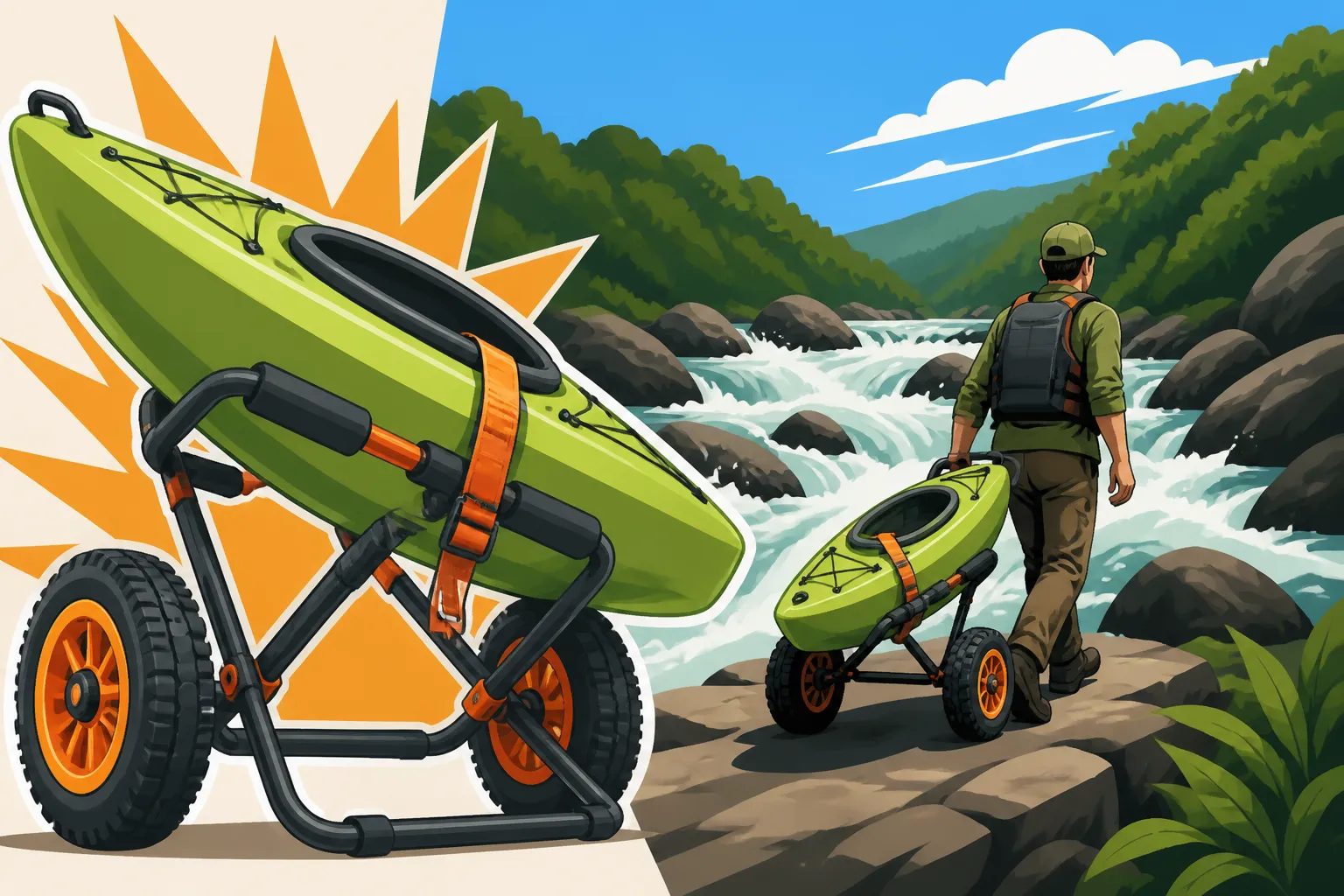
- Cradle Carts (or Strap Carts): These carts feature a U-shaped or V-shaped cradle where your kayak rests, secured by straps. They are the most versatile type, suitable for almost any kayak, whether it's a sit-inside, a sit-on-top, or even some canoes. The weight of the kayak is distributed along a broader area of the hull, which is generally better for structural integrity, reducing stress points. For anglers with heavily loaded kayaks or those made of thinner plastic, a cradle cart is usually the safest bet to avoid hull deformation. Many models are designed to be quite sturdy, making them excellent for the rough portages often found accessing places like the Elk River Trout Fishing spots.
- Pros: Highly versatile, distributes weight well, suitable for all kayak types, generally more robust for heavy loads.
- Cons: Can sometimes be bulkier to store; requires careful strap tightening.
- Scupper Carts: Designed specifically for sit-on-top kayaks, these carts feature two posts that insert directly into the scupper holes in the kayak's hull. They are incredibly quick and easy to attach and detach, which can be a huge advantage when you're trying to get on and off the water quickly.
- Pros: Very quick to set up, highly compact (posts usually detach from wheels), secure fit for compatible kayaks.
- Cons: Only works with sit-on-top kayaks with appropriately spaced scupper holes; can stress or damage scupper holes if the kayak is overloaded, the cart is poorly designed, or the terrain is too rough. This is especially true for heavier fishing kayaks or those carrying a lot of gear. For rugged portages over sharp rocks or steep inclines common in West Virginia, the concentrated stress on scupper holes can be a real concern. Always check your kayak manufacturer's recommendation for scupper cart use. You can find a range of both types on sites like Amazon, often with user reviews that highlight their performance on different terrains.
Heavy-Duty All-Terrain Carts
When you know your portages will be gnarly – steep, rocky, muddy, and long – you'll want to invest in a heavy-duty all-terrain cart. These are the workhorses built to tackle the absolute worst conditions that West Virginia can throw at them.
- Construction: These carts typically feature oversized, rugged pneumatic tires (often 10-12 inches or more in diameter) with aggressive treads, designed to roll over obstacles rather than getting bogged down. The frames are made from thick-gauge marine-grade aluminum or stainless steel, with reinforced axles and robust welds to handle heavier loads and impacts.
- Stability: They often have wider wheelbases for enhanced stability, which is critical when navigating side-slopes or very uneven ground. Many come with integrated kickstands that are equally robust.
- Purpose: These carts are for the serious angler who isn't afraid to go off the beaten path to find trophy fish. They might be a bit heavier or bulkier than minimalist options, but their ability to effortlessly conquer challenging terrain makes the trade-off well worth it. If you're planning on extended trips where you might be portaging your kayak and gear for a significant distance to fish Best Muskie Waters in West Virginia, this is the type of cart that will save your sanity and your back. Specialty outdoor retailers like Bass Pro Shops will often have a selection of these more premium, robust models.
Lightweight, Packable Options
On the other end of the spectrum are the lightweight, minimalist, and highly packable kayak carts. These are ideal for situations where storage space in your kayak is extremely limited, or when your portages are generally shorter and less extreme, perhaps just getting you across a paved road to another launch, or around a small set of rapids.
- Design: These carts typically feature smaller-diameter solid or semi-pneumatic wheels and a simpler frame design that breaks down very quickly and compactly. Some even feature detachable wheels that can be stowed inside your kayak's hull.
- Trade-offs: While incredibly convenient for storage, they usually come with trade-offs in terms of weight capacity and all-terrain performance. They might struggle more with soft sand, deep mud, or larger rocks. The smaller wheels can get hung up more easily, and the lighter frames may not withstand heavy loads or significant abuse over time.
- Best Use: If you're primarily fishing lakes or slower rivers with relatively easy access points, or if you're using a very lightweight recreational kayak and only need to traverse short, relatively smooth distances, these carts can be perfect. They are great for quick hops or when you're simply trying to move your kayak from your vehicle to the water's edge without dragging it, but perhaps not for serious, long-distance portages around major rapids. For scenarios like quickly getting your kayak from the car to the water for Summersville Lake Bass Fishing, a compact, lightweight cart can be a real time-saver.
| Cart Type | Best For | Pros | Cons |
|---|---|---|---|
| Cradle/Strap Cart | All kayak types, heavy loads, rugged terrain | Versatile, good weight distribution, robust | Can be bulkier, requires careful strapping |
| Scupper Cart | Sit-on-top kayaks with compatible scuppers | Quick setup, compact when disassembled | Limited to SOT kayaks, can stress scuppers, less versatile |
| Heavy-Duty All-Terrain | Very rough, long portages, heavy loads | Superior terrain capability, maximum durability | Heavier, less compact, higher cost |
| Lightweight/Packable | Short, easy portages, limited storage space | Highly portable, compact, often more affordable | Less durable, struggles on rough terrain, lower weight capacity |
Tips for Using Your Kayak Cart Effectively
Having the best kayak cart is only half the battle; knowing how to use it efficiently can make all the difference in your portaging experience. A few smart practices can extend the life of your cart and kayak, and most importantly, conserve your energy for fishing.
Proper Loading and Balance
It might seem obvious, but how you load your kayak onto the cart has a huge impact on stability and ease of movement.
- Center of Gravity: The key is to position the cart so that the kayak's center of gravity is directly over the axle. This means most of the weight is on the wheels, and only a small amount of weight is on the end you'll be lifting to pull or push. If the cart is too far forward, you'll be lifting too much weight; too far back, and the front will lift, making it unstable. Experiment a bit to find that sweet spot for your specific kayak and gear load.
- Even Distribution: Distribute your internal gear as evenly as possible. If you have a heavy cooler or tackle box, try to place it close to the center of the kayak and low down. This prevents the kayak from wanting to tip or list to one side as you move.
- Secure All Gear: Before you start rolling, double-check that all hatches are sealed, and any gear on deck (like your fishing rods or a Best Tackle Bag for Bank Fishing) is firmly secured. A sudden bump could dislodge loose items, creating extra work or even losing valuable equipment.
Taking an extra minute to load and balance properly will save you headaches and exertion down the trail.
Navigating Tricky Terrain
West Virginia's riverbanks are rarely flat and smooth. You'll encounter obstacles that require a bit of technique to overcome.
- Rocks and Roots: For large rocks or stubborn roots, don't try to power directly over them if you can avoid it. Often, a slight angle will help the wheels roll up and over more smoothly. If an obstacle is too large, you might need to lift and shift the kayak a few inches to clear it, rather than risk damaging the cart or kayak. Keep your steps measured and deliberate.
- Mud and Soft Ground: This is where those large, pneumatic wheels really shine. If you hit a patch of soft mud, maintain momentum if possible. If you get bogged down, try to lift the front of the kayak slightly to shift weight off the stuck wheels and then pull or push with steady force. Avoid sharp turns in mud, as this can dig the wheels in deeper. For extremely soft areas, consider if there's an alternative, firmer path, even if it's slightly longer.
- Inclines and Declines: When going uphill, it's often easier to pull the kayak from the front. Lean into it, using your body weight to keep momentum. Going downhill, it's usually safer to position yourself at the back of the kayak, guiding it down slowly and using your body to control its speed. On steep sections, keep a firm grip and be ready to brace against any sudden shifts. Always watch your footing, as a slip could send both you and your kayak tumbling.
Practice makes perfect! The more you use your cart, the more intuitive navigating different terrains will become.
Maintenance for Longevity
Like any piece of outdoor gear, your kayak cart will last much longer and perform better with a little TLC. Given its exposure to dirt, mud, and water, regular maintenance is crucial.
- Rinse After Use: After every trip, especially if you've been in muddy or sandy conditions, give your cart a good rinse with fresh water. Pay special attention to the axle, wheel hubs, and any folding mechanisms. This removes abrasive particles that can cause wear and helps prevent corrosion.
- Lubricate Moving Parts: Periodically apply a marine-grade lubricant or silicone spray to any moving parts, such as folding hinges or wheel axles. This keeps things running smoothly and provides an extra layer of protection against rust and corrosion.
- Check Tires (Pneumatic): If your cart has pneumatic tires, regularly check the tire pressure. Proper inflation ensures optimal performance and reduces the risk of flats. Carry a small hand pump with you if you're heading to remote areas. Also, inspect the tires for any signs of wear, cracks, or embedded sharp objects that could lead to a puncture.
- Inspect Straps and Frame: Before each use, quickly inspect the straps for frays or damage and the frame for any bends, cracks, or loose hardware. Addressing small issues proactively can prevent bigger problems down the line.
A well-maintained kayak cart will be a reliable partner on countless West Virginia fishing adventures, allowing you to focus on the Best Time of Year to Fish in West Virginia rather than fighting with your gear.
Disclaimer
This article is for general informational purposes only and does not constitute professional advice. Laws, prices and regulations vary by location and change over time. Consult a qualified professional for guidance on your specific situation.