How to locate crappie in West Virginia reservoirs
Trying to find crappie in West Virginia's vast reservoirs can sometimes feel like searching for a needle in a haystack, especially when they aren't shallow during the spring spawn. Many anglers get frustrated by casting blindly, wondering where these schooling panfish disappear to once the weather warms up. This comprehensive guide will break down crappie behavior, seasonal movements, and proven strategies to help you consistently locate these delicious fish in the Mountain State's larger impoundments.
Understanding Crappie Behavior and Habitat in Reservoirs
Crappie, both black and white, are fascinating fish that have distinct preferences when it comes to their home in a reservoir. They're not just random wanderers; they seek out specific conditions that offer them safety, food, and comfort. If you can understand what makes a crappie tick, you're already halfway to finding them.
Crappie Preferences: Structure, Cover, and Depth
Crappie are absolute magnets for structure and cover. Think of it from their perspective: they're smaller fish, making them prime targets for bigger predators like bass and muskie. They need places to hide, ambush prey, and escape danger. This means they'll gravitate towards anything that breaks up the open water.
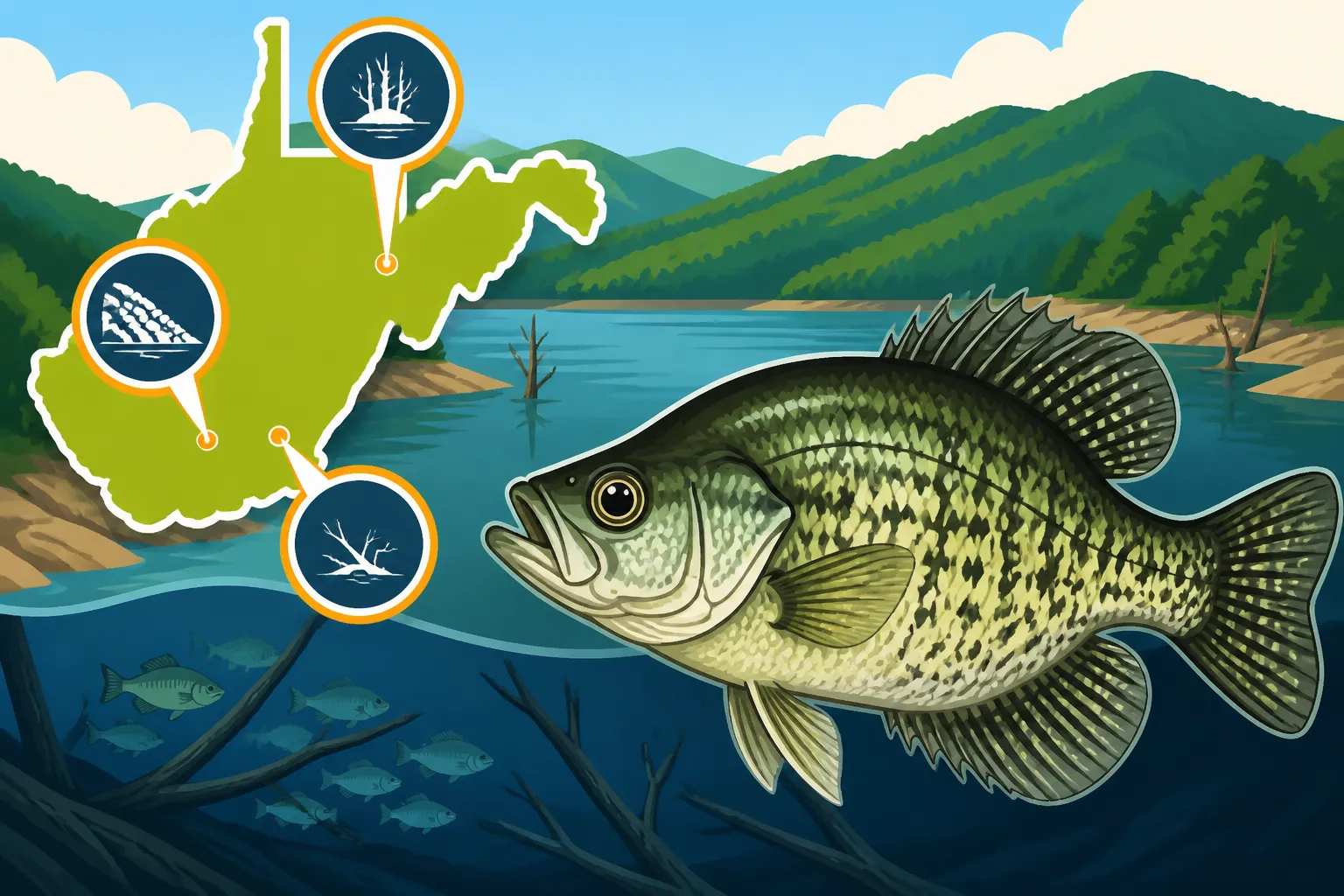
In West Virginia reservoirs, this often includes standing timber – those old, ghostly trees that remained when the valley was flooded. They love brush piles, whether natural or man-made, that offer dense refuge. Rock piles, ledges, old roadbeds, submerged bridges, and even channel edges are also prime real estate. If there's a significant depth change, like a creek channel winding through a flat, crappie will often position themselves along its edges. They also have a knack for suspending themselves just above the thermocline in deeper water during warmer months, seeking that ideal temperature and oxygen level. The key is to think about where a small fish would feel safe and have access to food.
Baitfish Connection: Why They Follow the Food
Ultimately, crappie are driven by their stomachs. They are ambush predators, and their primary diet consists of smaller baitfish like shad and minnows, along with various aquatic insects and crustaceans. This means if you can find the baitfish, you're almost guaranteed to find the crappie.
Baitfish tend to school up and move throughout the reservoir, often relating to the same types of structure and cover that crappie prefer. They might be in the open water over a deep channel, or tucked into a creek arm, or congregating around a submerged island. Learning to identify baitfish on your fish finder is crucial. If you see large clouds of bait, especially if there are larger arches (which could be crappie) lurking around the edges or underneath, you're on the right track. Understanding this food chain connection is fundamental; crappie will literally follow their food source, sometimes for miles, across a large reservoir.
Seasonal Crappie Movements and Patterns
The biggest challenge with crappie is that they don't stay in one spot all year. Their location in West Virginia reservoirs changes dramatically with the seasons, driven by water temperature, spawning urges, and baitfish availability. Knowing these general patterns is key to narrowing down your search.
Spring: The Spawn and Shallower Waters
Ah, spring! This is often the easiest time to find crappie, but it can still be tricky if you're not paying attention. As the water temperatures climb into the 50s and then 60s, crappie begin their journey from deeper wintering holes towards the shallower spawning grounds. They'll stage in slightly deeper water adjacent to these areas first, often around channel swings or points leading into coves.
Once the water hits the mid-60s, typically late April through May in many West Virginia reservoirs, they move right into the shallow bays, coves, and creek arms. Look for them around flooded brush, willow bushes, submerged logs, docks, and even riprap banks. These areas offer protection for their eggs and fry. They’ll often be in just 1-5 feet of water. This is when vertical jigging or casting small jigs or minnows under a float can be incredibly effective. However, once the spawn is over, they disperse quickly, which leads to the summer dilemma. If you're looking for specifics on targeting them during this prime time, check out our guide on Best time to fish for crappie in spring.
Summer: Heading for Deeper, Cooler Havens
Once the hot West Virginia summer arrives and water temperatures soar into the 70s and 80s, crappie retreat from the shallows. They become much harder to locate for many anglers because they move to deeper, cooler, and more oxygenated water. This is where those deep-water structures really come into play.
Crappie will often suspend over submerged creek channels, hang out on the deep side of main lake points, or relate to offshore brush piles and standing timber in 15-30 feet of water, sometimes even deeper. They won't necessarily be on the bottom; often, they'll be suspended at a comfortable depth within the water column. Finding them in summer requires a good fish finder and often some patience as you systematically search these offshore structures. They'll still be grouped up, sometimes in massive schools, but they'll be much more spread out across the vastness of the reservoir.
Fall: Feeding Frenzy Before Winter
As autumn descends upon West Virginia, bringing cooler air and dropping water temperatures, crappie experience a resurgence of activity. They know winter is coming, and they need to bulk up. This often leads to a "feeding frenzy" phase, making fall a fantastic time for crappie fishing.
Crappie will start to migrate from their deepest summer haunts back towards shallower to mid-depth areas, often following baitfish schools. You might find them transitioning along creek channels, congregating around points, or relating to the edges of flats where baitfish are abundant. They might be anywhere from 8 to 20 feet deep, but their aggression level increases, making them more willing to chase down a jig or minnow. Look for them near the mouths of creeks, large coves, and main lake points that offer access to both deep and shallower water.
Winter: Deep Water Schools and Subtle Bites
When the full chill of winter sets in and water temperatures drop into the 30s and 40s, crappie move to their deepest, most stable water. They become much more lethargic, schooling up tightly in large, dense balls. You'll typically find them in the deepest parts of the reservoir, often suspended over main lake channels, deep timber, or around large, sunken brush piles. Depths can range from 25 to 50 feet or more, depending on the reservoir's characteristics.
The bite in winter can be incredibly subtle, requiring light tackle and a keen eye on your electronics. They might just barely 'peck' at a bait. However, once you locate a winter school, you can often catch many fish in one spot, especially if you're vertical jigging with tiny jigs or minnows. If you're venturing out onto the ice in one of the few West Virginia lakes that freeze reliably, the same deep-water principles apply, but you're dropping your bait straight down through a hole.
Practical Techniques for Locating Crappie
Knowing where crappie generally are is one thing, but actually finding them in a big West Virginia reservoir is another. It requires a combination of modern technology, strategic searching, and good old-fashioned angling intuition.
Interpreting Your Electronics: Fish Finders and GPS
Your fish finder is your absolute best friend when trying to locate crappie in large reservoirs. It's essentially your underwater eyes. Don't just rely on the default settings; learn to adjust the sensitivity, depth range, and zoom features to get the clearest picture of what's below.
When you're scanning, you're looking for arches or blobs that indicate fish. Crappie often show up as distinct arcs, or if they're tightly schooled, they might appear as a dense cloud or a "Christmas tree" shape within the water column, especially if they're relating to standing timber. Pay close attention to baitfish schools – those often appear as smaller, speckled clouds. If you see larger arches near or under these bait clouds, you've likely found crappie. Side imaging or down imaging can also be invaluable for spotting submerged timber, brush piles, or ledges off to the sides or directly beneath your boat that might be holding fish.
Once you find a promising spot, use your GPS to mark it immediately! This is critical for returning to the same location, especially on a large, featureless reservoir. You can also use your GPS to trace patterns, like following a contour line or a creek channel. If you're in the market for some reliable tech, many anglers find great deals on fish finders through retailers like Amazon, offering a range of options from basic units to advanced side-imaging models. For more on what to look for, check out Best Fish Finders for West Virginia Lakes.
Fan Casting and Grid Search Strategies
While electronics are fantastic, sometimes you need to physically cover water, especially if you're not seeing much on the screen or if the fish are spread out. This is where fan casting and grid search strategies come in.
Fan Casting: If you're approaching a promising area, like a main lake point or the mouth of a cove, don't just cast straight out. Make casts in a fan pattern, starting from one side and working your way around to the other. This ensures you cover a wide swath of water, varying your retrieve depth with each cast if possible. Pay attention to any bites, no matter how subtle, as this can indicate a crappie school nearby.
Grid Search: For more systematic coverage of an open-water area that you suspect holds crappie, a grid search is effective. This involves moving your boat in a methodical pattern, like mowing a lawn, while constantly watching your fish finder. Drive parallel lines across the area, overlapping your sonar cone to ensure no gaps. This is particularly useful for finding those suspended crappie over deep channels or flats in summer and winter. If you're using a kayak, your search might be a bit slower, but the same principles apply, perhaps focusing on smaller grid sections at a time. A portable fish finder can be a game-changer for kayak anglers trying to pinpoint these elusive schools.
The Importance of Patience and Observation
Fishing for crappie, especially when they're not in their predictable shallow-water spawn, demands patience. You might spend hours scanning and searching before you find that one productive school. Don't get discouraged! The payoff of finding a concentration of fish is always worth the effort.
Beyond your electronics, pay attention to subtle cues on the water. Are there birds diving? That often indicates baitfish near the surface. Are other anglers catching fish? Observe where they are, what they're using, and how they're fishing. Sometimes, a slight change in wind direction or current can push baitfish – and thus crappie – into a new location. Keep an open mind, be willing to move, and trust your instincts. Remember, every trip teaches you something new about the reservoir and its crappie population.
Gear and Electronics to Aid Your Search
Having the right tools can significantly increase your chances of finding and catching crappie in West Virginia's diverse reservoirs. From what you see on your screen to what's at the end of your line, gear plays a crucial role.
Essential Electronics: Fish Finders and GPS
As mentioned, a quality fish finder is non-negotiable for serious reservoir crappie anglers. Brands like Humminbird, Lowrance, and Garmin offer excellent units with features like Down Imaging and Side Imaging, which can reveal submerged timber and brush piles that conventional sonar might miss. Even a good entry-level unit with solid 2D sonar can show you fish arches and bait balls. Many anglers find great deals and a wide selection of these devices, from basic models to advanced units, on Amazon.
A reliable GPS unit, often integrated into your fish finder, allows you to mark waypoints for productive spots, follow contour lines, and navigate safely across large bodies of water. This is especially important on reservoirs like Summersville Lake or Bluestone Lake, where structure can be extensive and crappie can move. Knowing how to save and recall these waypoints is as important as finding the fish in the first place. You can also integrate mapping cards that show detailed contours and potential underwater structures, saving you valuable search time.
Jigs, Minnows, and Scent: What to Offer Them
Once you've located the crappie, what you present to them can make all the difference. Crappie are usually not too picky, but certain presentations are more effective depending on their mood and depth.
Jigs: Small jigs, typically 1/32 to 1/8 ounce, are crappie staples. They come in countless colors and styles, but grub-style bodies, tubes, and small minnow imitations are always good bets. Chartreuse, white, black, and various greens are popular in West Virginia waters. When fishing deeper, consider Jigging for Crappie in West Virginia Lakes with heavier jigs (1/8 to 1/4 ounce) to get down quickly. You can often find multi-packs of effective crappie jigs for a great price on Amazon.
Live Minnows: It's hard to beat a live minnow, especially when crappie are less active, like in winter or during post-spawn. Hooked lightly through the back or lip, a minnow presented vertically or under a float can entice even the most finicky crappie.
Scent: Don't underestimate the power of scent. Applying a crappie-specific attractant to your jigs or even live minnows can sometimes trigger bites, especially in murky water or when fish are neutral. This added enticement can make them hold onto the bait longer, giving you more time to set the hook.
Rods and Reels for Detecting Subtle Bites
Crappie fishing, especially when the bite is light, calls for sensitive gear.
Rods: Look for light to ultralight spinning rods, typically 6 to 7.5 feet long, with a fast or moderate-fast action. The sensitive tip will allow you to detect those subtle "taps" or the feeling of extra weight on your line that signals a bite. A good quality graphite rod will transmit even the slightest vibrations up your line.
Reels: Pair your sensitive rod with a small, smooth spinning reel (size 1000 or 2000). Fill it with 4-6 pound test monofilament or fluorocarbon line. Some anglers prefer braided line for its sensitivity and lack of stretch, often using a fluorocarbon leader for invisibility. The lighter line allows for better casting of small jigs and a more natural presentation, crucial when fish are shy. These lighter setups are also ideal if you're targeting other panfish species with the same gear, making them versatile for general Best Tackle for Panfish expeditions.
Having the right gear makes a huge difference in your ability to effectively search for and detect crappie, whether you're working a deep brush pile at Stonewall Jackson Lake or exploring a promising cove on Burnsville Lake.
Crappie Hotspots and Key Structures in West Virginia Reservoirs
While crappie move seasonally, certain types of structures and areas consistently hold fish in West Virginia's reservoirs throughout different times of the year. Knowing these prime locations can help you focus your search.
Standing Timber and Brush Piles
These are perhaps the ultimate crappie magnets in many West Virginia reservoirs. When a lake is impounded, trees in the flooded areas often remain standing or fall over to create massive, natural underwater forests. These provide vertical cover from the bottom all the way up through the water column, which crappie absolutely love for cover and ambush points.
Actively seek out these areas using your fish finder. Standing timber will show up as vertical lines or dense areas on your sonar. Brush piles, whether naturally accumulated or intentionally placed by anglers and DNR officials, appear as irregular, dense clumps on the bottom or suspended off it. Crappie will often position themselves within or just on the edges of these structures. Work your jigs or minnows vertically right into the cover, being prepared for snags, but also for explosive strikes. Reservoirs like Stonewall Jackson Lake and Burnsville Lake are particularly known for their abundant timber.
Creek Channels and Ledges
Every reservoir has old creek and river channels running through it from before it was flooded. These channels act as underwater highways for crappie and their baitfish. They provide deeper water access and distinct depth changes that crappie will relate to, especially during seasonal transitions.
Crappie often stage along the edges of these channels, particularly where the channel makes a sharp turn (a "channel swing") or intersects with a flat. Ledges, which are sharp drops in depth, are also prime areas. Fish will suspend off the face of a ledge or hold right at the break. Use your GPS to follow these old channels, constantly scanning your fish finder for schools of fish or bait. Summersville Lake, for example, has a very prominent channel that snakes through the main lake basin, and learning its path is key to finding fish there.
Main Lake Points and Humps
Main lake points are protrusions of land that extend into the main body of the reservoir. They offer access to both shallow and deep water and are natural congregating points for baitfish and predators. Crappie will often hold on the deeper sides of these points, especially those with structure like rocks, timber, or brush.
Submerged humps, or underwater islands, are similar to points but are entirely underwater. They rise from the lake bed and can attract crappie seeking higher ground for feeding or staging. These can be particularly productive in large, open reservoirs where other structure is scarce. A good contour map and fish finder are essential for finding and effectively fishing these features. Work your way around these points and humps, varying your depth until you locate active fish.
Docks, Bridges, and Riprap
While not as common in the deepest parts of large reservoirs, man-made structures are crucial crappie habitat, especially during the spring and fall. Docks provide shade, cover, and often have brush piles sunk underneath them by property owners. Crappie will hold tightly to the pilings or under the pontoons.
Bridge abutments, pilings, and the riprap (rocky banks) leading up to them also offer excellent crappie habitat. The riprap often holds baitfish and provides crevices for crappie to hide. Bridge pilings create current breaks and vertical structure, attracting crappie that might suspend directly alongside them. These spots can be particularly good for bank anglers or those in smaller boats. Just be mindful of boat traffic and safety when fishing around active bridges.
| Season | Typical Location | Depth Range (Approx.) | Preferred Structure/Cover | Effective Techniques |
|---|---|---|---|---|
| Spring | Shallow coves, creek arms | 1-10 feet | Flooded brush, docks, logs, riprap | Casting jigs/minnows under float, vertical jigging |
| Summer | Main lake basin, deep channels | 15-30+ feet | Suspended timber, offshore brush piles, channel edges | Trolling jigs, vertical jigging, spider rigging |
| Fall | Transitional areas, creek mouths | 8-20 feet | Points, humps, channel bends, brush piles | Casting jigs, slow trolling, drift fishing |
| Winter | Deepest areas of main lake | 25-50+ feet | Deep timber, channel breaks, massive brush piles | Vertical jigging tiny jigs/minnows, ice fishing |
Remember that these are general guidelines, and specific conditions in each West Virginia reservoir can alter crappie behavior. The most successful anglers are those who continuously adapt their approach based on what the fish are telling them. Keep learning, keep experimenting, and enjoy the hunt for those slab crappie!
Disclaimer
This article is for general informational purposes only and does not constitute professional advice. Laws, prices and regulations vary by location and change over time. Consult a qualified professional for guidance on your specific situation.