Best livewell aerator for a small boat
Let's be honest, nothing sours a fantastic day out fishing on West Virginia's beautiful waters quite like the worry of keeping your hard-won catch alive and healthy. Whether you're trying to win a bass tournament on Summersville Lake or simply hoping to bring home some fresh crappie for dinner from Burnsville Lake, a struggling livewell can turn a joyous moment into a frustrating dilemma. This guide is all about helping you understand, choose, and optimize the best livewell aerator for your small boat, ensuring your fish stay lively from hook to weigh-in or cooler.
Why a Livewell Aerator is Absolutely Essential for Small Boats in West Virginia
You might think a small boat, maybe a trusty jon boat or even a large kayak with a built-in well, doesn't need the fancy aeration of a big bass rig. But that couldn't be further from the truth. The smaller the volume of water, the faster it depletes oxygen and warms up, especially on a sweltering summer day on the Ohio River. Having a reliable aerator isn't just a luxury; it's a necessity for ethical angling and successful trips.
Keeping Your Catch Healthy and Alive
Imagine this: You've just pulled in a beautiful smallmouth bass from the New River, a real trophy. You want to snap a picture, maybe even release it to fight another day, or perhaps you're in a tournament where every ounce counts towards your final score. Dropping that fish into a stagnant livewell is like sending it into a warm, stuffy closet. Fish, just like us, need oxygen to breathe, and in a closed environment like a livewell, that oxygen gets used up quickly.
When oxygen levels plummet, fish become incredibly stressed. They might start "gasping" at the surface, losing their vibrant color, and can quickly become lethargic. This stress drastically reduces their chances of survival upon release, which goes against the core principles of catch-and-release fishing that many of us hold dear, especially for species like muskie or larger bass. For tournament anglers, a dead fish in the livewell often means a penalty, or even disqualification, turning a potential win into a disheartening loss. A good aerator continuously replenishes the oxygen, mimicking the natural flow of a healthy river or lake, giving your fish the best chance to remain active and strong. It's about respecting the fish and ensuring your efforts don't go to waste.
Maximizing Fishing Opportunities and Flexibility
Beyond the ethical considerations, a functional livewell aerator provides incredible flexibility in your fishing adventures. Let's say you're out chasing panfish on a quiet lake, and you decide you want to keep a limit of bluegill and crappie for a delicious fry. Without proper aeration, you'd constantly be worried about them expiring, forcing you to cut your trip short or risk losing your catch. With an aerator, you can enjoy a full day on the water, knowing your fish are comfortable and fresh until you're ready to head home.
For those of us who participate in local fishing tournaments, from the small club events to larger regional challenges, a healthy livewell is non-negotiable. It allows you to practice "culling," replacing smaller fish with larger ones throughout the day without fear of killing off your initial catches. This strategic element is crucial for competitive angling. It also ensures that when you finally arrive at the weigh-in station, your fish are lively and robust, ready to be presented to the judges. Think about a long day fishing the Greenbrier River Fishing Guide for smallmouth – you want those fish to be in top shape when you weigh them in, not barely clinging to life. Having a reliable aeration system means you can extend your time on the water, explore more spots, and manage your catch effectively without constantly checking on their well-being.
Understanding the Different Types of Livewell Aerators
When you start looking for an aerator, you'll quickly realize there isn't a one-size-fits-all solution. Different boat sizes, fishing styles, and even target species can influence what kind of system will work best for you. It's worth taking the time to understand the basic categories.
Portable vs. Permanent Aeration Systems
The first big decision you'll face is whether to go with a portable unit or a more permanently installed system. Both have their place, especially on smaller vessels.
Portable Aeration Systems:
These are often the go-to for small boat owners, especially those with canoes, kayaks, or smaller jon boats that might not have a dedicated livewell built-in.
- Pros: They are incredibly easy to install, often just clipping onto the side of a cooler or bucket that serves as your temporary livewell. Their flexibility means you can move them between different boats or use them for other purposes, like aerating a bait bucket. They're typically battery-powered (D-cells or small 12V batteries), making them self-contained. For someone just starting out or only occasionally needing a livewell, a portable bubbler is a fantastic, low-commitment option. You can find excellent options readily available at sporting goods stores like Bass Pro Shops or online retailers like Amazon.
- Cons: While convenient, portable units generally aren't as powerful or efficient as permanent systems. Their battery life can be a concern on longer trips, and you'll need to carry spare batteries. The aeration capacity might be limited, making them less ideal for larger fish or a full limit of fish in a moderately sized livewell. They can also be a bit noisier than a submerged permanent pump. Think about a day paddling your kayak on Summersville Lake Bass Fishing – you might appreciate the simplicity of a portable unit, but you'll need to monitor its battery.
Permanent Aeration Systems:
These are designed to be integrated directly into your boat's structure and livewell. While they require more initial effort, they offer superior performance and reliability for regular use.
- Pros: Permanent systems are usually much more robust, offering higher flow rates and better oxygenation for larger volumes of water. They draw power directly from your boat's main battery, eliminating the worry of constantly changing small batteries. Installation often includes through-hull fittings for both intake and overflow, creating a true circulating system that continuously refreshes the water. This is critical for maintaining optimal water quality and temperature, not just oxygen.
- Cons: The main drawback is the installation. It requires drilling holes in your boat, running wiring, and carefully routing hoses. This might be intimidating for some DIYers and could require professional help. They also take up more dedicated space in your livewell or bilge area. However, for serious anglers or those who frequently fish tournaments, the investment in a permanent system pays dividends in fish health and peace of mind.
Here's a quick comparison to help you visualize the differences:
| Feature | Portable Aerator System | Permanent Aerator System |
|---|---|---|
| Installation | Very easy, clip-on or drop-in, no drilling | Requires drilling, wiring, hose routing; more complex |
| Power Source | D-cell batteries, small 12V packs | Boat's main 12V battery system |
| Capacity/Flow | Generally lower, suitable for small volumes/few fish | Higher, suitable for larger livewells/multiple fish |
| Flexibility | High, can be moved between containers/boats | Low, fixed in place |
| Reliability | Can be limited by battery life and pump durability | High, integrated with boat power, robust pumps |
| Cost | Typically lower initial cost | Higher initial cost (equipment + installation) |
| Noise | Often audible bubbling or humming | Can be quieter as pumps are often submerged |
Aeration Methods: Sprayers, Bubblers, and Recirculation
Once you've decided between portable and permanent, it's good to understand how these systems actually get oxygen into the water.
Sprayers (Recirculation Kits):
This method is commonly found in permanent livewell systems, often referred to as recirculation kits. A pump draws water from the livewell (or directly from outside the boat) and sprays it back into the livewell through a small manifold or a nozzle.
- How They Work: The act of spraying the water breaks the surface tension, creating tiny droplets that absorb oxygen from the air as they fall back into the livewell. This also creates current within the livewell, circulating the water and distributing oxygen evenly, as well as helping to remove CO2.
- Pros: Very effective at rapidly oxygenating the water and providing vital circulation. Many systems allow you to adjust the spray pattern or direction. They can also often draw in fresh water from outside the boat, which is fantastic for water quality.
- Cons: Can be a bit noisy due to the splashing water. If the water quality in your livewell is poor (e.g., lots of fish slime or debris), the spraying action can create excessive foam, which is detrimental to fish. You'll want to ensure your livewell is clean.
Bubblers (Air Pumps):
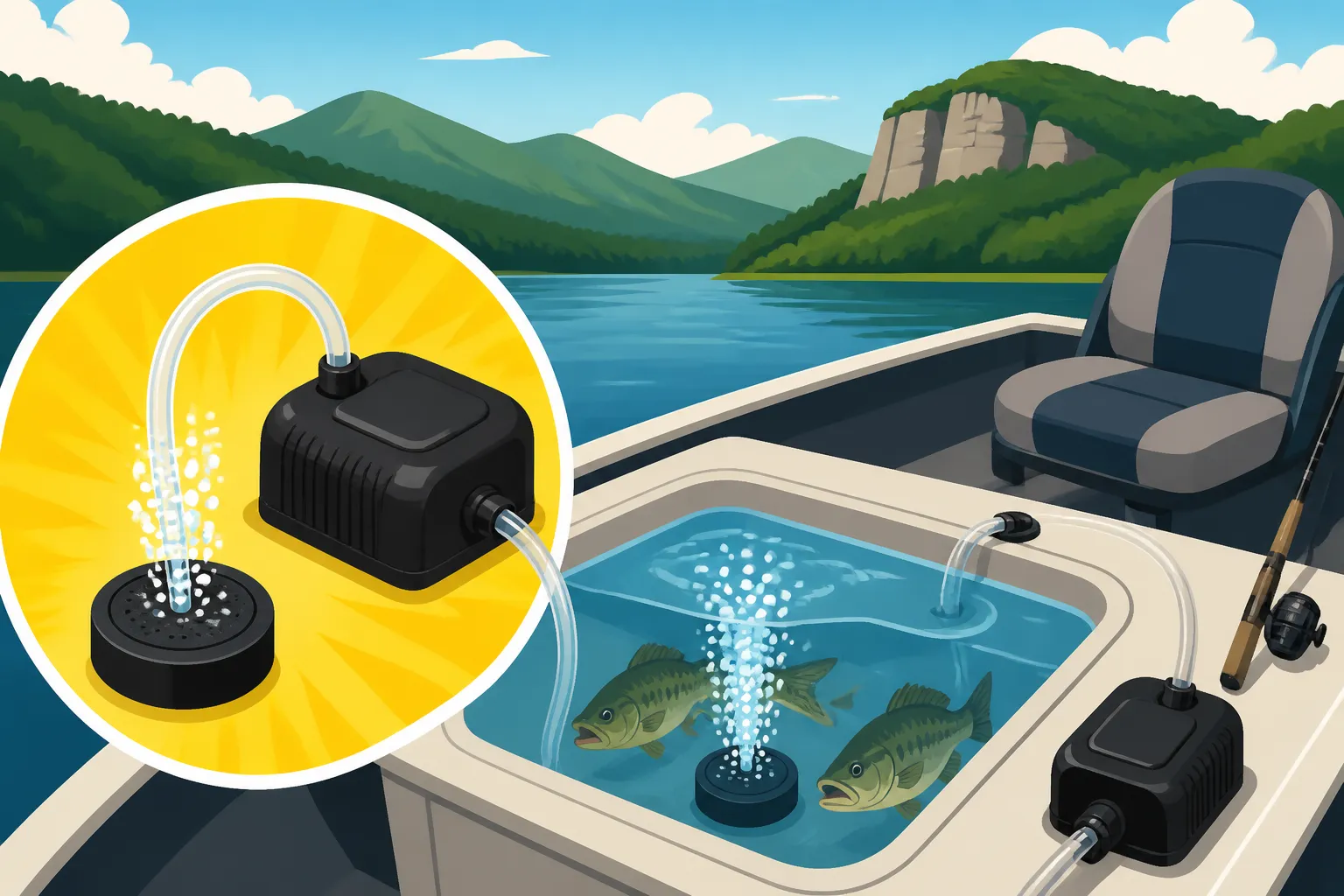
These are what most people picture when they think of a livewell aerator, especially portable ones. They use an air pump to push air through a small hose to an "air stone" submerged in the livewell.
- How They Work: The air stone creates a steady stream of fine bubbles that rise through the water. As these bubbles travel upwards, oxygen from the air dissolves into the water.
- Pros: Extremely gentle on fish, as there's no harsh spray or strong currents. They tend to be quieter in operation once the air stone is submerged, and the pumps themselves are often small and unobtrusive. They're great for delicate baitfish or very sensitive game fish.
- Cons: While good for oxygenation, bubblers don't provide much water circulation. This means water temperature or potential "hot spots" of deoxygenated water can still be an issue if the livewell is large or overcrowded. They might also be slower to oxygenate large volumes compared to a powerful spray system.
Recirculation (Continuous Flow) Systems:
This is often the most sophisticated and effective method, usually found in higher-end permanent livewell setups. It involves continuously pumping fresh water into the livewell from the surrounding lake or river, while simultaneously draining old water out through an overflow.
- How They Work: A dedicated pump (often a sprayer type) constantly pulls in new water, while an overflow outlet ensures the livewell doesn't flood and expels water that might be high in ammonia or CO2. This creates a complete water exchange.
- Pros: By far the best method for maintaining optimal water quality, oxygen levels, and temperature, as you're constantly replacing the livewell water with fresh, ambient water. This is crucial for long fishing days or for keeping fish healthy in challenging conditions.
- Cons: Requires a more complex plumbing setup with both an intake pump and an overflow. This system will also draw the most power from your battery, as the pump is running continuously. You'll need to consider your boat's battery capacity, especially if you're out fishing a remote section of the New River Gorge Fishing Guide for hours on end.
Many effective livewell systems for small boats will combine elements of these. For instance, a permanent setup might use a recirculation pump that both draws fresh water and sprays it into the livewell, giving you the best of both worlds.
Key Features to Look for in a Small Boat Aerator
Now that you know the types, let's dive into the nitty-gritty of what makes a good aerator for your small craft. It's not just about getting bubbles; it's about reliable performance when it matters most.
Power Source and Battery Life Considerations
This is perhaps the most critical factor for small boat owners, especially if you're relying on a single battery to run everything from your fish finder to your motor.
- For Portable Units: Many small, portable bubblers run on D-cell batteries. While convenient, these have limited lifespans, often only lasting 12-24 hours of continuous use, sometimes less. If you're planning a full day or a multi-day trip, you'll need a hefty supply of spare batteries. Other portable options use a small 12V battery pack, which can offer more power and longer run times but adds another battery to manage. Imagine you're doing some Kayak Fishing Techniques for West Virginia Rivers and suddenly your aerator dies midway through the day – that's a problem you want to avoid!
- For Permanent Systems: These almost universally run off your boat's main 12V battery system. This is great for consistent power, but you need to understand the amp draw of your chosen pump. A powerful recirculation pump running continuously can put a significant strain on a single small marine battery, especially if you also have other electronics like a trolling motor or depth finder.
- Amp Draw: Look for the pump's amp draw rating (usually listed in amps per hour). A lower amp draw means longer battery life.
- Battery Capacity: Consider upgrading to a deep-cycle marine battery if you plan to run a permanent aerator for extended periods. These batteries are designed for sustained power discharge, unlike starting batteries.
- Solar Solutions: For very small boats or kayaks, some anglers are getting creative with small solar panels to trickle charge auxiliary batteries that power their aerators. While not a primary power source, it can extend run times significantly on sunny days.
- Timer Controls: Many modern livewell systems come with timers, allowing you to cycle the pump on and off (e.g., 5 minutes on, 10 minutes off). This dramatically conserves battery life while still providing adequate oxygenation. This feature is highly recommended for any permanent installation on a small boat.
Pump Capacity and Water Flow Rates (GPH)
The "muscle" of your aerator is its pump, and its capacity is measured in Gallons Per Hour (GPH). This tells you how much water the pump can move or circulate in an hour.
- Matching GPH to Livewell Size: You want a pump that can "turn over" the water in your livewell several times an hour. A good rule of thumb is to aim for a GPH rating that's at least 3-5 times the volume of your livewell. So, if you have a 10-gallon livewell, a pump between 300 and 500 GPH is usually sufficient. For a 20-gallon livewell, you'd be looking for 600-1000 GPH.
- Over-aerating? Can you have too much GPH? Not really for oxygenation, but an excessively powerful pump for a very small livewell might create too much current, stressing fish. However, for typical small boat livewells (5-20 gallons), finding a pump that's too powerful is rarely an issue. Most small boat aerators will fall into the 300-800 GPH range.
- Why Turnover Matters: Rapid water turnover does more than just add oxygen; it helps to dissipate metabolic waste products (like ammonia) that fish release, and it helps to maintain a more consistent water temperature throughout the livewell. This is especially important if you're trying to keep fish cool with ice bottles on a hot day – you want that cool water distributed evenly.
Durability, Material Quality, and Ease of Installation
No one wants to install a new piece of gear only to have it fail after a few trips. Especially in the rugged environments of West Virginia's rivers like the Cheat River or the Elk River, durability is key.
- Corrosion Resistance: Marine environments are tough. Look for pumps made with corrosion-resistant materials, especially if they will be submerged or exposed to water regularly. Stainless steel shafts, marine-grade plastic housings, and sealed motors are good indicators of quality.
- Robust Housing: The pump and any external components (like intake screens or spray heads) should be built to withstand bumps, vibrations, and general wear and tear that comes with boating.
- Ease of Installation: For small boat owners, especially those without a dedicated electrical system, ease of installation is paramount.
- Portable: Look for simple clip-on designs, flexible air tubing, and easy-to-replace air stones.
- Permanent: Consider how accessible your bilge or livewell area is. Pumps that come with clear instructions, pre-wired connections, and flexible mounting options will make the job much smoother. Some models are designed for quick removal for cleaning or winterization. You might consider brands like Rule or Attwood for their reputation in marine pumping solutions. While specific prices aren't discussed, you'll generally find a range of quality and price points that reflect these material and design differences.
- Vibration and Noise: While some noise is inevitable, a well-designed pump will minimize excessive vibration or rattling. Excessive noise can be irritating for you and potentially stressful for the fish. Look for pumps with rubber mounts or designs that reduce transfer of vibration to the boat hull.
Setting Up and Maintaining Your Small Boat Livewell Aerator
Getting the right aerator is only half the battle. Proper setup and consistent maintenance are crucial to ensure it performs effectively and reliably, keeping your fish in prime condition.
Proper Placement and Hose Routing
Whether you choose a portable or permanent system, where and how you set it up makes a big difference.
- For Portable Units:
- Air Stone Submersion: Ensure the air stone (the part that creates bubbles) is fully submerged and rests near the bottom of your livewell or cooler. If it's too high, it won't oxygenate the full water column efficiently.
- Pump Security: Secure the pump unit (the part that generates the air) in a dry, stable location. Many portable units have clips to attach to the rim of your container. You don't want it bouncing around or falling into the water, which can damage it or even cause a short circuit.
- Tubing: Route the air tubing neatly to avoid kinks, which will restrict airflow. Keep it out of the way of your feet or fishing lines.
- For Permanent Systems: This involves a bit more planning and execution, often with through-hull fittings.
- Intake Location: If your system draws fresh water from outside the boat, the intake port needs to be positioned below the waterline and free from obstructions like trailer bunks, transducers, or propeller wash. You want a clear flow of clean water.
- Spray Bar/Diffuser Placement: Inside the livewell, position the spray bar or diffuser high enough to create splashing and surface agitation, but not so high that it creates excessive turbulence or sprays water out of the livewell. Angling the spray slightly downward or towards a corner can create a beneficial circular current without directly blasting the fish.
- Overflow Management: Ensure your livewell has an adequate overflow drain positioned high enough to maintain the desired water level but low enough to prevent overflowing into your boat. This drain should also be free from obstructions. Proper overflow is crucial for maintaining water quality in a recirculation system.
- Wiring and Fusing: All wiring should be marine-grade, properly crimped, and protected with heat shrink tubing. Always install an inline fuse appropriate for the pump's amp draw to protect your electrical system from shorts.
Best Practices for Livewell Management
Even with the best aerator, your livewell needs more than just bubbles to keep fish truly healthy.
- Pre-filling and Conditioning: Before you even cast a line, fill your livewell with fresh water from the lake or river you'll be fishing. Run your aerator for a few minutes to get the oxygen levels up. Some anglers add livewell conditioners, available at most tackle shops or online at Amazon, which help remove chlorine (if using tap water), neutralize ammonia, and reduce stress on fish. These can be particularly useful if you're using municipal water to initially fill the livewell.
- Temperature Control: On hot West Virginia summer days, your livewell water can heat up rapidly, stressing fish even if oxygen levels are good.
- Ice Bottles: A simple and effective trick is to freeze plastic water bottles (or milk jugs for larger livewells) and place them directly into the livewell. They slowly release cold without diluting the water or introducing chlorine from ice cubes.
- Continuous Flow: If you have a continuous flow system, regularly exchanging the water with cooler ambient water can help keep temperatures down.
- Don't Overcrowd: It's tempting to keep every fish, but an overcrowded livewell stresses all fish within it, regardless of aeration. Know your West Virginia Bag and Possession Limits by Species and stick to them, but also use common sense. If your livewell looks like a fish sardine can, some fish will suffer.
- Regular Cleaning: Fish slime, scales, and waste can quickly build up, creating an unhealthy environment. After every trip, thoroughly clean your livewell with a mild bleach solution or a specialized livewell cleaner. Rinse it completely to remove all chemical residue. This prevents the growth of bacteria and fungus that can harm fish on future trips.
Troubleshooting Common Aerator Issues
Things can go wrong, even with the most reliable equipment. Knowing how to quickly troubleshoot common problems can save your catch.
- Pump Not Running/No Bubbles:
- Check Power: Is the battery dead? Is the fuse blown (for permanent systems)? Check all connections. For portable units, are the D-cells fresh and inserted correctly?
- Clogged Intake (Permanent): The pump's intake screen might be clogged with weeds, leaves, or debris. Tilt your boat slightly or reach under to clear it.
- Jammed Impeller: Sometimes a small rock or piece of debris can jam the pump's impeller. If safe to do so, try to clear it. Many pumps have quick-release mechanisms for easy access.
- Weak Bubbles/Low Flow:
- Low Battery: Even if the pump is running, a weak battery might not be providing enough power for full performance.
- Kinked Hose/Tubing: Check all hoses and air lines for kinks or obstructions.
- Clogged Air Stone/Spray Nozzle: Over time, mineral deposits or organic matter can clog these components. For air stones, try soaking them in a vinegar solution. For spray nozzles, use a small wire or toothpick to clear them.
- Excessive Foaming:
- Water Quality: This often indicates poor water quality in the livewell. Too much fish slime, blood, or leftover livewell conditioner can cause foaming. Exchange some water, add fresh ice bottles, and consider a livewell defoamer.
- Overcrowding: Again, too many fish can lead to excessive waste and foaming.
- Bad Water Source: If you're drawing from particularly dirty or chemically treated water, this can also cause issues.
- Water Leaks:
- Loose Connections: Check all hose clamps and fittings on permanent systems.
- Cracked Housing: Inspect the pump housing or livewell itself for cracks or damage.
By being proactive with maintenance and knowing these basic troubleshooting steps, you'll be well-equipped to keep your livewell aerator running smoothly, ensuring your fishing trips remain enjoyable and your catches stay healthy. For more detailed insights into specific boat requirements, you might want to check out West Virginia Boating Laws for Anglers or Life Jacket Requirements for West Virginia Boaters.
Disclaimer
This article is for general informational purposes only and does not constitute professional advice. Laws, prices and regulations vary by location and change over time. Consult a qualified professional for guidance on your specific situation.