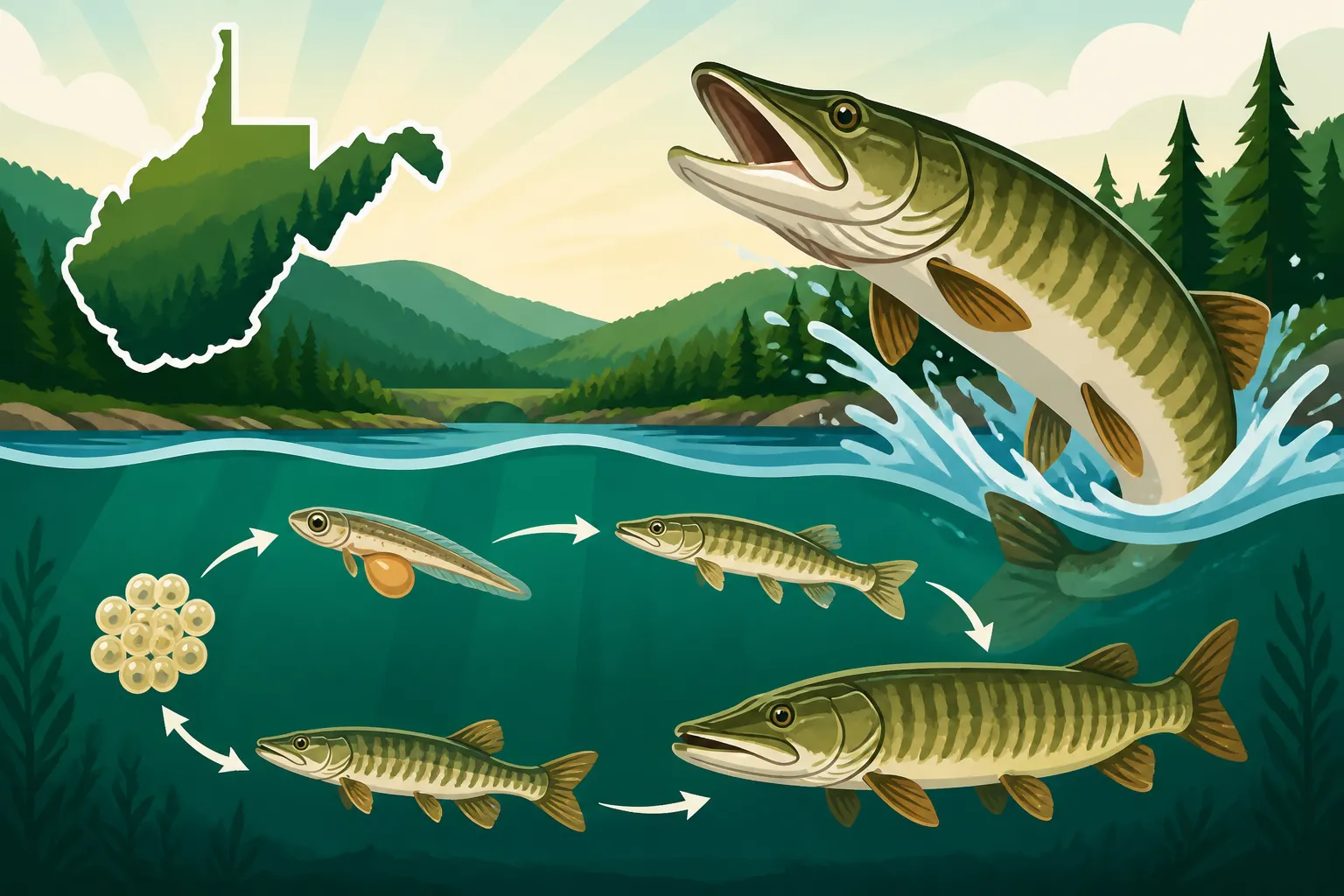
Muskie Life Cycle and Growth Rate in West Virginia Waters
Many anglers in West Virginia are captivated by the elusive muskie, often called the "fish of a thousand casts." There's a deep fascination with these freshwater giants, but also a common frustration: understanding why some muskie grow into absolute behemoths while others seem to remain more modest in size. This guide aims to demystify the muskie's incredible journey, from a tiny egg to a formidable apex predator, by exploring its full life cycle and the critical factors that influence its growth rate in the unique waters of the Mountain State.
The Mighty Muskie: A West Virginia Icon
The muskie, or muskellunge, isn't just a fish in West Virginia; it's a legend. Known for its sheer size, predatory prowess, and often infuriating elusiveness, it holds a special place in the hearts of anglers across the state. But beyond the tales of heart-stopping strikes and epic battles, lies a complex biological story of survival and growth that allows these fish to thrive in our rivers and lakes.
Identifying the West Virginia Muskie
Before we dive into their life story, let's make sure we're all on the same page about what a muskie looks like, especially in West Virginia. There are a few key characteristics that set them apart from their cousins, the northern pike, which are also present in some of our waters. Muskie typically have dark markings on a lighter body, often appearing as spots or vertical bars, though sometimes they can be quite plain. Northern pike, on the other hand, usually have lighter, bean-shaped spots on a darker body. A surefire way to tell them apart is to check the pores on the underside of their jaw: muskie generally have 6-9 pores on each side, while northern pike have 5 or fewer. Muskie Fishing in West Virginia is a great resource if you're looking to target these fish.
The muskie's elongated, cylindrical body and duck-bill-shaped snout are perfectly adapted for ambushing prey. Their dorsal, caudal, and anal fins are positioned far back on the body, giving them incredible burst speed – essential for a predator that relies on quick, explosive strikes. This streamlined design is a testament to their evolutionary success as top-tier hunters in West Virginia's aquatic ecosystems.
Why Muskie Are So Elusive
The "fish of a thousand casts" isn't just a catchy phrase; it's a testament to the muskie's famously challenging nature. Their elusiveness isn't just about luck; it's deeply rooted in their behavior and biology. Muskie are highly territorial, preferring specific ambush points, and they can be incredibly discerning about their prey. They often follow lures without striking, seemingly inspecting them before deciding if it's worth the energy expenditure.
Their solitary nature also plays a significant role. Unlike schooling fish, muskie tend to operate alone, making them harder to locate consistently. They're masters of camouflage and patience, often blending perfectly into submerged logs, weed lines, or rocky outcrops, waiting for the perfect moment to strike. Understanding this inherent elusiveness is crucial for any angler hoping to connect with one of these magnificent fish, and it helps to appreciate just how special each muskie encounter truly is.
The Muskie Life Cycle: From Egg to Apex Predator
The life cycle of a muskie in West Virginia is a fascinating journey, fraught with peril but culminating in one of freshwater's most formidable predators. It begins as a tiny, vulnerable egg and progresses through distinct stages, each vital to their survival and growth into the giants we admire.
Spawning Rituals and Early Life
Muskie spawning typically occurs in the spring, once water temperatures reach the mid-40s to low 50s Fahrenheit, usually from late March through May in West Virginia. Unlike many other fish, muskie don't build nests. Instead, they broadcast their eggs and milt (sperm) over shallow, vegetated areas, or flooded timber and debris, typically in tributaries or backwater areas of larger lakes and rivers. These sticky eggs adhere to the vegetation, providing some protection, but also leaving them vulnerable to predation and environmental fluctuations.
A single female can lay tens of thousands of eggs, sometimes over 200,000, but only a tiny fraction will ever hatch and survive to adulthood. The eggs usually hatch within 8-14 days, depending on water temperature. The newly hatched larvae, called sac fry, are incredibly small and carry a yolk sac that provides initial nourishment. They remain attached to vegetation or debris for about a week or two, absorbing the yolk sac before becoming free-swimming and beginning to hunt for microscopic organisms. This early stage is particularly vulnerable, as they are a food source for almost anything larger than themselves.
Larval and Juvenile Development
Once their yolk sac is absorbed and they become free-swimming, muskie enter their larval and then juvenile stages. At this point, they are incredibly aggressive predators, despite their small size. Initially, they feed on zooplankton and small insects, but their diet quickly shifts to anything they can fit in their mouths, including other fish fry and even smaller members of their own species. This rapid shift to piscivory (fish-eating) is a hallmark of muskie development and a key driver of their subsequent growth.
During their first year, muskie can grow surprisingly fast if food is abundant. They instinctively seek out cover to avoid predators and ambush prey. Areas with dense aquatic vegetation, submerged logs, and rock piles serve as critical nurseries. This is a period of intense competition and survival of the fittest. Only the most efficient hunters and those lucky enough to avoid becoming prey themselves will make it past these early stages. Understanding these early habitat preferences is crucial for West Virginia Fishing Regulations Explained which often protect spawning and nursery grounds.
Adult Stage: The Apex Predator
By the time muskie reach two to three years of age, they are firmly established as formidable predators in their aquatic environment. They continue to grow rapidly, especially in their early adult years, and their diet consists almost exclusively of other fish. What muskie eat in West Virginia rivers often includes suckers, chubs, panfish, and even smaller bass. They are opportunistic feeders, taking advantage of whatever prey species are most abundant and easiest to catch.
Adult muskie are generally solitary, maintaining distinct territories where they patrol for prey. Their powerful tails and large mouths, lined with razor-sharp teeth, are perfectly evolved for capturing and consuming their quarry. As they mature, they become less vulnerable to predation themselves, with humans and larger birds of prey being their primary threats. The adult stage is where muskie truly earn their reputation as the freshwater equivalent of sharks, ruling their domain with stealth and power.
Factors Influencing Muskie Growth Rate
While muskie have a general growth trajectory, their actual size and the speed at which they reach it can vary dramatically. Several interconnected factors in West Virginia's waterways play a critical role in how big a muskie will ultimately become. Understanding these influences can shed light on why certain bodies of water consistently produce larger fish.
Food Availability and Diet Quality
Perhaps the most significant factor affecting a muskie's growth rate is the abundance and quality of its food supply. Simply put, more food means more energy for growth. In a rich environment with a diverse and plentiful forage base, muskie will grow faster and larger than those in a system with limited prey. Think of a muskie living in a lake teeming with suckers and large panfish versus one in a stream where prey is scarcer or smaller. The former will likely bulk up much quicker.
The type of food matters too. Larger, more caloric prey fish, like common carp or large shiners, provide more energy per meal than smaller forage. Muskie are incredibly efficient predators, and in systems like the New River, where species like freshwater drum and various suckers are abundant, they can grow to impressive sizes. A healthy and balanced ecosystem with ample forage is the foundation for trophy muskie growth. You might even find specialized muskie fishing books on Amazon that detail diet analysis for different regions.
Water Temperature and Metabolism
Water temperature plays a critical, albeit often overlooked, role in muskie metabolism and growth. Muskie are cold-blooded, meaning their body temperature, and thus their metabolic rate, is directly influenced by the surrounding water. Warmer water, up to a certain point, increases their metabolism, leading to more frequent feeding and faster digestion, which translates to faster growth. However, excessively warm water can stress muskie, reducing their appetite and overall health.
In West Virginia, our lakes and rivers offer a good balance of temperatures. Summers provide the warmer water needed for active feeding and rapid growth, while winters slow things down, conserving energy. Bodies of water that sustain optimal temperatures for longer periods, without extreme highs or lows, tend to produce faster-growing muskie. This explains why some southern West Virginia waters might see slightly faster growth rates due to longer warm seasons compared to colder, higher-elevation streams.
Genetics and Population Density
Just like people, muskie have genetic predispositions that can influence their potential size and growth rate. Some individual fish, through their genetic makeup, simply have the capacity to grow larger than others, even under identical conditions. While impossible to observe directly, genetic factors are always at play in the background, shaping the maximum potential of a fish.
Population density also significantly impacts growth. In a body of water with a high density of muskie, there's increased competition for food resources. This competition can lead to slower growth rates for all fish, as they have to expend more energy to find fewer available prey items. Conversely, a body of water with a lower density of muskie but a strong forage base might produce fewer fish, but those fish could reach truly exceptional sizes. This delicate balance is often managed through stocking programs and Muskie Regulations in West Virginia Waters.
Muskie Habitat and Movement Patterns
Understanding where muskie live and how they move is just as important as knowing their life cycle. Their habitat choices and seasonal movements are deeply tied to their predatory nature and their drive to grow, offering clues to their presence and behavior in West Virginia's diverse waterways.
Preferred Structures and Cover
Muskie are ambush predators, meaning they prefer to lie in wait, hidden from their prey, before launching a surprise attack. This dictates their choice of habitat. They are almost always found near some form of cover or structure that allows them to conceal themselves and break up their outline. This can include dense weed beds, submerged timber (like fallen trees or stumps), rock piles, ledges, current breaks, or even the shadows created by docks and bridge pilings. Where to Find Muskie in West Virginia often details these specific types of locations.
In river systems like the New River or the Ohio River, muskie will often position themselves along current seams, behind large boulders, or in deep eddies where they can rest out of the main current while still being close to passing forage. In lakes, they might patrol the edges of flats, deeper points, or around stands of emergent vegetation. These preferred structures provide not only ambush points but also crucial protection from environmental stressors and other predators, making them indispensable for a muskie's sustained growth.
Seasonal Migration and Movement
Muskie movements are not random; they are often dictated by seasonal changes, water temperature, and the availability of food. While they can be territorial, they will make migrations throughout the year to optimize their chances of survival and growth. In spring, as we discussed, they move into shallow, vegetated areas for spawning. Post-spawn, they may remain shallow for a period, recovering and feeding aggressively before transitioning to deeper or more open water as summer progresses.
During the warmer months, muskie will often seek out cooler, oxygenated water, which can mean moving to deeper main lake basins or into areas with cooler spring feeds in rivers. They might also follow schools of baitfish, moving with their food source. As fall approaches and water temperatures begin to cool, muskie enter a "feeding frenzy" phase, bulking up for winter. This is often when they become most active and can be found in a wider range of depths and structures. In winter, they tend to move to deeper, more stable water, becoming less active but still feeding opportunistically. These movements are critical for their overall How long muskie live in West Virginia and Muskie Growth Rate to Trophy Size.
Conservation and Management of Muskie in West Virginia
Given the muskie's popularity and their role as apex predators, thoughtful conservation and management are absolutely vital to ensuring healthy populations in West Virginia for generations to come. This involves a combination of regulatory measures and angler practices.
Stocking Programs
Historically, muskie populations in West Virginia faced challenges due to habitat degradation and overfishing. To bolster their numbers and expand their range, the state actively implements stocking programs. These programs involve raising muskie in hatcheries from eggs, typically collected from wild broodstock, and then releasing them into suitable waters once they reach a certain size. This gives them a better chance of survival than if they were left to hatch and grow in the wild entirely.
These efforts are carefully planned, targeting specific lakes and rivers that have the right combination of habitat, forage, and water quality to support muskie. Stocking helps to supplement natural reproduction, especially in waters where spawning success might be limited, or to introduce muskie into new, appropriate environments. The success of these programs is continually monitored to assess their impact on population health and growth rates, ensuring that future generations of anglers have the opportunity to pursue these magnificent fish.
Catch and Release Practices
Because muskie are relatively slow-growing and long-lived, and because their populations can be sensitive, catch and release is not just encouraged, it's a cornerstone of muskie conservation in West Virginia. Many anglers voluntarily practice 100% catch and release for muskie, even when regulations allow for harvest. This ensures that these large, mature fish, which are the primary spawners and genetic drivers of the population, remain in the system to reproduce and contribute to the fishery.
Proper catch and release techniques are paramount for muskie survival. This includes minimizing fight time, keeping the fish in the water as much as possible, using large, rubberized landing nets to protect their slime coat, and having the right tools like long-nosed pliers or jaw spreaders on hand for hook removal. Releasing a muskie quickly and carefully, allowing it to recover before swimming off, significantly increases its chances of survival. You can find excellent resources on proper handling and Muskie catch and release survival tips from various fishing communities and even educational videos available on platforms like Amazon about responsible angling.
Understanding Muskie Age and Size
For many muskie anglers, landing a truly large fish is the ultimate dream. But how big do they really get in West Virginia, and how old are those giants? While we can't ask a muskie for its birth certificate, scientists and seasoned anglers use various methods to estimate their age and understand their potential.
Estimating Age
Determining the precise age of a muskie isn't something most anglers do on the water, but it's a vital part of fisheries management. Scientists typically age fish by examining structures that lay down annual growth rings, much like tree rings. For muskie, these are often scales, otoliths (ear bones), or fin rays. By counting these rings, biologists can get a fairly accurate picture of how old a fish is. This data is then used to track growth rates, understand population dynamics, and inform management decisions.
What this research has shown is that muskie are relatively slow-growing, especially after their initial rapid juvenile phase. A 30-inch muskie might be 3-5 years old, while a 40-inch fish could be 7-10 years old. Those true trophy muskie, pushing into the 50-inch range, are often well over a decade old, sometimes even approaching 15-20 years. This longevity makes their survival crucial for the health of the fishery. Knowing How long muskie live in West Virginia helps us appreciate each fish we encounter.
Trophy Size and State Records
West Virginia has a proud history of producing some truly impressive muskie. The definition of a "trophy" can vary, but generally, a muskie over 40 inches is considered a fantastic catch, with fish pushing 50 inches being the true giants. These larger fish are often females, as female muskie typically grow larger and live longer than males.
The state record for muskie in West Virginia stands as a testament to the potential of our waters. While specific weights and lengths can fluctuate with records, these fish represent the pinnacle of growth and longevity within our state's ecosystems. Pursuing these giants requires dedication, patience, and often specialized gear, which can be found at local tackle shops or even through online retailers on Amazon offering heavy-duty rods, reels, and leaders designed for these powerful fish. If you're curious about the biggest ever caught, checking out West Virginia state record muskie weight and length can be truly inspiring!
Table of Average Muskie Growth in West Virginia
To give you a clearer picture of how muskie typically grow in West Virginia waters, here's a table outlining average lengths and weights at different age ranges. Keep in mind that these are averages, and individual fish can vary significantly based on the factors discussed earlier, like food availability and genetics.
| Age (Years) | Average Length Range (Inches) | Average Weight Range (Pounds) | Key Characteristics |
|---|---|---|---|
| 1 | 10-18 | 0.5-1.5 | Rapid growth, shift to piscivory, highly vulnerable, found in shallow cover. |
| 2-3 | 20-30 | 2-6 | Young adults, establishing territories, actively feeding on smaller fish. |
| 4-6 | 30-40 | 6-15 | Good fighting size, consistent growth if forage is abundant, sexually mature. |
| 7-10 | 40-48 | 15-25 | Considered trophy class, strong fighters, often showing distinct patterns. |
| 10+ | 48+ | 25+ | True giants, apex predators, often females, may show signs of age or battle scars. Muskie Growth Rate to Trophy Size offers more insights into these larger fish. |
This table provides a general guideline, but the magic of muskie fishing often lies in the surprise of what you might encounter. Every fish is a product of its unique environment and journey.
Equipping Yourself for West Virginia Muskie
Chasing muskie isn't just about understanding their biology; it's also about having the right tools for the job. These powerful fish demand robust tackle that can withstand their explosive strikes and powerful runs. Investing in quality gear not only increases your chances of success but also ensures the safety of both you and the fish during a fight and release. For those starting out, a visit to a well-stocked local tackle shop or browsing platforms like Amazon for starter muskie combos is a great idea.
When choosing gear, think heavy-duty. Muskie rods are typically stout, ranging from 7 to 9 feet or even longer, with a strong backbone to handle large lures and powerful fish. Reels, whether baitcasting or spinning, need to have smooth drags and ample line capacity. Braided line, in the 50-80 pound test range, is common, often paired with a heavy fluorocarbon or wire leader to prevent bite-offs from their razor-sharp teeth. Best Muskie Gear for West Virginia Rivers provides a more detailed breakdown. Always remember to carry a large, rubberized landing net, long-nosed pliers, and jaw spreaders for safe and efficient catch and release.
Disclaimer
This article is for general informational purposes only and does not constitute professional advice. Laws, prices and regulations vary by location and change over time. Consult a qualified professional for guidance on your specific situation.