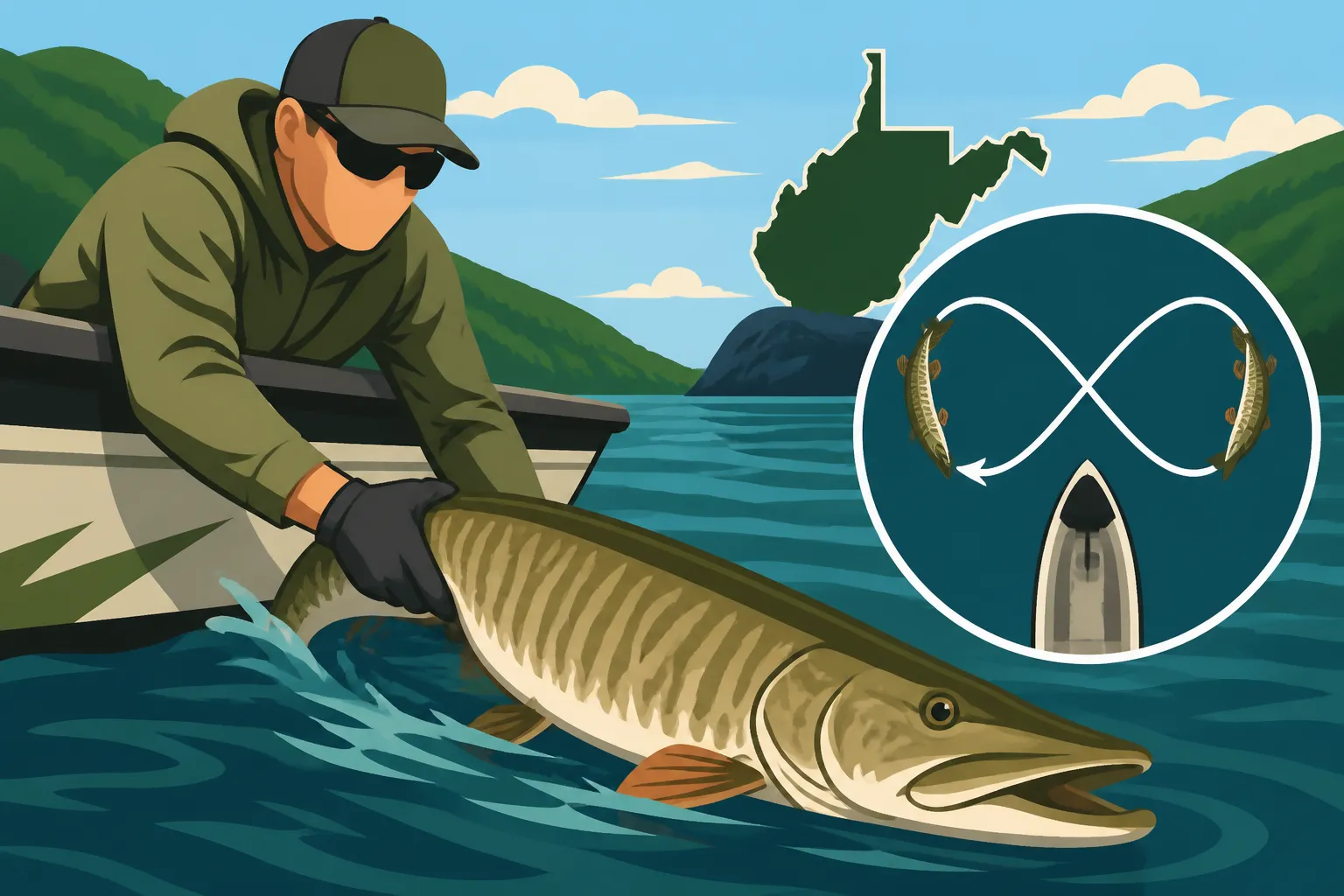
How to figure eight a muskie boatside
There are few things as heart-stopping in West Virginia fishing as having a massive muskie follow your lure all the way to the boat, only to turn away at the last second. This guide is all about mastering the figure eight technique, a crucial maneuver that can turn those frustrating boat-side follows into epic strikes and successful landings.
Understanding Why the Figure Eight is Critical for Muskie
Muskie fishing is often called the "sport of 10,000 casts," and a big part of that reputation comes from the exasperating experience of having a muskie shadow your lure right up to your boat, sometimes even bumping it, without committing to a strike. It's a moment that can make your heart leap into your throat, and then sink just as fast when the fish simply vanishes back into the depths. This is where the figure eight isn't just a fancy trick; it's an absolutely vital skill for any serious muskie angler in our beautiful Mountain State.
The Elusive Nature of Muskie Strikes
Muskie are notorious for their finicky nature. They are apex predators, yes, but they're also highly intelligent and often observe their prey before striking. Many times, a muskie will follow a lure for a considerable distance, inspecting it, assessing it, and probably wondering if it's worth the energy expenditure. This "follow-but-don't-commit" behavior is incredibly common, and it's precisely why anglers need a plan for that final few feet of retrieve.
Imagine you've been casting a big bucktail on the Little Kanawha River all morning, and suddenly, a shadow appears behind your lure. It grows, resolves into the unmistakable torpedo shape of a muskie, its eyes locked on your bait. Your heart pounds. Your hands might even tremble. As the lure gets closer and closer to the boat, the muskie stays glued to it. What happens next is critical. Many anglers, myself included in my early days, instinctively lift the lure out of the water too quickly, or stop the retrieve altogether, giving the muskie the perfect opportunity to peel off and disappear. That "boat-side" strike zone is the last chance you have to convert a curious follow into an aggressive strike, and it's a make-or-break moment.
Capitalizing on the Muskie's Instincts
The figure eight technique works because it directly capitalizes on a muskie's predatory instincts, particularly its ingrained chase response and its tendency to ambush. When your lure is retrieved in a straight line, the muskie has time to assess it. But when that lure suddenly changes direction rapidly and erratically at the boat, it often triggers a primal, reactive strike.
Think of it like this: a baitfish, fleeing a predator, doesn't just swim in a straight line and then stop. It darts, it changes direction, it makes desperate, erratic moves to escape. The figure eight mimics this frantic, last-ditch effort. By sweeping your rod tip in a wide, continuous figure eight (or sometimes an 'L' or 'O' pattern) right at the side of the boat, you keep the lure in the water and moving erratically. This sudden, unpredictable movement can be just the trigger a muskie needs to commit. It turns that moment of hesitation into a moment of pure aggression. The muskie, which was just casually following, suddenly sees an injured or fleeing meal making a desperate escape, and its instinct to strike takes over. It's a powerful tool in your arsenal, especially when you're fishing pressured waters or when muskie are particularly wary, which often happens in places like the Cheat River or the New River.
Essential Gear for a Successful Figure Eight
Executing a proper figure eight isn't just about technique; it's also heavily reliant on having the right gear. Trying to perform this maneuver with an undersized rod or weak line is not only ineffective but can also be dangerous, both for you and the fish. Investing in quality muskie-specific gear is non-negotiable if you want to increase your chances of landing these toothy giants. For a more general overview, check out our guide on Best Muskie Gear for West Virginia Rivers.
Rod, Reel, and Line Considerations
Let's talk about the backbone of your muskie setup.
- Rod: You need a heavy-duty muskie rod, typically 8 to 9.5 feet long, with a heavy power rating and a fast action. The length is crucial because it allows you to make those wide, sweeping figure eight motions effectively, keeping the lure away from your boat's hull. The heavy power provides the leverage needed to control a large muskie and drive those big hooks home during a boat-side strike. A fast action means the tip is sensitive enough for lure feedback, but the backbone kicks in quickly, which is vital for quick hooksets. Imagine trying to do a wide figure eight with a shorter, lighter bass rod – it just won't give you the reach or the authority you need. If you're looking for specific recommendations, you can find a lot of great options on sites like Amazon.
- Reel: A high-quality baitcasting reel is paramount. It needs a strong, smooth drag system that can handle the initial powerful surges of a muskie. Look for models designed for heavy lures and big fish, with a good line capacity. A comfortable handle and a solid retrieve ratio are also important for tirelessly casting large baits and quickly reeling in slack. Smooth operation is key, as you don't want any hitches in your retrieve, especially when a muskie is hot on your tail.
- Line: Heavy braided line is the standard for muskie fishing, usually in the 80 to 100-pound test range. Braid offers incredible strength, minimal stretch (which aids in powerful hooksets), and good abrasion resistance. Because muskie have razor-sharp teeth, you absolutely need a strong leader. A fluorocarbon or wire leader, often 100-200 pound test and 12-18 inches long, is tied directly to your braid via a strong knot. This leader prevents bite-offs and protects your main line from gill plates and teeth. Never skimp on your leader; it's the last line of defense between you and a trophy.
The Right Lures for Boating Presentation
While many lures can catch muskie, certain types excel when it comes to the figure eight. The key is a lure that moves well at slow speeds, has an erratic action, and can be easily kept in the water during the maneuver. Our article on Best Lures for Muskie Fishing in West Virginia dives deeper into specific options.
- Large Bucktails: These are classic muskie lures, and for good reason. Their flash and vibration are irresistible, and they're relatively easy to keep moving smoothly through a figure eight pattern. The blades continue to spin, and the bucktail pulsates, even at the slower speeds sometimes required around the boat.
- Glide Baits: These lures have a wide, side-to-side swimming action that can be manipulated beautifully in a figure eight. Their erratic glide mimics a wounded baitfish, which is exactly what you want to trigger a strike.
- Jerkbaits and Hard Baits: Larger jerkbaits, particularly those with a broad profile, can also be very effective. Their inherent darting action translates well into the figure eight, and their solid body can withstand repeated muskie attacks.
- Sharp Hooks: This might seem obvious, but it's worth emphasizing. Muskie mouths are bony, and their skin is tough. You need sticky-sharp treble hooks on all your lures. Replace dull hooks, and consider upgrading stock hooks if they don't meet muskie standards. A dull hook can cost you that trophy fish, even if you execute the perfect figure eight.
Safety and Landing Equipment
Landing a muskie is a dynamic and potentially dangerous process. These fish are powerful, full of sharp teeth, and have strong jaws. Proper landing gear isn't just about efficiency; it's about safety for both you and the fish.
- Long-Handled Net: This is your primary tool. A large, long-handled muskie net with a rubberized, knotless mesh is crucial. The long handle keeps your hands clear of the thrashing fish and hooks, and the wide opening allows for easy scooping. Rubberized mesh protects the fish's slime coat and fins, vital for a successful release. Don't cheap out here; a flimsy net will fail you when it counts. For more information, check out our guide on the Best Landing Net for Muskie.
- Hook Cutters/Long-Nose Pliers: Essential for quickly and safely removing hooks. Muskie often engulf lures, making standard pliers ineffective. Heavy-duty, long-handled hook cutters can snip trebles quickly if they're deeply embedded, minimizing stress on the fish. Long-nose pliers are great for leverage when the hooks are more accessible.
- Release Tools: A good jaw spreader can be helpful, though many experienced muskie anglers prefer to avoid them if possible to minimize jaw damage. A sturdy pair of release gloves can protect your hands from teeth and gill rakers.
- Gloves for Handling: While not always necessary for the landing itself, gloves are a good idea for handling a muskie, especially if you plan on a quick photo. They protect your hands from those sharp teeth and rough scales.
Step-by-Step Guide to Executing the Figure Eight
The figure eight is a fluid motion that requires practice, but once you get the hang of it, it becomes second nature. It's a critical skill for maximizing your chances on every cast, especially when fishing for the apex predators of West Virginia's waters.
Approaching the Boat and Recognizing a Follow
The figure eight begins long before the lure reaches the boat. Your retrieve leading up to the boat is just as important as the maneuver itself.
As your lure nears the boat, maintain your retrieve speed and tension. Don't slow down or, worse, stop reeling just because you're getting close. That's a common beginner's mistake. Instead, consciously extend your retrieve, bringing the lure right up to the gunwale. Keep your eyes peeled, not just on the lure, but behind it. Muskie are masters of camouflage, and often, you won't see them until they're within a few feet of your bait. You're looking for that tell-tale shadow, the flash of a side, or the entire fish appearing like a submarine in your wake.
When you spot a muskie following, the first instinct is often to lift the lure out of the water. Fight that urge! The goal is to keep the lure in the water and moving. If you rip it out, you've essentially told the muskie the game is over. Instead, smoothly transition from your retrieve into the figure eight motion. This smooth transition is key; any sudden jerk or stop can spook the fish.
Initiating the Figure Eight Maneuver
Once the muskie is spotted at the boat, it's time to act. This is where the actual "figure eight" shape comes in, though some anglers also use an 'L' or 'O' pattern, depending on the situation and the fish's behavior.
The basic figure eight is performed by sweeping your rod tip in a wide, continuous motion, tracing the shape of a figure eight in the water at the side of your boat. Your lure should never leave the water. The idea is to keep the lure moving, changing direction sharply at the "turns" of the eight.
Here's how to initiate it:
- Lower your rod tip: As the lure gets to the boat, drop your rod tip into the water, leading with your rod.
- Wide sweep: Begin a wide, smooth sweep of your rod. If you're right-handed, you might sweep out to the right, then down, then across to the left, then up. It should be a continuous, fluid motion, using your arm and body to generate the arc.
- Keep it going: Don't stop. Keep the lure moving in that pattern. The turns of the eight should be as wide as you can comfortably make them, usually extending at least a full rod length from the boat, if not more. A common beginner mistake is making the figure eight too small, which doesn't give the muskie enough room to react or truly believe the baitfish is trying to escape.
The "L" pattern is similar but might involve sweeping the lure away from the boat, then pulling it back along the gunwale. The "O" pattern is simply a continuous circle. The most important thing is continuous, erratic movement, keeping the lure in the water.
Varying Speed and Depth to Trigger a Strike
Just doing the figure eight isn't always enough. Sometimes, a muskie will continue to follow the pattern, still hesitant. This is where you become a true predator, manipulating the lure to trigger that final strike.
- Accelerate through turns: Often, accelerating the lure sharply as it goes through the "turns" of the figure eight can trigger a strike. Imagine a baitfish making a desperate burst of speed to escape. This sudden acceleration is often what breaks the muskie's hesitation. Crank your reel handle quickly for a few rotations as you round the turn, then slow down slightly for the straightaways.
- Change depth subtly: You can also subtly change the depth of your lure within the figure eight. By raising or lowering your rod tip slightly, you can make the lure dive a bit deeper or come closer to the surface. Sometimes, a muskie is looking for a lure that's just a foot or two deeper or shallower than where you're presenting it.
- Read the muskie's reaction: Pay close attention to the muskie's body language. Is it staying tight on the lure? Is its mouth opening slightly? Is it getting more aggressive? If the fish looks like it's losing interest, try a sudden change in speed or a deeper sweep. If it's getting more aggressive, keep doing what you're doing, but be ready for the strike. This is a game of cat and mouse, and you're the one pulling the strings.
Setting the Hook and Landing the Fish
When a muskie strikes during a figure eight, it's often violent and happens very close to the boat. You need to be ready to react instantly and decisively.
- React to the strike: When the muskie hits, it will often be an explosive strike, a sudden weight, or a flash of green and gold. Don't hesitate.
- Strong hookset: Swing hard! Muskie have incredibly hard, bony mouths. A gentle hookset simply won't do. Use your heavy muskie rod to drive those large hooks home with all your might. It's often a side-sweep hookset rather than an overhead one due to the close quarters.
- Using the net effectively: Once the muskie is hooked, the fight is on, and it's happening right at the boat. Keep the fish's head up and guide it towards your waiting net. Your partner should be ready with the net, submerging it and scooping the fish headfirst. Once the muskie is in the net, lift it quickly but carefully into the boat. Do not try to horse a big muskie in without a net; it's dangerous and often results in lost fish and broken gear. Always prioritize the safety of both yourself and the fish. Remember, West Virginia has specific Muskie Regulations in West Virginia Waters regarding size and possession, so be sure you know the current rules.
Common Mistakes and How to Avoid Them
Even seasoned anglers can make mistakes with the figure eight, especially when the adrenaline of a muskie follow kicks in. Recognizing and correcting these common pitfalls can significantly improve your success rate.
Lifting the Lure Out of the Water Prematurely
This is, by far, the most common and frustrating mistake. You've spent hours casting, finally get a muskie to follow, and then, at the critical moment, you subconsciously lift your lure out of the water. The muskie, seeing its "prey" vanish, simply turns and swims away. It's an agonizing moment.
Why it happens: It's a natural reaction. We retrieve a lure, and when it reaches the boat, we're accustomed to lifting it for the next cast. When a muskie shows up, the excitement and surprise can make you forget your training and revert to old habits. The muskie itself can also be deceptive; sometimes they just lazily follow, giving no indication of striking, leading you to think they're not interested.
How to avoid it: Cultivate an "always-on" mentality. From the moment your lure hits the water until it's back for the next cast, assume a muskie could be there. When the lure approaches the boat, make a conscious decision to transition directly into the figure eight without pausing or lifting. Think of your rod tip as an extension of the lure, and that lure should never break the surface. Practice dry runs (without a fish) to build muscle memory. Make it a routine.
Rushing the Figure Eight or Making it Too Small
Another frequent error is making the figure eight too tight or performing it too quickly, denying the muskie the space and time it needs to react and strike.
Why it happens: Adrenaline. When a muskie is at the boat, you're excited, perhaps a little nervous. You might rush the maneuver, making small, jerky motions. Or you might try to keep it too close to the boat for fear of losing sight of the fish. These small, rushed movements don't mimic fleeing baitfish effectively and can actually deter a strike. A muskie is a large, powerful fish; it needs room to turn and strike effectively.
How to avoid it: Consciously make your figure eight movements wide and smooth. Use your entire arm and body to sweep the rod, creating large, deliberate arcs in the water. Extend the lure as far as your rod length allows, keeping it a good distance from the boat. Imagine you're drawing a giant figure eight on the surface of the water. Vary your speed as discussed earlier, but always maintain a smooth, flowing motion. Give the muskie space to make its move. Our guide on Best Techniques for Muskie Fishing also emphasizes these fluid movements.
Improper Rod Angle and Body Positioning
Your body mechanics play a huge role in the effectiveness and safety of the figure eight. Poor rod angle or an unbalanced stance can lead to missed fish, tangles, or even an uncomfortable and unsafe situation.
Why it happens: In the excitement, anglers often forget basic angling posture. They might stand too close to the gunwale, have their rod held too high, or be off-balance. This reduces leverage, makes wide sweeps difficult, and can put you in an awkward position if a large muskie suddenly strikes.
How to avoid it:
- Maintain leverage: Keep your rod tip low and pointed towards the lure, even during the sweeps. This gives you maximum leverage and allows you to quickly set the hook.
- Balanced stance: Stand with your feet shoulder-width apart, slightly bent knees, and be ready to pivot. Your body should be able to move with the rod, not against it. This helps you generate power for the sweeps and absorb the shock of a strike.
- Distance from the gunwale: Give yourself some room from the boat's edge. This allows you to extend your rod fully during the figure eight and prevents the lure from hitting the boat if the muskie makes a sudden lunge. Think about how you'd fight a fish from an open stance, ready for anything.
Losing Focus After a Follow
Sometimes, a muskie will follow your lure, you'll perform a perfect figure eight, and still, the fish just turns and leaves. It's deflating, but it's crucial not to let it break your concentration.
Why it happens: Muskie fishing is a mental game. The sheer effort of casting heavy lures all day, combined with the occasional heart-stopping follow that doesn't convert, can lead to fatigue and frustration. It's easy to lose focus and let your guard down on subsequent casts after such an event.
How to avoid it: Treat every follow, whether it results in a strike or not, as valuable information. Take a moment, observe where the fish went (if possible), and consider what you might do differently next time. Did you vary the speed enough? Was the figure eight wide enough? Then, immediately reset your mindset. Every cast has the potential for a muskie. Maintain your focus, retrieve your lure completely on every cast, and be ready to execute the figure eight every single time. Consistent effort and unwavering focus are hallmarks of successful muskie anglers. Even if you just missed a fish, the next cast could bring an even bigger one. This mental resilience is key when chasing these elusive fish in West Virginia's rivers and lakes.
Advanced Tips and Practice for Muskie Anglers
Once you've got the basic figure eight down, there's always room to refine your technique and adapt it to different situations. Muskie fishing, especially in diverse West Virginia waters, demands adaptability and constant learning.
Experimenting with Different Figure Eight Variations
The classic figure eight is a great starting point, but it's not the only move in the muskie angler's playbook. Understanding when and how to vary your approach can make a significant difference, especially with highly pressured or finicky fish.
- The 'O' or 'U' Patterns: Sometimes, a muskie might respond better to a continuous circle ('O') or a sweeping 'U' shape, particularly if it's circling the boat. These patterns maintain continuous movement but can sometimes be less aggressive than the sharp turns of a traditional figure eight. The key is to keep the lure moving and changing direction, even subtly. Observe the muskie's behavior: if it's circling wide, a wider 'O' might be better. If it's staying tight to the boat, a tighter 'U' might provoke a strike.
- Vertical Figure Eights: While most figure eights are horizontal to the water's surface, sometimes a vertical presentation can be deadly. This involves raising and lowering your rod tip while still making those sweeping motions, causing the lure to dive and ascend within the figure eight. This can be particularly effective if the muskie is holding deeper or seems interested in an upward-moving target. It adds another dimension of erratic movement.
- "Hang Time" at the Turns: Some anglers find success by momentarily pausing or slowing the lure at the "turns" of the figure eight, letting it "hang" for a split second before accelerating into the next sweep. This hesitation can sometimes trigger a reactionary strike, mimicking a baitfish that's momentarily stunned or disoriented. It's a subtle tactic but can be very effective when muskie are particularly cautious. Remember, the goal is to present something unusual and irresistible.
Practicing Without a Fish
Just like any skill, the figure eight requires practice to become smooth and instinctive. You don't need a muskie on your line to hone your technique.
- Muscle Memory and Technique Refinement: Practice the motion in your yard, on a dock, or even in your living room (carefully!). Get comfortable with the wide sweeps, the rod movements, and the body positioning. Work on making the transitions from retrieve to figure eight seamless. Focus on keeping the rod tip low and the movements fluid. The more you practice, the more natural it will feel when a muskie finally shows up.
- Simulating Real-Life Scenarios: Imagine a muskie is behind your lure. Practice varying your speed, changing depth, and executing different patterns. Envision the fish and how it might react. This mental rehearsal can be incredibly valuable for developing the quick reflexes and decision-making skills needed when a real muskie appears. You can even attach a simple piece of rope or a tennis ball to your line to simulate the feel of a lure in the water.
Understanding Muskie Behavior in West Virginia Waters
Muskie behavior isn't always uniform; it can vary based on location, time of year, and local conditions. Understanding these nuances can help you apply the figure eight more effectively across different West Virginia fishing spots. For a deeper dive into their habitat, check out Where to Find Muskie in West Virginia.
- Local Conditions Affecting Follow-Throughs: In clear, calm waters like some sections of the South Branch Potomac, muskie might be warier and require more subtle, wider figure eights. In stained or choppy water, like parts of the Ohio River, they might be more aggressive and respond to faster, more erratic movements. Water temperature also plays a role. In colder water, muskie might need slower, more deliberate presentations, while warmer water can mean faster, more aggressive maneuvers.
- Time of Day, Water Clarity, Pressure: Muskie activity, and thus their willingness to strike at the boat, can fluctuate. Low-light conditions (dawn, dusk, cloudy days) often encourage more aggressive behavior. After a period of heavy fishing pressure, muskie might become more educated and require more creative figure eight variations. Always consider these factors when you're on the water.
- Seasonal Patterns: The Best Time of Year to Fish in West Virginia for muskie can influence their behavior. During the spawn (typically spring), muskie might be less interested in chasing. In the fall, however, they often enter a feeding frenzy, making the figure eight an incredibly potent tool. For specific techniques, check out Best Techniques for Fall Muskie Fishing. Learning these patterns will help you anticipate muskie reactions and tailor your figure eight approach. The more you understand about general Muskie Fishing in West Virginia, the better your chances of success.
| Common Figure Eight Mistakes | Why It Happens | How to Fix It |
|---|---|---|
| Lifting Lure Too Soon | Instinct to end retrieve | Consciously commit to the figure eight; keep rod tip low, lure in water. Practice "always-on" mentality. |
| Figure Eight Too Small | Adrenaline, fear of losing fish | Use full arm and body for wide, sweeping arcs. Extend lure as far as rod length allows from the boat. Imagine drawing a large '8'. |
| Rushing Movements | Excitement, nervousness | Maintain smooth, fluid motions. Vary speed deliberately (accelerate on turns, slow on straights) but avoid jerky, uncontrolled movements. |
| Improper Rod Angle/Body Position | Forgetting basics in excitement | Keep rod tip low for leverage. Stand balanced, ready to pivot. Position yourself to allow full arm extension for wide sweeps, maintaining a safe distance from the gunwale. |
| Losing Focus After a Follow | Frustration, fatigue | Treat every follow as information. Immediately reset your mindset for the next cast. Maintain vigilance and assume every cast has the potential for a boat-side follow. |
Disclaimer
This article is for general informational purposes only and does not constitute professional advice. Laws, prices and regulations vary by location and change over time. Consult a qualified professional for guidance on your specific situation.