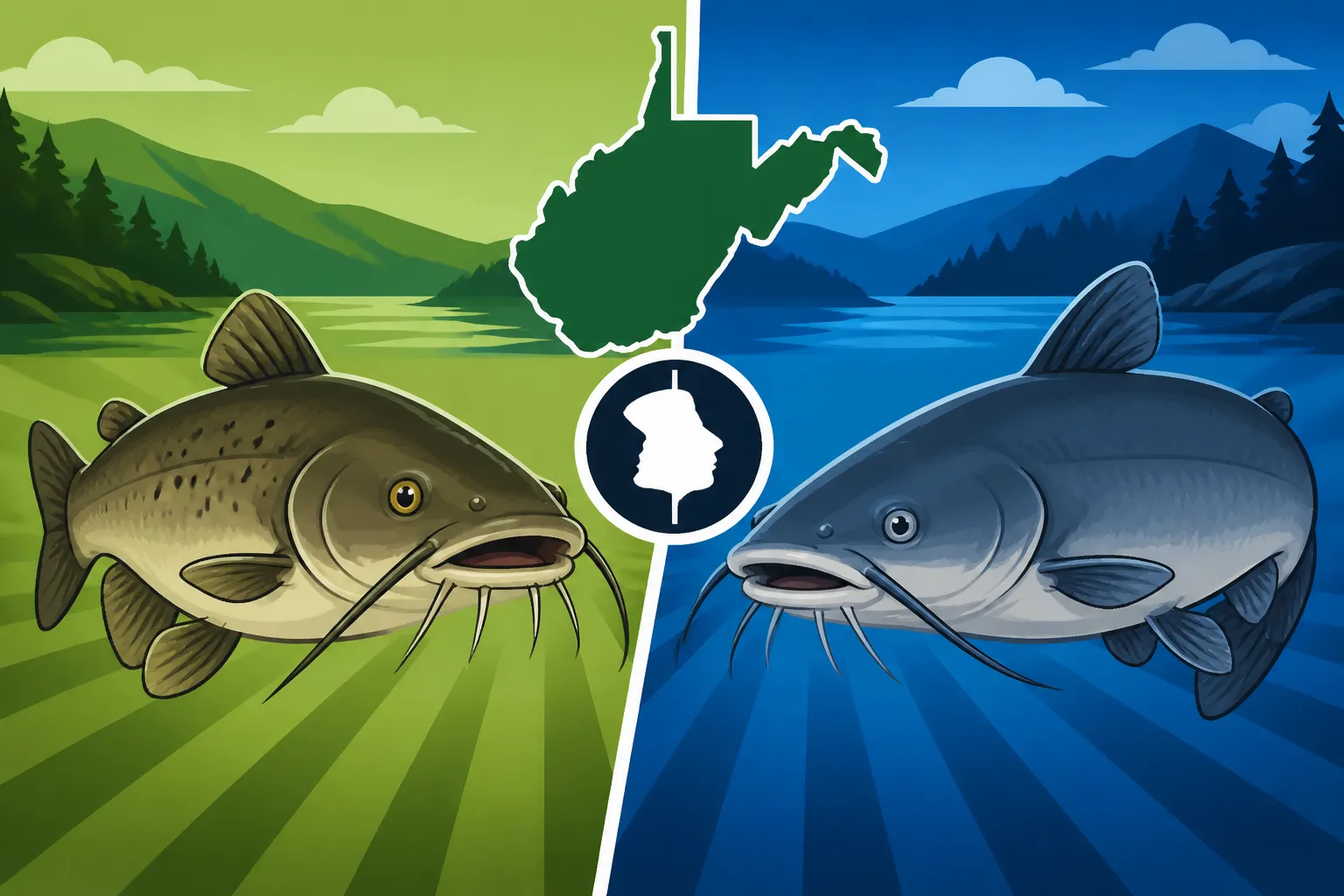
How to identify a channel catfish vs a blue catfish
There’s nothing quite like the tug of a big catfish on your line in West Virginia’s beautiful waters. You fight it, you land it, and then… you pause. Is it a channel cat or a blue cat? This is a question that stumps many anglers, even seasoned ones, because these two popular species, while distinct, can look surprisingly similar, especially when they're not fully grown or if you're fishing murky waters. This guide is here to untangle that confusion, providing you with clear, practical ways to confidently tell the difference between a channel catfish and a blue catfish, so you can adhere to regulations, refine your techniques, and truly know your catch.
The Catfish Conundrum in West Virginia Waters
West Virginia is blessed with a fantastic variety of fishing opportunities, and our rivers and lakes are home to some truly impressive catfish. From the mighty Ohio River to the tranquil ponds, catfish are a staple for many anglers, known for their powerful fights and delicious fillets. But the close resemblance between channel catfish and blue catfish often leads to head-scratching moments at the water's edge. Many folks just lump them all together as "catfish," and while that's fine for casual conversation, it can lead to issues when it comes to understanding fish behavior, targeting specific species, or even following local regulations.
Why Identification Matters for Anglers
Knowing exactly what kind of catfish you've caught isn't just about showing off your fish ID skills (though that's a bonus!). It has real, practical implications for your fishing experience. For starters, West Virginia Fishing Regulations Explained can have different size or bag limits for various species. Imagine proudly showing off a stringer of fish only to find out you've inadvertently kept too many of one species because you misidentified it! Beyond compliance, understanding whether you have a channel or a blue can inform your future strategies. These species, while both catfish, often have slightly different preferences for habitat, bait, and even how they bite.
The West Virginia Catfish Scene
Both channel catfish and blue catfish thrive in various West Virginia waterways. Channel cats are far more widespread, found in nearly all suitable waters, from small creeks to large rivers and lakes across the state. They're incredibly adaptable and a favorite target for many. Blue catfish, on the other hand, are primarily found in the larger river systems, particularly the Ohio River and its major tributaries like the Kanawha. They prefer the main channels of large, flowing rivers and are known for growing to immense sizes. While both are fantastic sport fish, the sheer size potential of a blue cat is often what draws dedicated trophy anglers. Are There Blue Catfish in West Virginia? dives deeper into their distribution.
Key Distinguishing Features: Channel Catfish
Let's break down the classic characteristics of the channel catfish, the most common cat you'll encounter in West Virginia. Think of these as the "tells" that give them away, even if they're trying to play coy.
Body Shape and Coloration
Channel catfish generally have a more slender, streamlined body compared to their blue counterparts. They're built for agility. Their coloration can vary quite a bit depending on the water clarity and substrate where they live, but they are typically olive-brown to silvery-gray on their backs, fading to white or cream on their bellies. The most telling feature, especially for younger or smaller channels, is the presence of distinct, small, dark spots scattered along their sides. These spots often fade or even disappear completely on very large, older channel cats, which is where some of the identification confusion begins. So, if you see spots, it's almost certainly a channel, but a lack of spots doesn't automatically rule them out!
Mouth and Jaw Structure
Take a close look at the mouth. For a channel catfish, the upper jaw (the maxilla) will typically extend slightly beyond the lower jaw. It's a subtle but consistent trait. This gives their mouth a bit of an "underbite" appearance, though it's more accurately described as the upper jaw overhanging the lower. This difference in jaw alignment can also influence how they feed and what baits they prefer, often being more opportunistic feeders.
Anal Fin Characteristics
Now, this is one of the most reliable indicators. The anal fin is the single fin located on the underside of the fish, behind the anus and before the tail fin. For a channel catfish, this fin will have a noticeably rounded or convex shape along its free margin. More importantly, if you can carefully count the rays (the spiny or soft supports within the fin), a channel catfish will typically have between 24 and 29 rays. This requires a bit of careful observation, but it's a definitive ID marker. Try to count them by gently fanning out the fin if the fish is calm.
Tail (Caudal Fin) Shape
The tail fin, also known as the caudal fin, on a channel catfish is deeply forked. We're talking about a distinct "V" shape, almost like a swallow's tail. This deep fork is one of the easiest visual cues, particularly from a distance, and it contributes to their swift movement in varied water conditions. It’s a classic catfish tail in many anglers' minds.
Barbels and Whiskers
Channel catfish have eight barbels, or "whiskers," which are sensory organs used to find food in murky water or at night. They have two on the chin, two on the sides of the head near the mouth, and four longer ones on the upper jaw. These barbels are generally dark, matching their body coloration, and can be quite prominent. They might not be a primary distinguishing feature from blues in terms of number or placement but contribute to their overall appearance.
Key Distinguishing Features: Blue Catfish
Now, let's turn our attention to the blue catfish, the true giants of West Virginia's catfishing world. These magnificent fish have their own set of unique characteristics that set them apart.
Body Shape and Coloration
Blue catfish tend to have a more robust, heavy-bodied appearance than channels, especially as they get larger. They are built for power. Their coloration is typically a uniform slate-blue or gray on their back and sides, fading to white on their belly. The key here is "uniform" – adult blue catfish do not have the distinct dark spots that are often found on channel catfish. While a very young blue cat might have some faint mottling, it's rarely the clear, distinct spotting of a channel. This lack of spots is a huge clue. They can sometimes appear almost silvery depending on the water they're in, but the overall lack of patterning is consistent.
Mouth and Jaw Structure
In contrast to the channel catfish, the blue catfish usually has an upper jaw and lower jaw that are relatively equal in length, or sometimes the lower jaw might even protrude slightly. This gives them a more terminal mouth, meaning it's located right at the front of the head. This subtle difference is important because blue cats are often piscivores, meaning they primarily eat other fish, and this mouth structure is well-suited for engulfing prey.
Anal Fin Characteristics
Here's another one of the absolute best ways to tell them apart: the anal fin. On a blue catfish, the free margin of the anal fin will be notably straight, or even slightly concave, giving it a much straighter, almost "clipped" appearance compared to the channel's rounded fin. And the ray count? Blue catfish typically have a higher number of rays, ranging from 30 to 35 or more. This is the most scientific and reliable method of differentiation. Once you learn to count those rays, you'll be able to identify them with confidence, even for juveniles. Catfish Species Identification Guide for West Virginia further elaborates on this and other catfish.
Tail (Caudal Fin) Shape
While blue catfish also have a forked tail, it is generally less deeply forked than that of a channel catfish. It's still a "V" shape, but the indentation isn't as pronounced. It might be described as moderately forked. Observing the degree of the fork can be a good secondary indicator, especially when other features are less clear.
Barbels and Whiskers
Similar to channel cats, blue catfish also possess eight barbels. These barbels are generally dark and prominent, serving the same sensory function. The number and basic arrangement are not a distinguishing factor between channels and blues, but their overall appearance contributes to the classic "catfish" look.
Side-by-Side Comparison: Channel vs. Blue Catfish
Sometimes, seeing the differences laid out side-by-side makes all the difference. This table highlights the primary characteristics we've discussed, giving you a quick reference point when you're on the water.
| Feature | Channel Catfish | Blue Catfish |
|---|---|---|
| Body Shape | More slender, streamlined | More robust, heavy-bodied, especially large ones |
| Coloration | Olive-brown to silvery-gray, often with dark spots (especially juveniles) | Uniform slate-blue or gray, typically no spots |
| Mouth/Jaw | Upper jaw extends beyond lower jaw (slight "overbite") | Jaws usually equal, or lower jaw slightly protrudes |
| Anal Fin Shape | Rounded (convex) | Straight or slightly concave ("clipped" appearance) |
| Anal Fin Ray Count | 24-29 rays | 30-35+ rays (most reliable indicator) |
| Tail Fork | Deeply forked ("V" shape) | Moderately forked (less pronounced "V") |
Beyond the Obvious: Subtle Clues
While the anal fin ray count and the presence or absence of spots are your go-to methods, there are a few other subtle clues that experienced anglers might pick up on. For example, some suggest that blue catfish tend to have a more pronounced hump behind their head, giving their back a more arched appearance, especially in larger specimens. Their eyes might also appear relatively smaller compared to the size of their head when contrasted with a channel cat of similar size. These are not definitive on their own, but when combined with the primary indicators, they can build a stronger case for identification. Also, consider the habitat: a giant catfish caught in the main stem of the Ohio River is statistically more likely to be a blue cat, while one pulled from a small pond is almost certainly a channel.
Common Misidentification Scenarios and Tips
It's easy to stand by the bank and say, "just count the rays!" but the reality of fishing can be a little different. Fish squirm, water is murky, and sometimes you just want to get your line back in the water! Let's address some common reasons for confusion.
Juvenile Catfish Confusion
This is perhaps the trickiest scenario. Young channel catfish often have very prominent spots, making them relatively easy to identify. However, young blue catfish can sometimes have a faint, mottled appearance that might be mistaken for spots by an untrained eye, especially if you're not looking closely or in poor lighting. As they grow, these "spots" on blue cats disappear, while channel cat spots can fade or vanish on older, larger fish. This is where the anal fin ray count becomes your absolute best friend. Regardless of size or age, the number of rays in that fin will hold true.
Hybridization and Variations
While true hybridization between channel and blue catfish is considered rare in the wild, natural variations within each species can sometimes throw a curveball. A channel cat might be unusually dark and lack spots, or a blue cat might be lighter than average. Environmental factors like diet, water clarity, and genetics can all influence a fish's appearance. However, these are exceptions, not the rule. Focus on the core physical attributes, especially the anal fin, which is less subject to environmental variation. Rest assured, the vast majority of catfish you'll encounter will clearly fall into one category or the other with careful examination.
When in Doubt: "Counting the Rays"
Seriously, if you take one thing away from this guide, make it this: when in doubt, count those anal fin rays. It's the most reliable, scientific method for distinguishing between channel catfish and blue catfish. Gently spread the fin and use a finger or a small stick to count the individual rays. Take your time. It might feel a bit awkward at first, but with practice, it becomes second nature. This skill is invaluable for any serious catfish angler.
Why Accurate Identification Matters for West Virginia Anglers
Beyond the personal satisfaction of knowing your catch, accurate identification plays a crucial role in responsible angling and can even enhance your fishing success.
Following Regulations and Bag Limits
As mentioned, West Virginia's fishing regulations are designed to protect fish populations and ensure sustainable fishing for everyone. Sometimes, different catfish species might have varying regulations regarding size, creel limits (the number you can keep), or even specific areas where they can be harvested. For example, West Virginia Bag and Possession Limits by Species might differ for these two fish. Misidentifying a fish could inadvertently lead to violations, which no angler wants. Being confident in your identification means you're always fishing legally and responsibly.
Understanding Behavior and Targeting
Channel catfish and blue catfish, while both bottom-dwelling predators, have some nuanced differences in behavior and preferred habitats. Channel cats are highly opportunistic, eating almost anything from insects and crustaceans to dead bait and small fish. They're often found in a wider range of habitats, including slower currents, ponds, and even smaller rivers. Blue cats, especially the big ones, are more piscivorous, preferring live or cut baitfish, and they favor the main channels and deeper, swifter currents of large rivers. Knowing which species you're catching helps you refine your tactics. If you're consistently catching channel cats in a certain spot, you'll know that perhaps adjusting your bait or moving to a different type of water might be more effective for landing a blue. Understanding What channel catfish eat in West Virginia lakes versus what a blue cat might prefer in the Ohio River can make a huge difference in your success.
Contributing to Conservation Efforts
Every time an angler accurately identifies and reports their catch (especially for state record applications or citizen science programs), they contribute valuable data to wildlife agencies. This information helps biologists monitor fish populations, understand distribution, and make informed decisions about stocking, regulations, and habitat management. When anglers consistently misidentify species, it can skew these data sets and potentially hinder conservation efforts. So, your accurate identification isn't just for you; it's a small but meaningful contribution to the health of West Virginia's aquatic ecosystems. Learning Catfish Fishing in West Virginia will help you respect and preserve the species you're targeting.
Disclaimer
This article is for general informational purposes only and does not constitute professional advice. Laws, prices and regulations vary by location and change over time. Consult a qualified professional for guidance on your specific situation.