Best jon boat size for shallow rivers
Navigating the beautiful, often unpredictable, rivers of West Virginia can be a truly rewarding experience for anglers. But anyone who’s spent time on our waterways knows that "shallow" can mean a lot of things, and picking the wrong boat for those skinny stretches and rocky shoals can quickly turn a peaceful fishing trip into a frustrating ordeal. This guide is dedicated to helping you unravel the mystery of jon boat sizing, specifically focusing on what dimensions and features will serve you best when you're targeting those hard-to-reach spots in our beloved Mountain State rivers.
Navigating West Virginia's Unique Shallow Rivers
West Virginia's rivers are a diverse tapestry, from the winding smallmouth bass havens to larger flows that still have surprisingly shallow sections. Understanding the nature of these rivers is the first step in choosing the perfect jon boat. It's not just about hitting a certain depth; it's about how that depth interacts with current, structure, and obstacles.
Understanding Water Depth and Fluctuations
When we talk about shallow rivers in West Virginia, we're often looking at places where the water might only be inches deep in spots, even if there are deeper holes nearby. Rivers like the Greenbrier, the South Branch of the Potomac, or even sections of the New River can present significant depth challenges, especially during dry spells or late summer. You might launch in what seems like decent water, only to find yourself scraping bottom a mile downstream. This constant variability means you need a boat that can truly float in minimal water, allowing you to access those untouched bends and riffles where fish often hide, rather than being confined to the main, deeper channels. The ideal jon boat for these conditions will have a minimal draft, which is how much water the boat displaces.
Moreover, our rivers are dynamic. A heavy rain can turn a gentle stream into a raging torrent, and then a week later, it can be back to ankle-deep water. This fluctuation means a boat that performs well in one condition might be a liability in another. For instance, a boat that's too light can be easily pushed around by strong currents, while one that's too heavy might not float shallow enough when the water drops. You want a boat that offers a balance, giving you the confidence to navigate the ebb and flow of West Virginia's changing river landscape. Having a boat that can handle these shifts means you're not constantly checking gauges or worrying about getting stranded.
Dealing with Current and Obstacles
Beyond just depth, West Virginia's rivers are often characterized by their current and abundant structure. Picture a smallmouth bass stream like the Elk River or the Cheat River; you've got rapids, riffles, gravel bars, and boulders galore. A longer, heavier boat designed for open lakes might become a handful in such an environment. It's harder to pivot, difficult to stop, and more prone to hitting submerged rocks or logs that are just out of sight. A boat that's too unwieldy can quickly become a safety concern, not to mention damaging to your hull.
This is where maneuverability really shines. A well-sized jon boat for shallow, obstacle-rich rivers needs to be nimble. You need to be able to turn on a dime, backpaddle effectively (if you're using a motor), and navigate tight spaces with precision. Imagine trying to hold your position in a swift current while casting to a promising eddy behind a submerged boulder. A boat that responds quickly to your inputs, whether from a trolling motor or a push pole, makes all the difference. You're not just moving from point A to B; you're actively working the water, and your boat needs to be an extension of your fishing strategy, not a hinderance. For more on safe boating, check out West Virginia Boating Laws for Anglers.
Key Dimensions: Length, Width, and Draft for Shallow Waters
When you're looking at jon boats, the numbers on the spec sheet tell a big part of the story, but it's how those numbers translate to real-world performance on a shallow river that truly matters. Length, width (or beam), and draft are your primary considerations.
Length: Maneuverability vs. Space
The length of your jon boat is a crucial factor, impacting both its maneuverability and how much space you have inside. For shallow, winding West Virginia rivers, shorter is often better, but there's a limit.
-
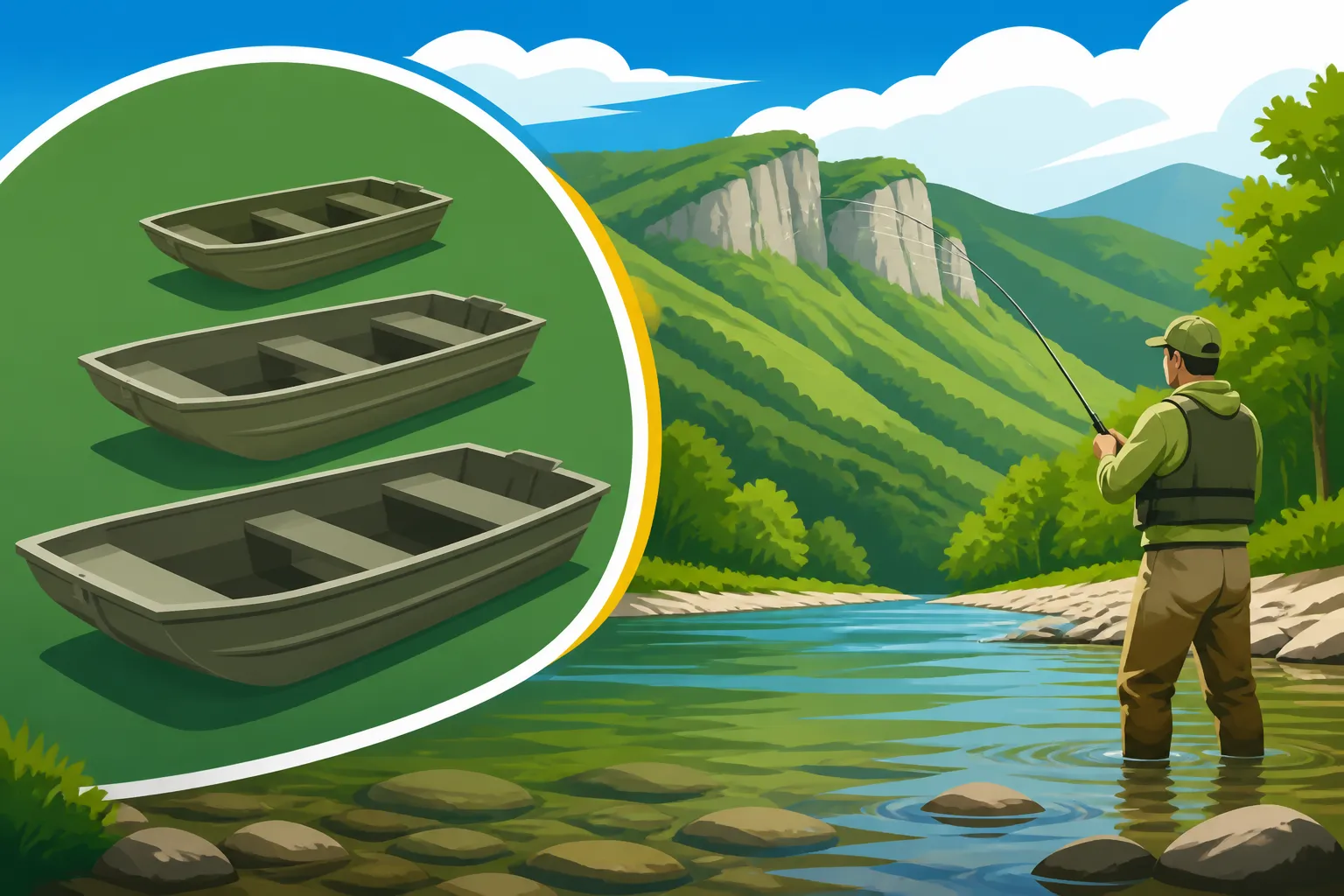
Shorter Jon Boats (10-12 feet): These are the kings of tight spaces and ultimate shallow-water access. A 10 or 12-foot jon boat can be easily pushed, paddled, or motored into incredibly skinny water. They turn quickly, making it easier to navigate around submerged rocks, fallen trees, and tight bends that are common in smaller streams. They're also typically lighter, making them easier to launch and retrieve, especially at unimproved access points often found along our more remote rivers. You can often car-top these or transport them on a small utility trailer. However, the trade-off is limited interior space. If you're a solo angler with minimal gear, this size might be perfect. But add a buddy, a cooler, and a couple of rod cases, and things can get cramped fast, potentially impacting stability. For those exploring really tight spots, these smaller boats offer fantastic access.
-
Medium Jon Boats (14-16 feet): This length often represents a sweet spot for many West Virginia river anglers. A 14-foot jon boat provides a good balance between maneuverability and space. You can comfortably fish two people with gear, and even three if you pack light. While slightly longer, they still generally float quite shallow and can be effectively navigated through modest currents and around obstacles. A 16-foot boat offers even more room for gear or another angler, but you'll start to notice a decrease in nimble handling in the tightest river sections. They're generally more stable than their shorter counterparts, which can be a real plus when standing to cast in choppy water or when a fishing partner moves around. However, the increased length means a larger turning radius and a bit more challenge when negotiating very narrow channels or trying to quickly pivot to avoid an underwater hazard. You might find a good selection of these sizes at places like Bass Pro Shops.
Width and Stability: Casting Platforms and Safety
The width, or beam, of a jon boat directly impacts its stability. In shallow, sometimes turbulent rivers, stability is paramount for both safety and effective fishing.
-
Narrower Jon Boats (Under 40 inches bottom width): While a narrow boat might slip through tight spots a bit easier, it sacrifices significant stability. Standing to cast, especially when drift fishing or trying to gain a better vantage over submerged structure, can feel precarious. If you're fishing solo and plan to mostly sit, it might be manageable, but for two anglers or any kind of active casting, a narrow boat can feel tippy and unsafe, especially if you encounter boat wakes or sudden changes in current. The risk of accidental falls or gear overboard increases considerably.
-
Wider Jon Boats (40 inches or more bottom width): A wider bottom on your jon boat translates to a much more stable platform. This is a huge advantage in West Virginia's rivers where you might be standing to sight-fish for smallmouth, or needing to quickly shift weight to avoid a submerged log. A wider boat allows for more confident casting, easier movement around the boat, and simply feels safer, especially if you have gear, dogs, or kids on board. While it might draw an inch or two more water, the enhanced stability is often worth it for the improved fishing experience and peace of mind. For example, a 14-foot jon boat with a 48-inch bottom width will feel dramatically more secure than one with a 36-inch bottom width. This extra width also provides more room for gear, making it easier to arrange tackle boxes and coolers without tripping over them.
Draft: How Deep Your Boat Sits
Draft is arguably the most critical dimension for shallow river fishing. It refers to how much vertical distance the lowest part of your boat extends below the waterline. The less draft, the shallower the water you can float in.
Jon boats are inherently designed for shallow draft, often having a flat or nearly flat bottom. However, the actual draft will depend on the boat's design, length, width, and, critically, how much weight you put in it. A 12-foot jon boat might technically float in 4 inches of water when empty, but add two anglers, a battery, a motor, and a day's worth of gear, and that draft could easily double. This is why lighter construction and thoughtful gear packing are so important. The goal is to maximize your floatation while carrying everything you need.
When considering draft, also think about the prop of your outboard motor or the skeg of your trolling motor. These often extend deeper than the hull itself. Many shallow river anglers opt for jet-drive outboards or mud motors precisely because they minimize the draft of the propulsion system, allowing them to navigate incredibly shallow water that would instantly chew up a traditional prop. Without a low draft, you'll find yourself constantly lifting your motor, or worse, damaging it, when traversing our numerous rocky shoals.
Matching Your Jon Boat to Your Fishing Style and River Type
Choosing the right jon boat size isn't just about the numbers; it's about how those numbers align with your specific fishing adventures in West Virginia. Are you a solo angler seeking solitude, or do you always bring a crew? What kind of gear do you need to bring? And perhaps most importantly, which West Virginia rivers are you planning to explore?
Solo Angler vs. Fishing with Buddies: Space and Weight
Your typical crew size is a huge determinant in optimal jon boat sizing.
-
For the Solo Adventurer: If you're primarily a solo angler, a smaller jon boat, perhaps in the 10 to 12-foot range, is often ideal. These boats are lighter, easier to handle by yourself, and can be maneuvered into the tightest spots without assistance. They're also simpler to launch and retrieve from less-than-perfect river access points. The reduced weight means they float incredibly shallow, perfect for those super skinny sections of the Elk or Greenbrier rivers. You can easily manage gear for one person, like a small tackle box, a cooler, and a couple of rods. Think about how much easier it is to navigate a compact vehicle through a narrow forest road compared to a full-size truck – the same principle applies here. Plus, the fuel consumption with a smaller motor will be minimal.
-
Fishing with a Partner or Small Crew: If you consistently fish with one or two others, stepping up to a 14 to 16-foot jon boat makes a world of difference. This provides the necessary space for two or three adults to fish comfortably, stand and cast without bumping elbows, and move around without upsetting the boat's stability. Imagine trying to land a big muskie or unhook a feisty smallmouth in a cramped 12-footer with another person; it can be challenging and even a bit dangerous. The extra length and width of a 14 or 16-foot boat allow for better weight distribution, which in turn enhances stability, especially crucial when everyone is moving or fighting a fish. You'll have more room for tackle, coolers, and safety equipment like extra life jackets. While it might not float quite as shallow when fully loaded as an empty 10-footer, the enhanced comfort and safety for a group often outweigh the minimal increase in draft. Remember, a bigger boat generally means a bigger motor, which you'll need to power it effectively with a heavier load. Do You Need a State License to Fish in New River Gorge? discusses specific regulations for certain areas that may impact your choice.
Gear Loadout: Motors, Batteries, Tackle
Don't forget all the "stuff" you bring! Modern fishing often involves more than just a rod and reel.
-
Motors and Power: If you plan on running an outboard motor, you need to account for its weight, the weight of the fuel tank, and potentially a heavy marine battery for an electric start or a trolling motor. A larger, heavier motor can significantly increase your boat's draft, especially in the stern. For shallow river fishing, many anglers swear by smaller, lighter outboards (often 9.9hp or 15hp) or even jet-drive outboards which remove the prop beneath the hull. If you're using a bow-mount electric trolling motor, you'll need space for a large battery, which adds considerable weight to the bow. All this weight needs to be factored into the boat's capacity and how shallow it will truly float.
-
Tackle, Coolers, and Safety Gear: A day's worth of fishing can easily include multiple tackle boxes, a cooler packed with drinks and lunch, maybe a livewell or a bucket for bait, and essential safety gear like life jackets, anchors, and a first-aid kit. All of this adds up in both weight and physical space. A smaller boat might force you to make tough choices about what to leave behind. A larger boat, however, provides ample storage and floor space to keep everything organized and easily accessible, reducing clutter and improving safety. For general guidelines on necessary safety equipment, you might consider articles like Life Jacket Requirements for West Virginia Boaters or West Virginia Boating Laws for Anglers. Many anglers find essential accessories for their gear, such as dry bags for electronics, on Amazon, or specific fishing equipment at Bass Pro Shops.
Specific West Virginia River Types: From Creeks to Larger Rivers
West Virginia offers a spectrum of rivers, and the ideal jon boat size can vary significantly depending on where you plan to spend most of your time.
-
Small, Technical Streams (e.g., upper reaches of the Elk, Greenbrier tributaries, smaller mountain creeks): For these intimate, often rocky and very shallow waters, absolute minimalism is key. An ultra-light, short jon boat (10-12 feet) with a narrow beam and minimal motor (maybe a small electric trolling motor or even just oars/a push pole) is often the best choice. Here, maneuverability and minimal draft trump all else. You'll be navigating tight turns and very shallow riffles where a larger boat would constantly get stuck or be impossible to turn. Some anglers even prefer a robust canoe or a Best Kayak for the New River for these areas.
-
Medium-Sized Rivers (e.g., sections of the New River, South Branch Potomac, lower Elk, Cheat River): These rivers offer a mix of depths, currents, and open stretches. A 14 to 16-foot jon boat with a good balance of width and length is often perfect. It provides enough stability for standing and casting in moderate current, ample room for a couple of anglers and gear, and can still float shallow enough to navigate most typical river conditions. These boats are versatile enough to handle both the quicker riffles and the wider, slower pools. A small jet-drive outboard motor (e.g., a 20-30hp jet) is often favored here to tackle both speed and shallow water. For specific river fishing insights, check out New River Smallmouth Bass Fishing or Elk River Trout Fishing.
-
Larger Rivers (e.g., Ohio River, lower Kanawha): While this guide focuses on "shallow rivers," even larger West Virginia rivers have very shallow banks or backwaters you might want to explore. For these wider, often more open waters where you might encounter larger boat wakes, a slightly longer and wider jon boat (16 feet or even 18 feet with a wider beam) can offer better comfort and safety. While still a jon boat, you'd typically pair it with a more powerful conventional prop outboard (or larger jet) to cover distance. The additional length helps cut through chop and provides a more stable ride. However, remember that the further you stray from the "flat bottom" design, the more draft you'll have. For these larger rivers, you might also consider Best Boats for West Virginia Rivers and Lakes which could include different styles.
Essential Features and Rigging for Shallow River Jon Boats
Beyond just the raw dimensions, there are specific features and ways to rig your jon boat that can make or break your shallow river fishing experience in West Virginia.
Transom Height and Motor Choice
The transom height of your jon boat is critical because it dictates what kind of outboard motor will fit properly and perform efficiently. Most jon boats come with either a 15-inch (short shaft) or 20-inch (long shaft) transom.
-
Short Transom (15-inch): This is common on smaller jon boats and is designed for short-shaft outboard motors. Using a short-shaft motor on a short transom ensures the cavitation plate (the flat plate above the propeller) is at the correct depth relative to the hull. This allows for optimal thrust and prevents the propeller from ventilating (sucking air) or running too deep. For shallow rivers, a short-shaft motor is often preferred if you're using a prop-driven engine, as it keeps more of the lower unit out of the water when tilted slightly.
-
Long Transom (20-inch): Found on larger jon boats, these require long-shaft outboards. The same principle applies: correct shaft length for transom height means better performance. However, for shallow river specific applications, many anglers consider alternative propulsion systems to fully capitalize on shallow draft.
-
Jet-Drive Outboards: These are incredibly popular for West Virginia's shallow, rocky rivers. A jet-drive replaces the propeller with an impeller that sucks water in and expels it as a high-velocity stream, providing thrust. This eliminates the propeller and lower unit extending below the hull, meaning your motor can run in water only a few inches deep, as long as the boat itself is floating. If you plan to consistently fish very shallow or rocky rivers like the New or Gauley, a jet-drive motor on a properly sized transom is often the ultimate solution, albeit a more expensive one.
-
Mud Motors: Another specialized option, mud motors are designed for extremely shallow water, often found in swampy or muddy areas, but they are also effective in rocky rivers. They typically have a long shaft that positions a small, robust propeller much further back and shallower than a conventional outboard, allowing it to "kick up" over obstacles. They excel in situations where a prop needs to churn through mud, weeds, or gravel.
Construction and Durability: Aluminum Thickness, Riveted vs. Welded
A jon boat for West Virginia's shallow rivers needs to be tough. You're going to hit things – rocks, gravel, submerged logs – it's inevitable. The construction quality will determine how well your boat holds up.
-
Aluminum Thickness (Gauge): Thicker aluminum means a more durable hull. Jon boats are often made from marine-grade aluminum, but the thickness can vary significantly. Look for boats with thicker aluminum in the hull (e.g., .080 gauge or higher for smaller boats, up to .100 or .125 for larger, heavy-duty models). A thicker hull is more resistant to punctures and dents from impacts with river obstacles. It also contributes to the boat's overall rigidity and lifespan.
-
Riveted vs. Welded Hulls: This is a classic debate among jon boat enthusiasts.
- Riveted Hulls: These boats are constructed by riveting aluminum sheets together. They are often lighter and can be more flexible, which some argue allows them to "flex" over impacts rather than dent. However, over time, rivets can loosen or leak, especially with repeated abuse on rocky rivers. While repairs are possible, persistent leaks can be a frustration.
- Welded Hulls: Welded jon boats have seams that are fully welded, creating a stronger, more rigid hull. They are generally heavier and more expensive, but they are also typically more durable and less prone to leaks from the seams. For serious shallow river fishing where impacts are common, a well-built welded hull offers superior peace of mind and longevity. The structural integrity is often higher, making them a popular choice for guides and frequent river anglers.
Accessories for Shallow Water Success: Trolling Motors, Anchors
Even the perfect size boat can be enhanced with the right accessories, especially for shallow river conditions.
-
Electric Trolling Motors: Essential for stealthy approach and precise boat positioning. A bow-mount trolling motor allows you to control your boat with a foot pedal or remote, leaving your hands free to fish. This is invaluable when drift fishing a seam, holding position in current, or working a specific piece of cover without spooking fish with a noisy gas motor. Consider a model with ample thrust for the size of your boat and the typical current you'll encounter. Many modern trolling motors also have GPS anchoring features, which are a game-changer for river fishing. You can find excellent options and batteries on Amazon.
-
Anchoring Systems: In rivers, a traditional mushroom anchor often won't hold well. You need specialized anchors designed for current.
- Grapple Anchors: These have multiple prongs that can dig into rocky or gravel bottoms, offering superior hold in current. They are also relatively easy to retrieve.
- Drift Socks/River Anchors: These are often deployed from the stern to slow your boat's drift in current, allowing you to thoroughly fish a stretch of water without constantly running your motor. They don't technically "anchor" you in place but provide controlled drift.
- Spud Poles/Shallow Water Anchors: For very shallow water, these systems (like a Power-Pole or Talon, or even a simple manually deployed spud pole) allow you to quickly stick a rod into the bottom, instantly holding your boat in place. This is incredibly useful for fishing specific holes or quickly stopping to land a fish without having to deploy a conventional anchor. Learn more about effective boat anchoring in Best Anchor System for River Fishing.
-
Push Poles: A simple, yet incredibly effective tool for shallow river anglers. A sturdy push pole allows you to silently propel your boat through incredibly shallow water where a motor would be impractical or impossible. It's also great for freeing your boat from sandbars or maneuvering in tight spots without starting the engine.
Here’s a quick comparison of popular jon boat lengths for shallow river applications:
| Jon Boat Length (Feet) | Best Use Case for WV Shallow Rivers | Pros | Cons | Ideal Angler Count |
|---|---|---|---|---|
| 10-12 | Small creeks, very shallow sections | Extremely maneuverable, lightest draft, easy to launch | Limited space, less stable, less weight capacity | 1 (max 2 light) |
| 14 | Versatile medium rivers, mixed depths | Good balance of maneuverability & space, decent stability | Can be challenging in very tight spots, heavier than 10-12' | 2 |
| 16 | Larger shallow rivers, more gear/crew | More stable, ample space for 2-3, handles chop better | Less nimble in tight turns, increased draft with load, heavier to launch | 2-3 |
Choosing the right jon boat size for West Virginia's shallow rivers is about finding the sweet spot where accessibility, stability, and your personal fishing style all meet. Take your time, consider the specific rivers you frequent, and equip your boat wisely. Happy fishing!
Disclaimer
This article is for general informational purposes only and does not constitute professional advice. Laws, prices and regulations vary by location and change over time. Consult a qualified professional for guidance on your specific situation.