Best Line Weight for Muskie Fishing
If you've ever hooked into a true West Virginia muskie, you know that heart-stopping, rod-bending fight is unlike anything else. But for many anglers, the thrill can quickly turn to heartbreak when a seemingly strong line snaps, leaving you wondering what went wrong. Choosing the right line weight isn't just about strength; it's about balance, sensitivity, and resilience against these toothy giants, and this guide is here to help you dial in your setup for success on our mountain state waters.
Understanding the Muskie Challenge: Why Line Weight Matters So Much
Muskie fishing isn't for the faint of heart, and the gear you use has to match the sheer power and aggressive nature of the fish itself. It's not just about setting the hook; it's about staying connected through blistering runs, head shakes, and the constant threat of sharp teeth. In West Virginia, where our rivers and lakes hold some truly magnificent specimens, your line choice becomes a make-or-break decision.
The Raw Power and Aggression of a West Virginia Muskie
Let's be real, a muskie isn't just a big fish; it's a torpedo with a bad attitude. These predators grow to impressive sizes in our state, with many anglers dreaming of catching a "50-incher" from spots like the New River or the Little Kanawha. When one of these fish hits your lure, it's often with a violent strike that sends shockwaves up your rod. They don't just nibble; they ambush with a full-force attack.
Once hooked, the battle truly begins. Muskie are known for their explosive runs, deep dives, and powerful head shakes that can quickly find any weakness in your tackle. They'll try to dive into cover, wrap you around submerged logs, or simply grind through your line with the sandpaper-like edges of their mouth or the sharp plates in their throat. A line that might seem robust for bass or walleye simply won't cut it when a determined muskie is on the other end. You need every ounce of confidence in your line's integrity to withstand this incredible power.
Navigating West Virginia's Diverse Muskie Habitats
West Virginia offers an incredible array of muskie waters, each presenting its own set of challenges that directly impact your line weight decision. From the rocky, fast-flowing currents of the New River to the timber-strewn depths of some of our larger reservoirs like Summersville Lake, the environment is just as demanding as the fish. You're not just fighting a muskie; you're fighting the river or lake itself.
Consider a place like the Little Kanawha River, where muskie often lurk around submerged trees, rock piles, and thick weed beds. Here, your line will constantly be subjected to abrasive surfaces. A light line might get you more bites in clear water, but the second that muskie dives into a brush pile, you're likely to snap off. Conversely, in a wide-open lake with fewer snags, you might prioritize casting distance or subtle lure presentation, but you still need the backbone to land a heavy fish. Understanding these varied conditions is paramount to making an informed choice for your line, ensuring it's durable enough for the specific West Virginia water you're fishing. For more insights on where these beasts lurk, check out our guide on Where to Find Muskie in West Virginia.
The Core Line Types for Muskie: A Head-to-Head Comparison
When you're chasing muskie, your choice of line isn't just a preference; it's a strategic decision. Three main types of fishing line dominate the market, but only one is truly crowned king for muskie fishing. Let's break down the contenders and understand why each plays a particular role in your setup.
Braided Line: The Uncontested King for Muskie Fishing
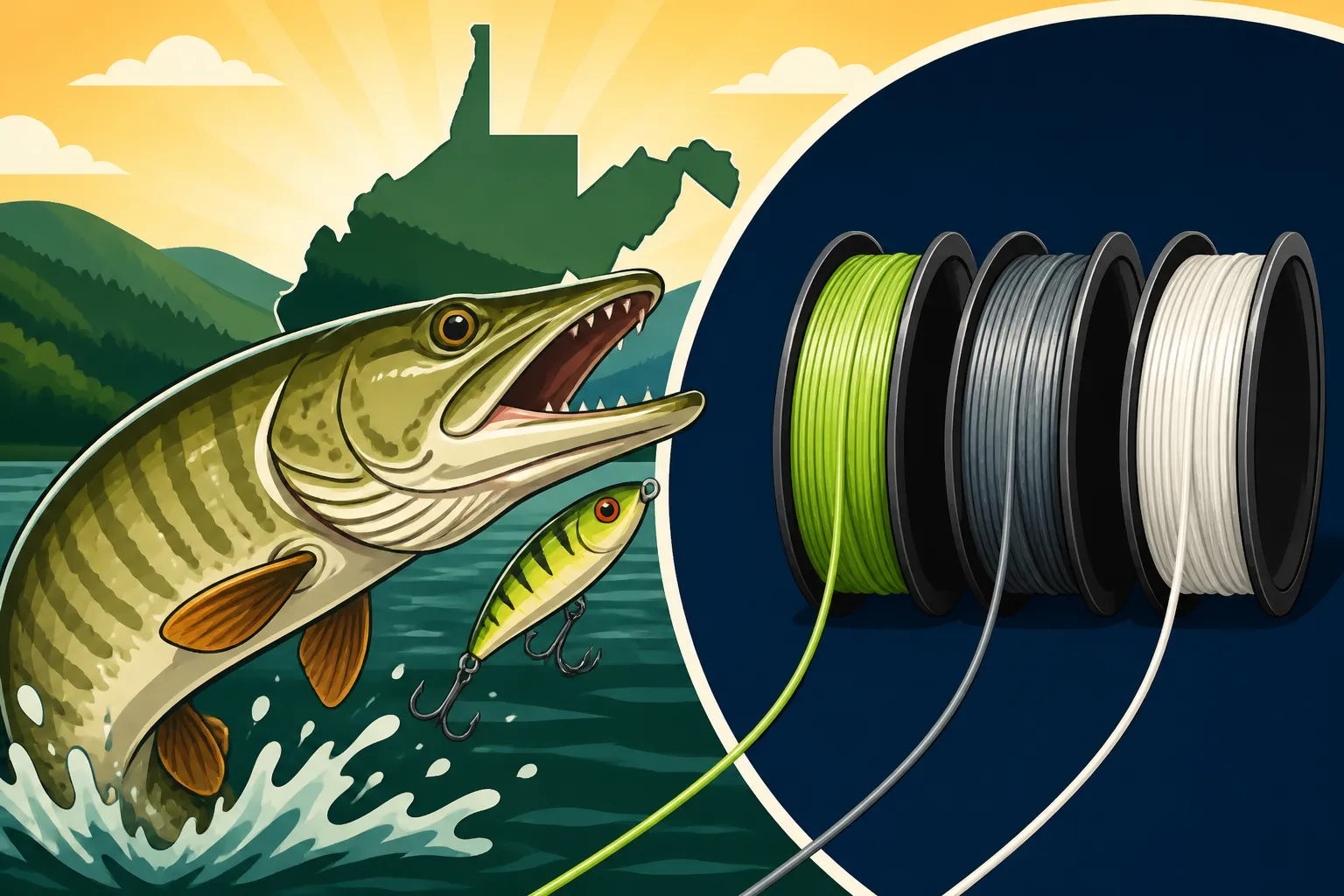
If there's one line type that every serious muskie angler in West Virginia swears by, it's braided line. And for good reason. Braided line is constructed from multiple strands of synthetic fibers woven together, creating an incredibly strong, no-stretch line that is perfect for battling powerful fish like muskie. You can often find a wide array of options at reputable retailers like Bass Pro Shops.
The primary advantage of braided line is its astounding strength-to-diameter ratio. You can use a relatively thin line with incredible breaking strength, which is essential for muskie. Its near-zero stretch provides unparalleled sensitivity, allowing you to feel every bump, tick, and, most importantly, the often subtle "thunk" of a muskie strike. This lack of stretch also translates directly into powerful, efficient hooksets, crucial for piercing the tough, bony mouth of a muskie. Furthermore, braided line offers excellent abrasion resistance against rough structure, making it a reliable choice when muskie dive into heavy cover. The main downsides? It can be more visible in clear water, and some anglers find knot tying a bit trickier, but these are minor concerns compared to its benefits.
Fluorocarbon Line: The Invisible Assassin (Often as Leader Material)
Fluorocarbon line, while exceptional in its own right, doesn't typically serve as the main line for muskie fishing. Instead, it shines as an indispensable leader material. Unlike monofilament, fluorocarbon has a refractive index very close to that of water, making it virtually invisible underwater. This stealth factor is a huge advantage, especially in clearer West Virginia waters where muskie might be line-shy.
Beyond its invisibility, fluorocarbon boasts excellent abrasion resistance, which is vital when a muskie's teeth or rough mouth parts come into contact with your line. It's also much stiffer and denser than monofilament, which helps it sink faster and transmit vibrations more effectively than mono. However, using fluorocarbon as a main line for muskie can be problematic due to its stiffness, tendency to retain memory, and significantly higher cost compared to braid for the required heavy breaking strengths. For these reasons, it's almost universally employed as a leader, typically in much heavier tests than your main braided line. This setup creates a powerful, sensitive main line with an invisible, abrasion-resistant buffer zone right at the lure.
Monofilament Line: A Less Common Choice for Modern Muskie Anglers
Monofilament line, the traditional workhorse of fishing, holds a nostalgic place for many anglers. It's generally less expensive, easier to tie knots with, and offers a good amount of stretch, which can act as a shock absorber during a sudden strike. However, for serious muskie fishing, monofilament usually falls short of modern demands.
The primary drawback of monofilament for muskie is its stretch. While it provides some forgiveness, it significantly reduces sensitivity, making it harder to detect subtle bites or differentiate between a snag and a hesitant muskie. More critically, the stretch also hinders solid hooksets into a muskie's bony jaw, and you might find yourself losing fish due to inadequate penetration. Monofilament also has lower abrasion resistance than braid or fluorocarbon, making it more susceptible to nicks and cuts from sharp teeth or rough structure. While you might use it in very specific, niche situations (perhaps as a budget option on a beginner's setup, paired with a very heavy leader), it's largely been superseded by braided line for its superior performance and reliability in muskie applications.
Here's a quick comparison of the line types in key muskie fishing categories:
| Feature | Braided Line | Fluorocarbon Line (Leader) | Monofilament Line |
|---|---|---|---|
| Breaking Strength | Extremely High (e.g., 65-100+ lb) | High (e.g., 80-150 lb) | Moderate (e.g., 20-30 lb for general fishing) |
| Stretch | Near Zero | Very Low | High (Significant) |
| Sensitivity | Excellent | Good (as leader) | Poor |
| Visibility | High (can be problematic in clear water) | Very Low (nearly invisible) | Moderate (visible) |
| Abrasion Resistance | Excellent | Excellent | Moderate |
| Knot Tying | Can be tricky, requires specific knots | Can be stiff, requires careful cinching | Easy, good knot strength |
| Cost | Moderate to High | High (especially for heavy leader material) | Low to Moderate |
| Muskie Application | Main Line (nearly always) | Leader Material (nearly always) | Generally not recommended as main line for muskie |
Choosing the Right Pound Test for West Virginia Muskie
Now that we've covered the different types of line, let's get down to the brass tacks: what pound test should you actually be using for muskie fishing in West Virginia? This isn't a one-size-fits-all answer, as various factors will nudge you toward a slightly heavier or lighter option. However, the general rule for muskie is: don't skimp on strength.
Standard Recommendations for General Muskie Fishing
For most muskie anglers in West Virginia, you'll want to gravitate towards braided line in the 65 lb to 100 lb test range for your main line. This might sound incredibly heavy if you're used to bass or even striper fishing, but remember the power of these fish and the lures you'll be throwing.
Think about it this way: muskie lures are often large, heavy baits like oversized bucktails, swimbaits, jerkbaits, and topwaters. Casting these behemoths puts immense strain on your line, and you need a line that won't snap mid-cast. The lower end of this range, say 65-80 lb braid, is often sufficient for most situations, providing a good balance of strength and castability, especially if you're regularly throwing baits in the 2-4 oz range. If you're consistently slinging massive 8-12 oz lures, or fishing particularly snag-heavy waters, bumping up to 100 lb braid gives you that extra margin of error and confidence. This robust line will also help you rip through any unexpected weeds or small snags without fear of breaking off.
Adjusting for Specific West Virginia Water Conditions
West Virginia's diverse waterways mean you can't always use the exact same setup everywhere. The conditions dictate a nuanced approach to line weight.
- Heavy Cover and Snaggy Rivers (e.g., New River, Little Kanawha River): When you're fishing systems known for their rocky bottoms, submerged timber, or dense aquatic vegetation, like stretches of the New River, Little Kanawha River, or the larger sections of the Elk River, you absolutely want to err on the side of heavier line. A muskie will instinctively try to wrap you around any available structure to break free, and a heavier braid (80-100 lb) provides the brute strength needed to horse them out of these potential snags. It also gives you more leverage if you need to pull a hung-up lure free, saving you money on expensive muskie baits.
- Open Water and Clearer Lakes (e.g., Summersville Lake, Tygart Lake): While you still need robust line for the fish itself, in more open water or clearer lakes like Summersville, you might get away with the lower end of the recommended range (65-80 lb braid). Here, the risk of immediate abrasion from structure might be slightly less, and a thinner diameter line can sometimes aid in casting distance for those long retrieves across open water. However, don't drop too far down; the power of the muskie remains the same, and these lakes often have deep timber or rock piles you can't always see. It’s always better to be slightly over-gunned than under-gunned when it comes to muskie. For general information on tackle, check out Best Muskie Gear for West Virginia Rivers.
The Importance of a Robust Leader System
Perhaps even more critical than your main line weight, is your leader system. Muskie have fearsome teeth that can slice through even heavy braided line like butter. A strong, abrasion-resistant leader is not just recommended; it's absolutely essential to prevent cut-offs.
Most West Virginia muskie anglers opt for a heavy fluorocarbon leader, typically ranging from 80 lb to 150 lb test. The exact pound test depends on the size of the muskie you anticipate and the size of the lures you're throwing. For general muskie fishing, a 100 lb fluorocarbon leader is a fantastic starting point. This material provides excellent abrasion resistance and, as mentioned, is nearly invisible underwater. The length of your leader is also important; aim for at least 12-24 inches to ensure that if a muskie "rolls" or lunges, its teeth don't contact your main line. Alternatively, some anglers prefer heavy wire leaders for maximum bite protection, especially when targeting monster muskie with extra-large baits. However, wire can be more visible and affect lure action, so fluorocarbon is often the preferred choice for its balance of stealth and strength. You can find more detailed information on specific leader options in our guide on Best Leader for Pike and Muskie Fishing.
Beyond Pound Test: Other Critical Line Features for Muskie
While selecting the right pound test is paramount, there are other characteristics of your fishing line that contribute significantly to your success and confidence when muskie fishing in West Virginia. Ignoring these aspects can lead to frustrating moments on the water, even if your line's breaking strength seems adequate.
Abrasion Resistance: Protecting Against Rocks and Teeth
When you're dealing with muskie, abrasion is your constant enemy. These fish don't just fight hard; they live in environments that are inherently tough on fishing line. Whether it's the jagged rocks of a riverbed, the sharp edges of submerged timber, or the abrasive internal mouth parts of a muskie itself, your line needs to stand up to a beating.
High-quality braided lines are engineered with superior abrasion resistance, often due to tighter weaves or special coatings. This isn't just about preventing break-offs during the fight; it's also about preventing cumulative damage. Repeated casting against guides, dragging over unseen structure, or even just repeated friction inside the muskie's mouth can weaken a line over time. Investing in a line renowned for its durability, such as those you might find on Amazon with strong angler reviews, means you're less likely to experience a sudden, inexplicable break. Always inspect your line regularly, especially the last few feet, for any frays or nicks after battling a fish or getting hung up.
Low Stretch vs. Controlled Stretch: Why it Matters for Hooksets
The stretch (or lack thereof) in your fishing line plays a monumental role in how effectively you can fish for muskie. For these fish, low stretch is almost always the preferred characteristic.
Here's why: Muskie have incredibly hard, bony mouths. A solid hookset is crucial to drive the large, heavy-gauge hooks of muskie lures deep enough to hold. With a low-stretch line like braid, when you lean into that hookset, nearly all of your energy is transferred directly to the hook point. This creates a powerful, instantaneous penetration that drastically increases your chances of keeping the fish pinned. Conversely, a line with too much stretch, like monofilament, will absorb a significant portion of that energy, resulting in a less effective hookset. You might pull the lure, but not drive the hook home, leading to frustrating short strikes or lost fish mid-fight. The enhanced sensitivity of low-stretch line also helps you detect those subtle "follows" or tentative bumps before a full commitment, allowing you to react faster with figure-eights or follow-up casts.
Line Diameter and Casting Performance
While choosing a heavy pound test is essential, you don't want a line so thick it hinders your casting performance. There's a delicate balance between strength and diameter, especially when you're throwing large muskie baits all day long.
Modern braided lines are fantastic because they offer incredible strength in a relatively thin diameter. A 65-80 lb braided line, for example, will have a much thinner diameter than a monofilament line of comparable strength. A thinner diameter line means less air resistance during the cast, allowing your heavy muskie lures to fly further and more accurately. It also means less current resistance when retrieving, which can be an advantage in river systems like the Greenbrier or the Ohio River. However, going too thin can lead to issues with line digging into the spool, especially on softer braids, or being harder to handle with cold hands. Generally, sticking to the recommended 65-100 lb braid will give you a diameter that balances excellent casting performance with the necessary strength and handling characteristics for muskie fishing.
Rigging and Maintenance: Maximizing Your Muskie Line's Performance
Even the best fishing line can fail if not properly rigged and maintained. Muskie fishing puts immense strain on every component of your tackle, and your line is no exception. Paying attention to these details can prevent heartbreaking break-offs and ensure your line performs optimally on every cast and retrieve in West Virginia's waters.
Knot Tying: The Weakest Link in Your Setup
It's a common saying that a fishing knot is only as strong as the person who ties it, and for muskie, this couldn't be more true. The knot connecting your main line to your leader, and your leader to your lure, is often the weakest point in your entire system. A poorly tied knot can reduce your line's breaking strength by 50% or more, turning your 80 lb braid into something far less reliable.
For braided line, solid, reliable knots like the Palomar knot or the Improved Clinch knot (if tied carefully with sufficient wraps) are excellent choices for connecting to a swivel or split ring. When connecting your braided main line to your fluorocarbon leader, a FG knot or Alberto knot are popular choices because they create a strong, low-profile connection that slides smoothly through rod guides. Always moisten your knots with saliva before cinching them down tightly to prevent friction-induced heat damage, which can weaken the line. Practice these knots at home until you can tie them quickly and perfectly, because a muskie fight is not the time to second-guess your knot-tying skills. This diligent attention to detail is part of what makes How to Catch Muskie in West Virginia such a rewarding challenge.
Spooling and Line Care
The way you spool your line onto your reel is another crucial step that impacts performance. Improper spooling can lead to line twists, tangles, and frustrating wind knots, especially with braided line. When spooling new braid, make sure it's coming off the filler spool smoothly, without any twists, and with consistent tension. Many anglers use a pencil through the spool or have a friend hold it to create even pressure. Avoid overfilling your spool, as this can cause line to jump off the reel during casts.
Once on the water, regular line care is essential. After each fishing trip, especially if you've been battling fish or fishing in abrasive conditions, take a few moments to inspect the last several feet of your line. Look for any frays, nicks, or discoloration. If you find any damage, don't hesitate to cut off the compromised section. Braid can sometimes pick up dirt or discoloration, which usually isn't an issue, but physical damage needs to be addressed immediately. It's also a good practice to respool your main braided line at least once a year, or more frequently if you're a hardcore muskie angler, ensuring you always have fresh, strong line.
The Full System: Rod, Reel, and Line Synergy
Finally, remember that your fishing line is just one component of a larger system. Your line weight needs to be properly matched to your rod's power and action, as well as your reel's drag system. A heavy line on a light rod or a weak drag system is a recipe for disaster.
For muskie fishing, you'll typically be using heavy-power, fast-action rods (often 7'6" to 9' in length) paired with robust baitcasting reels that have powerful, smooth drag systems. The heavy line (65-100 lb braid) works in harmony with these components, allowing the rod to load effectively for casting heavy baits and providing the backbone needed to control a fighting muskie. The reel's drag, when properly set, will allow the line to pay out under extreme pressure, preventing break-offs while still applying enough force to tire the fish. A balanced setup ensures that all components work together seamlessly, maximizing your chances of landing that trophy muskie in West Virginia's challenging yet rewarding waters. Consider researching Best Rod setup for New River muskie for a holistic approach to your tackle.
Disclaimer
This article is for general informational purposes only and does not constitute professional advice. Laws, prices and regulations vary by location and change over time. Consult a qualified professional for guidance on your specific situation.